
Gaziantep: Mosaics, Baklava and the Old Bazaars of Antep

On this page
- What is Gaziantep?
- How do you get to Gaziantep?
- Where should you stay in Gaziantep?
- What type of climate does Gaziantep have?
- When is the best time to visit Gaziantep?
- What is the history of Gaziantep?
- What is Gaziantep famous for?
- What are the historical places of Gaziantep?
- What are the best things to do in Gaziantep?
- What are the best places to visit in Gaziantep?
- What is the traditional food of Gaziantep?
- What should you buy in Gaziantep?
- Frequently asked questions about Gaziantep
- What do the official records say about Gaziantep?
Key facts: Gaziantep
- UNESCO Tentative List: Three Gaziantep entries are on Türkiye’s Tentative List: the Archaeological Site of Zeugma (2012), the Yesemek Quarry and Sculpture Workshop (2012) and the city’s underground water structures, the livas and kastels (2018). None is yet an inscribed World Heritage Site.
- UNESCO Creative City: Gaziantep joined the UNESCO Creative Cities Network as a City of Gastronomy in 2015.
- Region: Southeastern Anatolia, between the Euphrates and the Amanus (Nur) Mountains, bordering Syria to the south.
- Best known for: Baklava and pistachios, the Zeugma mosaics, its castle and old bazaars, and Rumkale on the Euphrates.
What is Gaziantep?
Gaziantep is the largest city in southeastern Türkiye and the capital of the province of the same name. It is an industrial and trading city of more than two million people, but its old core, around a castle mound, is a dense quarter of stone houses, covered bazaars, caravanserais, mosques and coppersmiths’ workshops. Locals still call it Antep.
Most visitors come for two things: food and mosaics. Gaziantep is the home of baklava made with local pistachios, and its kitchens are among the most admired in the country. The Zeugma Mosaic Museum holds the Roman floors rescued from the ancient city of Zeugma on the Euphrates before a dam reservoir covered part of it in 2000.
The 2002 inventory introduces Gaziantep as the largest city of the region, a metropolis by its population, economy, tourism potential and status as a metropolitan municipality, and as one of the oldest centres in Anatolia reflecting the culture of its communities, with a history reaching back to 4000 BC.
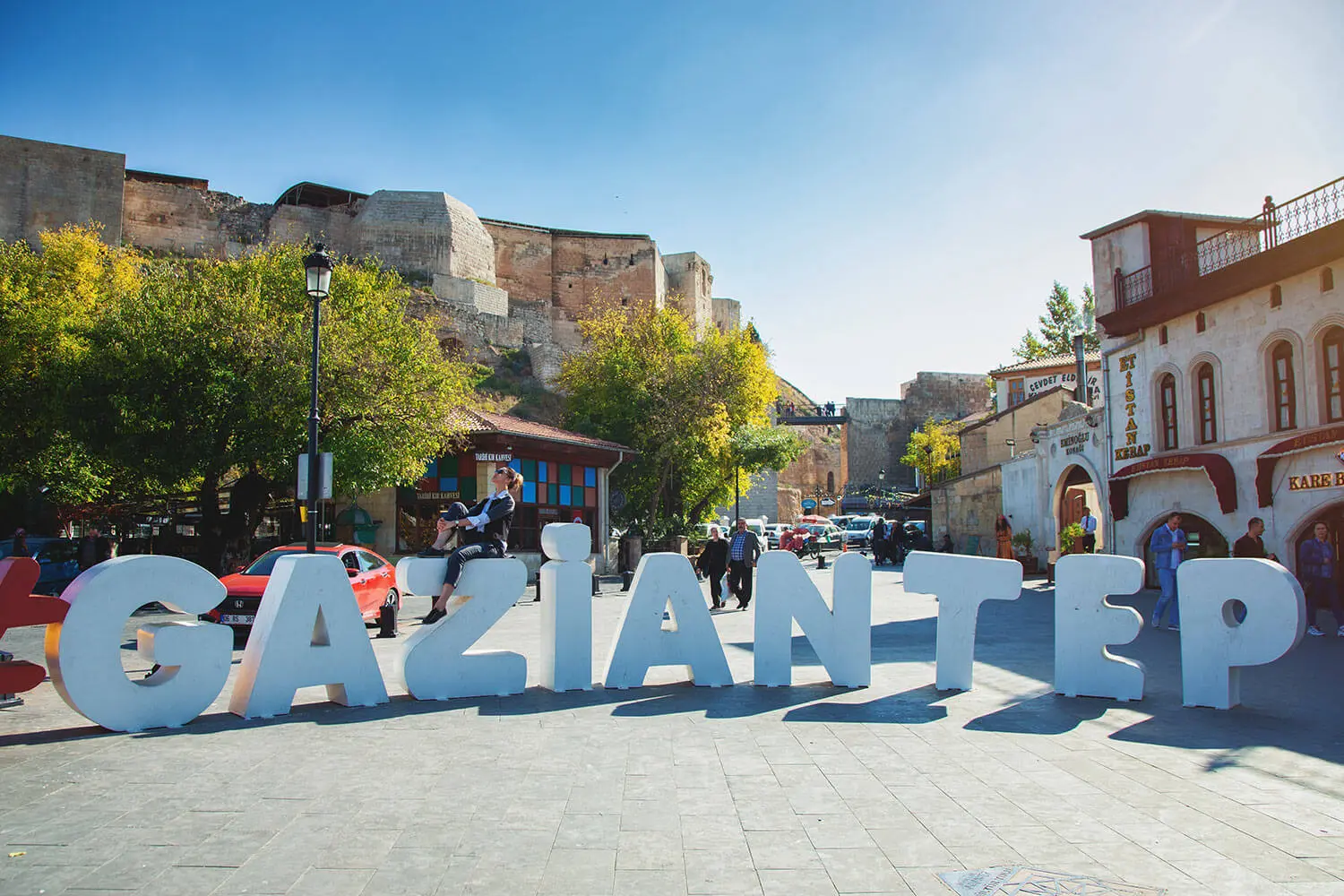
Places to visit in Gaziantep
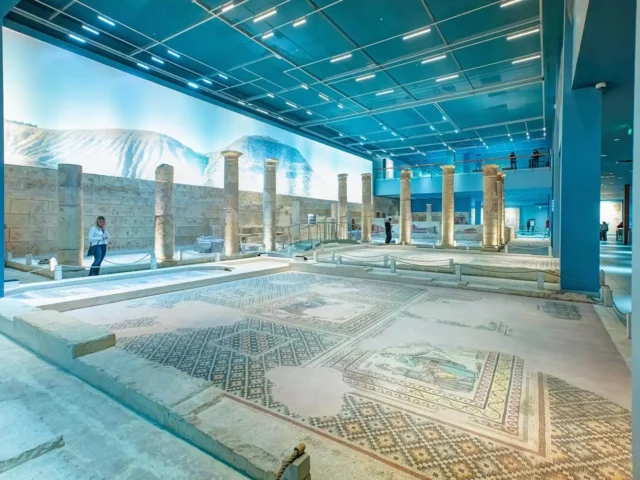
Zeugma Mosaic Museum
Zeugma Mosaic Museum in Gaziantep: the Gypsy Girl, Dionysos and Ariadne and…
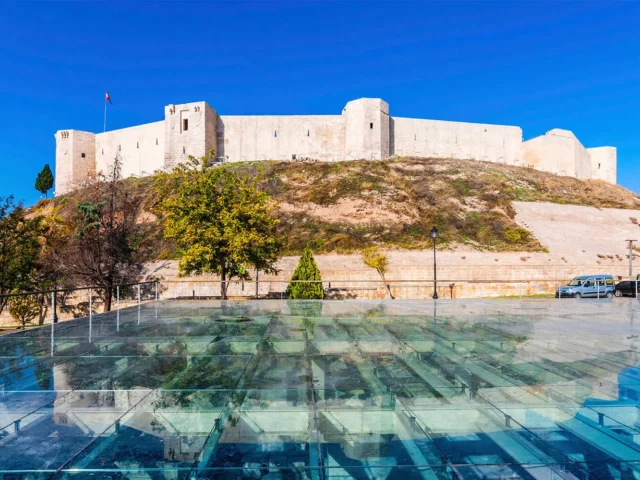
Gaziantep Castle
Gaziantep Castle: Roman watchtower turned Byzantine citadel, damaged in the 2023 earthquake…

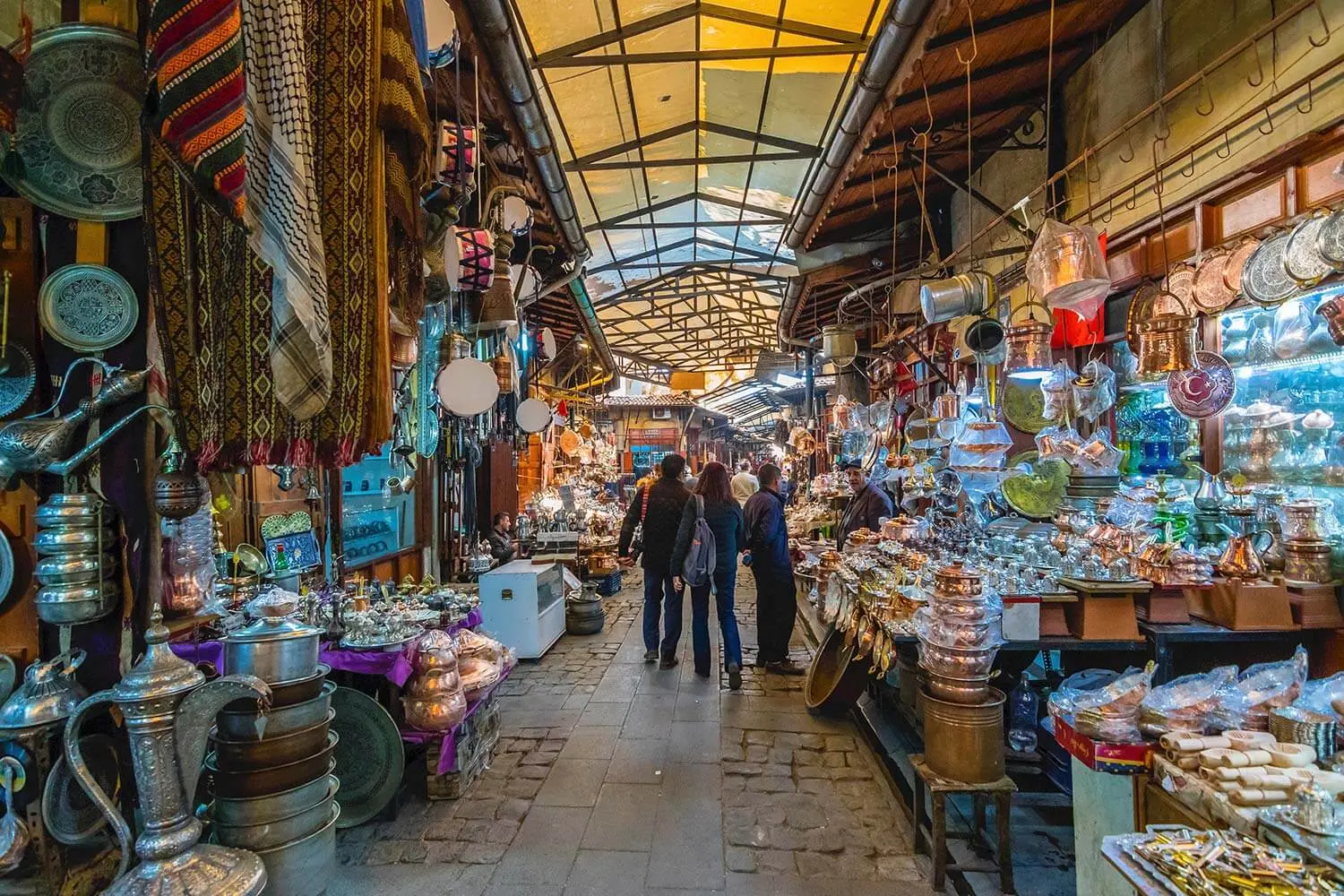
Coppersmiths’ Bazaar
Gaziantep’s Coppersmiths’ Bazaar below the castle: working copper workshops, engraved trays and…
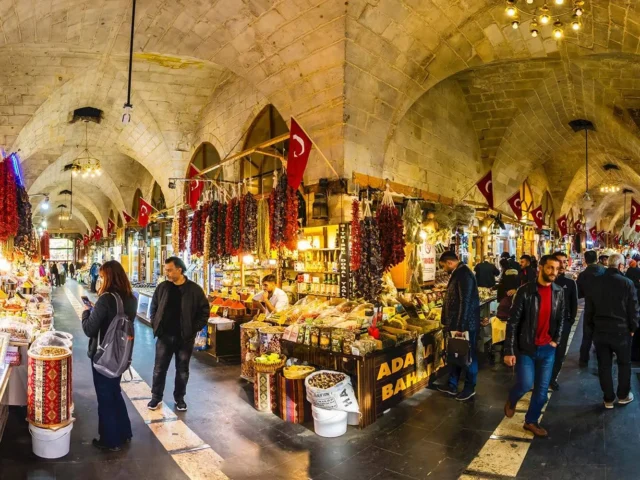
Zincirli Bedesten
Zincirli Bedesten in Gaziantep: an L-shaped Ottoman market of 1718, once the…

Rumkale
Rumkale on the Euphrates: cliff-top fortress, former seat of the Armenian Catholicos,…
How do you get to Gaziantep?
By air: Gaziantep Airport (GZT) is about 20 km east of the city centre. There are several flights a day from Istanbul Airport and Sabiha Gökçen, and direct flights from Ankara, İzmir and other Turkish cities. Airport shuttle buses and taxis run into town.
By road: Gaziantep sits on the main motorway between Adana and Şanlıurfa, and its large bus station has coaches from Istanbul, Ankara, İzmir and every city in the region. Şanlıurfa is about two hours east, Kilis about an hour south, and Adıyaman (for Mount Nemrut) around two and a half hours northeast.
Getting around: The old town around the castle, the bazaars and the Bey quarter are best walked. Trams and buses link the centre with the bus station; for the Zeugma Mosaic Museum, a taxi is simplest.
Border areas: The UK Foreign Office advises against all travel within 10 km of the Syrian border (FCDO). In Gaziantep province that affects Karkamış, whose ancient city lies on the border itself; Gaziantep city is well outside it.
Where should you stay in Gaziantep?
Stay in or near the old town, between the castle and the Bey quarter. Many 19th-century stone houses there have been converted into small hotels around courtyards, and you can walk to the bazaars, the castle and the best baklava and kebab shops. The newer districts to the north and west, along the main boulevards, have large modern hotels with parking that suit drivers and business travellers.
Gaziantep is also the most practical base for day trips to Kilis, Rumkale, Zeugma and Halfeti, and some travellers combine it with two or three nights in Şanlıurfa.
Book a Gaziantep tour
−5% Istambul readers save 5% on every tour below — applied at checkout.
Partner listings via GetYourGuide · free cancellation on most
What type of climate does Gaziantep have?
Gaziantep has hot, dry summers and cool, wet winters. July and August afternoons are often in the mid to high 30s°C. Winters are colder than on the coast: frost is common at night and snow falls most years, though it rarely lasts in the city. Most of the rain falls between November and April. The 2002 inventory explains that the heat shaped local houses, which face inwards onto shaded courtyards.
When is the best time to visit Gaziantep?
April to early June and mid-September to November are the best months. Spring brings green hills and comfortable temperatures for walking the bazaars; autumn is pistachio harvest time (August to September), when the city is full of fresh nuts and new-season baklava. Summer is hot but workable if you sightsee early and spend the afternoon in museums. Winter is quiet, cold and a good time for heavier dishes like beyran soup.
What is the history of Gaziantep?
Gaziantep sits at the meeting point of Anatolia, northern Syria and Mesopotamia, and the province has been settled for a very long time. At Dülük, 10 km north of the city, the 2002 inventory describes a large cave, Şarklı Mağara, where people from the Euphrates valley settled because of the high-quality flint deposits, made the most advanced tools of their day and probably traded them to other communities along the Euphrates. The inventory calls it one of the oldest known human settlements in Anatolia.
In the Bronze and Iron Ages the region held important cities. Tilmen Höyük near İslahiye, the highest mound in the area at 24 m, was a city of the Yamhad kingdom in the late 3rd millennium BC. Zincirli Höyük was Sam’al, a Late Hittite and Aramaean capital with a double ring of walls that the inventory says has no parallel anywhere. Karkamış (Carchemish), on today’s border, was a great Late Hittite city on the crossing of the roads from Mesopotamia, Egypt and Anatolia. At Dülük the Hittite storm god Teshub was worshipped, and under Rome he became Jupiter Dolichenus, a god soldiers carried across the empire; the name Dülük comes from the Roman Doliche.
Zeugma was founded around 300 BC by Seleucus I Nicator, one of Alexander the Great’s generals, at a crossing of the Euphrates. Under Rome it grew rich as a garrison and trading town, until the Sasanians sacked it in AD 253. The castle that crowns the old city began, according to the inventory, as a Roman watchtower and took its present form under Justinian in the 6th century.
In the Middle Ages Antep (Ayıntab) passed between Byzantines, Arabs, Seljuks, Crusaders, Ayyubids and Mamluks, and came under Ottoman rule after Selim I defeated the Mamluks at Marj Dabiq in 1516. It became a prosperous trading town of hans, bazaars and stone houses. During the Turkish War of Independence the city resisted French occupation through a long siege in 1920–21. The inventory notes that the title Gazi (“veteran”, “warrior”) was granted to Antep on 8 February and that the city celebrates its liberation from occupation on 25 December; since then it has been called Gaziantep.
On 6 February 2023 the Kahramanmaraş earthquakes hit the province hard, especially Nurdağı and İslahiye. In the city, the castle walls partly collapsed. Restoration of the castle and many historic buildings has since been completed, and the Zincirli Bedesten reopened in 2025.
What is Gaziantep famous for?
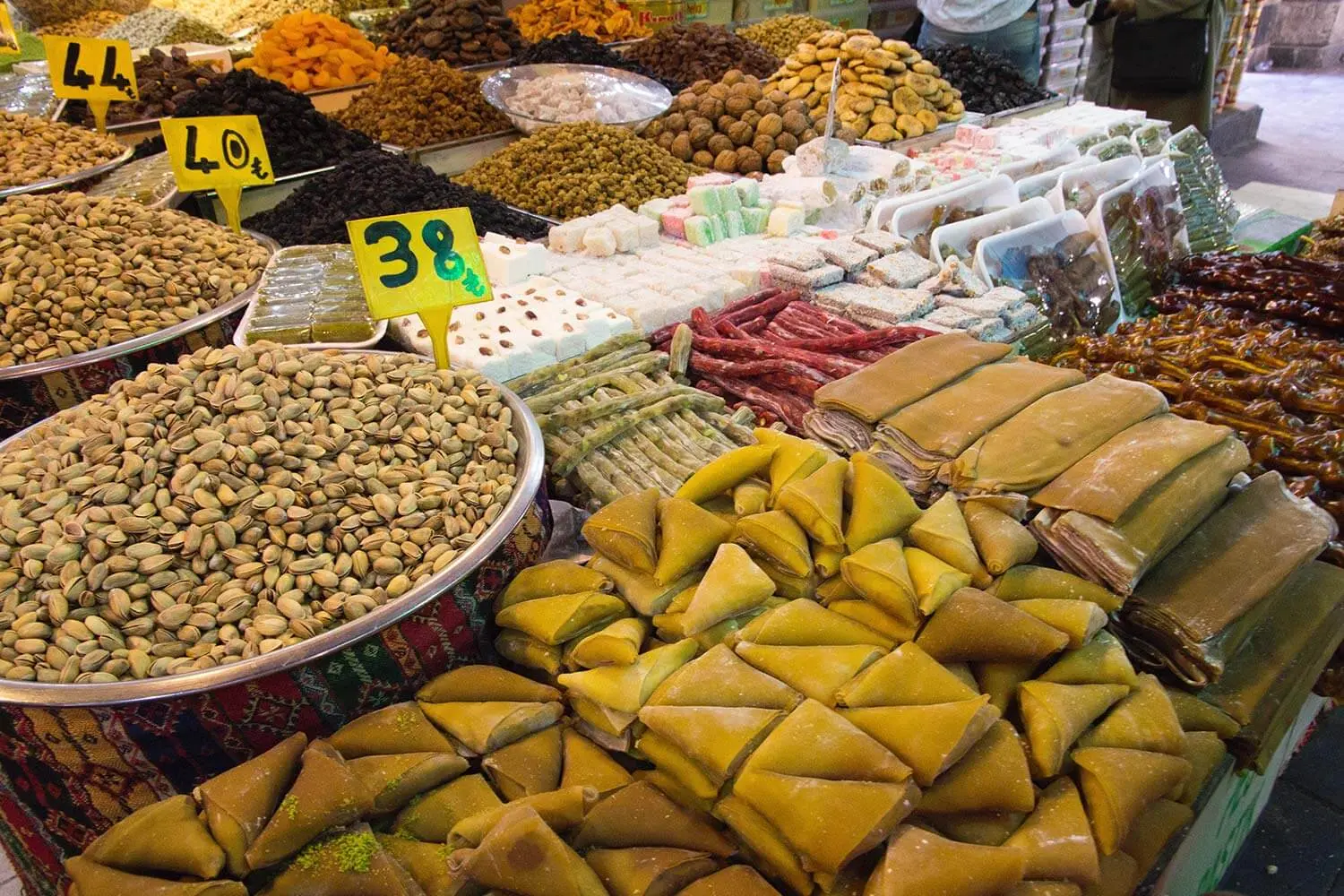
Baklava and pistachios. Antep baklava was registered as a protected geographical indication in the European Union in 2013, the first Turkish product to receive that status. The local pistachio, Antep fıstığı, goes into baklava, kebabs, katmer and coffee.
Gastronomy. Gaziantep became a UNESCO Creative City of Gastronomy in 2015. Its kebabs, soups, stuffed vegetables and breakfasts draw food lovers from across Türkiye.
Mosaics. The Zeugma Mosaic Museum, opened in 2011, has one of the largest collections of Roman mosaics in the world, including the famous “Gypsy Girl”.
Crafts. Copperware, mother-of-pearl inlay, yemeni (soft leather shoes), kutnu silk-cotton cloth and carved wood are still made in the old bazaars.
What are the historical places of Gaziantep?
In Gaziantep city
Gaziantep Castle. The inventory calls it one of the most beautiful surviving castles in Türkiye: round in plan, about 1,200 m around, with walls of large stones supported by 12 towers. It was restored after the 2023 earthquakes.
Şeyh Fethullah Mosque and complex. The inventory calls it the most important historic building in Gaziantep, in the Şehreküstü quarter. According to its endowment deeds it consisted of a mosque, zaviye (dervish lodge), bath and madrasa, and its still-working kastel (underground fountain) belongs to the complex. The window pediments show Seljuk geometric patterns and the mihrab Mamluk-style coloured stonework, and a handwritten Qur’an by Şeyh Fethullah is kept inside.
Boyacı Mosque. Built in 1357 by Boyacı Yusuf and Kadı Kemalettin in the Turkish Mamluk period; the inventory calls it the oldest mosque in Gaziantep. Its wooden minbar, decorated with twelve-armed stars, palmettes and rosettes, is one of the oldest examples of Gaziantep woodwork.
Ömeriye Mosque. In the Düğmeci quarter, recorded as repaired in 1210. Its portal and mihrab are of black and white stone, and the inventory notes that bullet and shrapnel marks from the defence of Antep can still be seen on the minaret.
Ahmet Çelebi Mosque. A complex of mosque, madrasa and kastel dated by its inscription to 1672. The kastel is reached by 44 steps, 12 of cut stone and 32 carved into the rock.
Kurtuluş Mosque. Built in 1892 as the Armenian cathedral of the Holy Mother of God and converted into a mosque in 1986, with striped black and white stonework.
Tombs of Yuşa (Joshua) and Pirsefa. In the Boyacı quarter, on a street leading to the Kavaflar bazaar, two tombs share one building. The inventory notes that a Jewish community lived in Gaziantep until the founding of Israel.
Zincirli Bedesten and the Coppersmiths’ Bazaar. The 1718 covered market and the lanes of copper workshops below the castle.
Hasan Süzer Ethnography Museum. A three-storey stone house built over a cellar carved into bedrock. The inventory describes the courtyard called hayat, the selamlık reception rooms, the rock-cut basement with jars for grape molasses and olive oil and a well, and upper floors furnished with the region’s household objects. A separate section displays weapons, documents and photographs from the defence of Antep.
Traditional Antep houses. The inventory explains that houses face inward onto a courtyard called hayat, with carved stones, flowerbeds and a pool called gane. Upper floors are reached by outside stairs, and the projecting metal-clad bays on the upper storey are called köşk. There are no street windows on the ground floor for privacy, and a cellar called hazna lies underneath.
Around the province
Zeugma. 10 km east of Nizip by the Euphrates at Belkıs village. Its villas and mosaics are covered in our Zeugma Mosaic Museum guide; the site itself is open to visitors.
Rumkale. A fortress on a rock where the Merzimen stream meets the Euphrates, once the seat of the Armenian Catholicos.
Yesemek Open-Air Museum. On a hillside southeast of İslahiye. Discovered in 1890 by Felix von Luschan and excavated in 1958–1961, it was a Hittite-period basalt quarry and sculpture workshop with more than 300 unfinished sculptures: sphinxes, lions and mountain gods. The inventory calls it a historic sculpture school with no equivalent in the world, where every stage from quarrying to finishing can be seen.
Dülük (Doliche). 10 km north of the city, the ancient crossroads city of Jupiter Dolichenus, with rock-cut tombs in its necropolis and the surrounding Dülükbaba forest.
Roman tomb monuments. In Araban district, the inventory lists three 2nd-century tower tombs: the 11 m Hisar tomb with its pyramidal roof, the Elif tomb and the Hasanoğlu tomb.
Tilmen Höyük, Zincirli and Sakçagözü. Bronze and Iron Age mounds in the west of the province; many reliefs from Zincirli and Sakçagözü are now in museums in Istanbul, Ankara and abroad.
What are the best things to do in Gaziantep?
- Eat a baklava breakfast. Start the day with fresh baklava or katmer, a thin pastry with pistachio and clotted cream.
- Walk from the castle to the bazaars. The coppersmiths’ lanes, Zincirli Bedesten and the old hans are all within a few minutes of each other.
- Drink menengiç coffee. Made from roasted wild pistachio (terebinth) and milk, served in historic coffee houses near the bazaars.
- Take a boat on the Euphrates. From Halfeti in neighbouring Şanlıurfa, boats run along the reservoir to Rumkale and the half-submerged village of Savaşan.
- Go up to the yaylas. The inventory describes Hızır Yaylası, about 1,500 m up in the Amanus Mountains west of İslahiye, green in every season and surrounded by pine, cedar, fir and plane trees, and Sofdağı Yaylası, 32 km from the city, where 267 plant species have been recorded.
- Walk in Dülükbaba forest. The inventory calls these black pine and cedar plantations, covering 40 km² north and northwest of the city, one of the largest hand-planted groves in Türkiye.
- Visit the food museums. The Baklava Museum, the Emine Göğüş Kitchen Museum and the Pistachio Museum explain the city’s food culture.
What are the best places to visit in Gaziantep?
Zeugma Mosaic Museum displays the floors of Roman villas from Zeugma, including the Gypsy Girl and the wedding of Dionysos and Ariadne, in one of the largest mosaic museums in the world.
Gaziantep Castle rises on a mound in the heart of the old city, ringed by its moat and towers, and was restored after the 2023 earthquakes.
Coppersmiths’ Bazaar is where you hear Gaziantep before you see it: lanes of workshops hammering trays, pots and coffee sets below the castle.
Zincirli Bedesten is an L-shaped covered market of 1718, once the city’s meat market, restored and reopened in 2025.
Rumkale is a cliff-top fortress above the Euphrates, linked with St John and with the Armenian Catholicos Nerses the Gracious.
Also worth your time: Yesemek Open-Air Museum, the Hasan Süzer Ethnography Museum, the Şeyh Fethullah and Boyacı mosques, Dülük, and the restored hans of the old town. For more mosaics, the Misis Mosaic Museum in Adana and Hatay are a few hours west.
What is the traditional food of Gaziantep?
Gaziantep cooking leans on pistachios, red pepper, sumac, pomegranate molasses and fresh lamb. Breakfast might be katmer or a bowl of beyran, a spicy lamb and rice soup eaten early in the morning. Kebabs include simit kebabı (minced meat with fine bulgur), ali nazik (meat over smoked aubergine and yoghurt) and kebabs with aubergine or loquat in season.
Home dishes include yuvalama (tiny bulgur and meat balls in yoghurt soup, traditional at Ramadan feasts), içli köfte, lahmacun on thin dough, and many dried and stuffed vegetables. Baklava is the centrepiece: thin layers of pastry with Antep pistachios, baked in wood ovens. Finish with menengiç coffee.
What should you buy in Gaziantep?
Pistachios and baklava. Buy pistachios by the kilo in the bazaars and baklava packed in tins for travel from the old bakeries.
Copperware. Hand-hammered trays, coffee pots and bowls from the Coppersmiths’ Bazaar, plain or engraved.
Yemeni and kutnu. Soft leather slip-on shoes made by hand, and striped kutnu cloth woven from silk and cotton.
Mother-of-pearl work. Boxes, backgammon boards and furniture inlaid with mother-of-pearl, a Gaziantep speciality.
Spices and peppers. Red pepper flakes, sumac, dried aubergines and peppers for stuffing, sold along the bazaar lanes.



Frequently asked questions about Gaziantep
Is Gaziantep worth visiting?
Yes, especially for food and mosaics. The Zeugma Mosaic Museum, the castle quarter with its bazaars and the city’s baklava and kebabs are among the best in Türkiye.
How many days do you need in Gaziantep?
Two days cover the Zeugma Mosaic Museum, the castle, the bazaars and plenty of eating. Add a day for Rumkale and Halfeti or for Yesemek.
What is the nearest airport to Gaziantep?
Gaziantep Airport (GZT), about 20 km east of the city, with direct flights from Istanbul’s two airports, Ankara and İzmir.
Is Gaziantep Castle open after the earthquake?
The castle was damaged in February 2023 and its restoration was completed in late 2025. Check locally whether the interior and its panorama museum are open on the day you visit.
What food is Gaziantep famous for?
Baklava with Antep pistachios, katmer, beyran soup, yuvalama, ali nazik and simit kebabı. Antep baklava has had EU protected geographical indication status since 2013.
Is Gaziantep a UNESCO site?
Gaziantep is a UNESCO Creative City of Gastronomy (2015). Zeugma, Yesemek and the city’s kastel water structures are on the Tentative List but not inscribed.
When is the best time to visit Gaziantep?
April to early June and mid-September to November. Summer afternoons are often in the mid-30s°C.
What do the official records say about Gaziantep?
Gaziantep is the largest city of the Southeastern Anatolia Region and the sixth largest city of Türkiye, and with its population, economic structure, tourism potential and metropolitan status it is a metropolis. Gaziantep is one of the oldest centres reflecting the culture of the human communities in Anatolia, and its history reaches back to 4000 BC.
With its ruins, old houses, mosques, tombs, madrasas, hans, baths, churches and castles worth seeing, its unique natural beauty, its handicrafts, its delicious cuisine, its industry and the particular industriousness and warmth of its people, Gaziantep is a city of veterans where the past and the future live together. (Ministry of Culture and Tourism, Gaziantep Provincial Tourism Inventory, 2002)
Ready to see Gaziantep?
Hand-picked tours with good reviews and clear prices.
Partner listings via GetYourGuide · free cancellation on most
Before or after: Istanbul
Most trips start or end in Istanbul. Our own experiences there:

 Dinner, sunset and day cruises between Europe and Asia.See cruises bosporuscruise.com

 Historic Turkish baths in the old city — hand-picked hamams, booked direct.Book a hamam istanbulhamam.com

 Istanbul’s tallest viewpoint: both continents from 369 metres.Get tickets camlicatower.com

 Free audio guides in 15 languages, safe routes and local tips — plus 5% off GetYourGuide.Open the free guide localada.com
Nearby
All destinationsKilis
Kilis travel guide: Ravanda Castle, Oylum Höyük, Mamluk mosques, Kilis…
Sinop
Sinop travel guide: the historic prison museum, Greek walls, Hamsilos…
Afyon
Afyon, also known as Afyonkarahisar, is a city located in…
Kırklareli
Kırklareli travel guide: Dupnisa Cave, İğneada floodplain forests, Kıyıköy, Vize…
