
Osmaniye: Hittite Gates and Castles of Eastern Çukurova
On this page
- What is Osmaniye?
- How do you get to Osmaniye?
- Where should you stay in Osmaniye?
- What type of climate does Osmaniye have?
- When is the best time to visit Osmaniye?
- What is the history of Osmaniye?
- What is Osmaniye famous for?
- What are the historical places of Osmaniye?
- What are the best things to do in Osmaniye?
- What are the best places to visit in Osmaniye?
- What is the traditional food of Osmaniye?
- What should you buy in Osmaniye?
- Frequently asked questions about Osmaniye
- What do the official records say about Osmaniye?
Key facts: Osmaniye
- UNESCO Tentative List: Karatepe-Aslantaş Archaeological Site, on the list since 2020 (UNESCO); not yet inscribed. Its inscriptions were added to UNESCO’s Memory of the World Register in 2025.
- Region: The eastern edge of the Çukurova plain in the Mediterranean Region, between the Taurus to the north-west and the Amanos (Nur) Mountains to the east.
- Best known for: The Late Hittite gates of Karatepe, the Roman city of Kastabala, a ring of medieval castles, summer plateaus and peanuts.
What is Osmaniye?
Osmaniye is one of Türkiye’s youngest provinces, created in 1996 from the eastern part of Adana. It covers the eastern end of the fertile Çukurova plain and the mountains that close it in: the Taurus to the north-west and the Amanos, locally called the Nur Mountains, to the east. Its neighbours are Adana to the west, Hatay to the south, Gaziantep to the east and Kahramanmaraş to the north.
Few foreign travellers stop here, which is a mistake. Within an hour of the city are the Karatepe-Aslantaş Open-Air Museum, one of the most important Iron Age sites in Anatolia; the Roman colonnaded street and theatre of Hierapolis-Kastabala; and a string of castles guarding the routes between Cilicia and Syria, including the black basalt Toprakkale. In summer, the city empties onto the plateaus of the Amanos, such as Zorkun.
Osmaniye was one of the provinces affected by the February 2023 earthquakes centred in neighbouring Kahramanmaraş. Damage was lighter than in Hatay or Kahramanmaraş: the provincial culture director reported cracked castle walls, damaged historic houses in the city centre and a damaged mosque in Bahçe, while the Karatepe reliefs were unharmed and the museum and Kastabala reopened in 2023.
Places to visit in Osmaniye
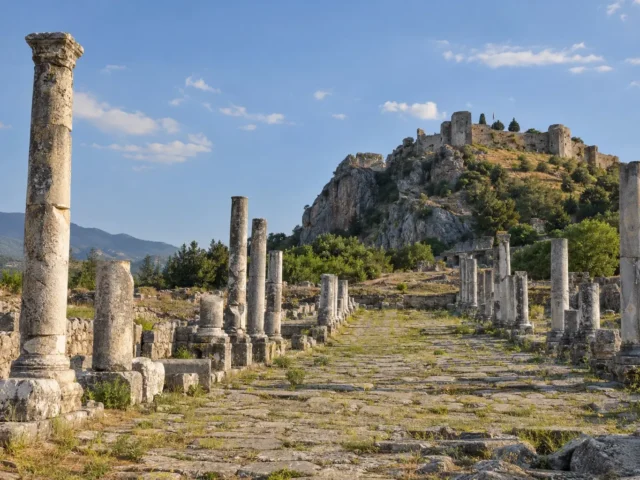
Kastabala Ancient City
Hierapolis-Kastabala in Osmaniye: the colonnaded street, theatre and castle of the city…
Karatepe-Aslantaş
Karatepe-Aslantaş Open-Air Museum near Kadirli: the 8th-century BC gates, the Phoenician–Luwian bilingual,…
Toprakkale Castle
Toprakkale Castle near Osmaniye: Abbasid, Crusader, Armenian and Mamluk basalt fortress at…
Zorkun Plateau
Zorkun Plateau above Osmaniye: a 1,600 m summer yayla of wooden houses…
How do you get to Osmaniye?
By air: Osmaniye has no airport. The main gateway is Çukurova International Airport near Tarsus, which replaced Adana’s Şakirpaşa Airport in August 2024. Hatay Airport, on the Amik plain, and Gaziantep Airport are the other options.
By road: Osmaniye lies on the Adana–Gaziantep motorway, and the road to İskenderun and Hatay branches off at Toprakkale. Intercity coaches stop here on routes between Istanbul, Ankara, Adana and the cities of the southeast.
By rail: Regional trains run daily between Osmaniye and Adana, taking about 1 hour 30 minutes, with stops at Toprakkale and Ceyhan.
Getting around: Karatepe, Kastabala and the plateaus are not well served by public transport. A hire car, or a taxi for the day, is the practical choice.
Where should you stay in Osmaniye?
Osmaniye city has a modest range of business hotels, convenient for the motorway and the railway station, and is the most practical base for Toprakkale, Kastabala and Zorkun. Kadirli, north-west of the city, is closer to Karatepe and the Ala Mosque. Many travellers see Osmaniye as a day trip from Adana or combine it with a drive on to Hatay or Gaziantep. In summer, ask locally about rooms on the plateaus.
Tours in Anatolia
−5% Istambul readers save 5% on every tour below — applied at checkout.
Partner listings via GetYourGuide · free cancellation on most
What type of climate does Osmaniye have?
Osmaniye has a typical Mediterranean climate: long, hot summers and mild, rainy winters. According to the 2002 inventory, summer temperatures exceed 40°C on the plain, which is why the plateau culture is so strong here. The inventory also describes it as one of the rare places where all four seasons can be felt in a single day, as you climb from the plain to the high plateaus at up to 2,100 m.
When is the best time to visit Osmaniye?
April–May and October–November are ideal for the archaeological sites: green hills, comfortable temperatures and wild flowers in spring. Karatepe keeps longer hours from 1 April to 1 November. In July and August, do your sightseeing in the early morning and spend the afternoon on a plateau.
What is the history of Osmaniye?
The 2002 inventory places Osmaniye in the basin of the Ceyhan river, where many civilisations have lived since around 3000 BC, forming the eastern end of the fertile lands of Çukurova. In the Chalcolithic and Early Bronze Ages, it says, a people called the Leleges ruled here, and later the great Hittite state, the Assyrians, Rome, Byzantium, the Seljuks and finally the Ottomans.
In the 8th century BC, the Late Hittite ruler Azatiwata built the frontier fortress of Karatepe for the kingdom of the Adana plain. In the 1st century BC the local king Tarcondimotus made Kastabala the capital of his kingdom; after his death fighting on Mark Antony’s side against Octavian, the city was absorbed into the Roman Empire. Cicero, who governed Cilicia, wrote of the “Free Cilicians” who held mountain strongholds such as Pindenissum, identified locally with the “Pirate City” on a steep hill in the Nur Mountains.
In the Middle Ages this was frontier country between Byzantium and the Islamic states, then the borderland of the Armenian Kingdom of Cilicia, the Crusaders and the Mamluks, which explains its many castles. The inventory records that, with the Turkish conquest of Anatolia, the Ulaşlı tribe settled in the region in the 1080s. Under the Mamluks, from 1250 to 1517, large Turkish migrations took place, and the Kınık, Bayat and Yüreğir tribes settled the area. From 1517 to 1696 it was attached to the sanjak of Payas as the “Kınık district”, and later came under the Dulkadir, Aleppo and Adana administrations. Osmaniye became a province with the founding of the Republic, returned to district status in 1933 and became a province again on 24 October 1996.
What is Osmaniye famous for?
- Karatepe-Aslantaş. The Phoenician–Luwian bilingual that made Anatolian hieroglyphs readable.
- Castles. Toprakkale, Hemite, Savranda, Babaoğlan and the citadel of Kastabala.
- Peanuts. Osmaniye yer fıstığı became Türkiye’s first peanut with EU Protected Designation of Origin status in 2024.
- Yaşar Kemal. The novelist was born in Hemite village, and the plateaus above Kadirli are the setting of Memed, My Hawk.
- Plants. The inventory notes that forest and scrub cover 42% of the province, with endemic plants such as the Çukurova crocus.
What are the historical places of Osmaniye?
Hierapolis-Kastabala. The 2002 inventory places the city in the village of Bahçe, 15 km from Osmaniye. It was the capital of King Tarcondimotus in the 1st century BC, and its cult of the mother goddess Artemis made it important in the religious history of antiquity; at her festivals, the inventory says, priestesses walked barefoot over red-hot coals. Its best-preserved remains are a colonnaded street and a theatre for about 5,000 spectators, with two Byzantine churches, a 13th-century castle, a Roman bath and necropolises. In 2023 one of the columns on the colonnaded street fell and parts of the church and bath walls collapsed; the site reopened later that year.
Savranda Castle. A mountain castle 30 km east of Osmaniye on the Kaypak road, with 12 towers. The inventory describes a rectangular circuit about 800 m round, walls 7–10 m high, a single gate reached by steps cut into the rock, and pine trees growing in its courtyard, “a flawless union of history and nature”.
Hemite Castle. On a steep hill beside the Ceyhan, 20 km north-west of Osmaniye, with 20 two-storey towers and walls 1,500 m long.
Ala Mosque, Kadirli. According to the inventory, a Roman building of the 5th century AD converted by the Byzantines into a church and turned into a mosque in 1489 under the Dulkadirids, who added a minaret. After about two years of restoration it reopened for prayers in July 2020, 96 years after it was closed; mosaics excavated in its courtyard can be seen outside prayer times.
Ağcabey Mosque, Bahçe. A half-timbered mosque with a fine minaret dated by its inscription to 1809, though parts may go back to the 15th century. It was damaged in 2023 and restoration was planned.
Pirate City (Korsan Kenti). A cliff-girt hilltop west of Küllü village in the Nur Mountains, known locally as “Sarnıç” for its many cisterns, with rock-cut tombs 3 km to the south. It is reached by a footpath of about 2 km.
What are the best things to do in Osmaniye?
Read the stones at Karatepe. Walk between the two gates, then sit by the Aslantaş lake in the national park.
Drive the castle circuit. Toprakkale on the plain, Kastabala above the Ceyhan, and Hemite and Savranda in the hills make a long day out by car.
Go up to a plateau. Zorkun is the most popular. Maksutoğlu, 45 km north of Kadirli, is wrapped in cedar and fir; the inventory notes that the chain of plateaus from Maksutoğlu to Yedigözler, where the Savrun stream rises, is the landscape of Yaşar Kemal’s İnce Memed. Beyoğlu Savrungözü, under the Dibek Mountains, is suited to trekking and climbing.
Run or walk the Amanos. The Amanos Ultra Trail, first held in June 2026, uses routes between Zorkun, the Karaçay waterfall and the castles.
Join a festival. Local events listed in the inventory include a cherry festival in June, karakucak wrestling and the Aşık Feymani festival in September. More recently, Osmaniye has held a peanut festival.
What are the best places to visit in Osmaniye?
Karatepe-Aslantaş Open-Air Museum. The 8th-century BC citadel of Azatiwataya with its carved gates and bilingual inscription, on UNESCO’s Tentative List.
Toprakkale Castle. The basalt fortress at the Çukurova crossroads, under excavation and due to open to visitors when work is complete.
Zorkun Plateau. The city’s summer plateau in the pine forests of the Amanos.
Hierapolis-Kastabala. The Roman city on the Ceyhan with its colonnaded street, theatre and hilltop castle.
Ala Mosque. The late Roman building in Kadirli that has served as a church and a mosque, reopened for prayers in 2020.
What is the traditional food of Osmaniye?
Osmaniye eats like the rest of Çukurova: grilled meats, Adana-style kebab, bulgur dishes, and plenty of vegetables and fruit from the plain. Peanuts are the local speciality, sold roasted in the shell, salted, or as sweets and peanut paste. On the plateaus, look for kömbe, a pastry sold at stalls in summer.
What should you buy in Osmaniye?
Osmaniye peanuts, which hold EU Protected Designation of Origin status: the inner skin ranges from pinkish to dark red and darkens when roasted. Look for the name “Osmaniye Yer Fıstığı” on the pack.



Frequently asked questions about Osmaniye
Is Osmaniye worth visiting?
Yes, especially for history. Karatepe-Aslantaş, Hierapolis-Kastabala and Toprakkale are all within an hour of the city and see few foreign visitors.
What is the nearest airport to Osmaniye?
Osmaniye has no airport. Use Çukurova International Airport near Tarsus, Hatay Airport or Gaziantep Airport, then drive or take a coach.
How do I get from Adana to Osmaniye?
By motorway, or by regional train, which takes about 1 hour 30 minutes. Coaches also run frequently.
Was Osmaniye damaged in the 2023 earthquakes?
It was affected, but less severely than Hatay or Kahramanmaraş. Karatepe’s reliefs were unharmed, and both Karatepe’s museum and Kastabala reopened in 2023.
What is Osmaniye famous for?
Karatepe’s Phoenician–Luwian inscription, its castles, its summer plateaus and its peanuts, which have EU Protected Designation of Origin status.
How many days do you need in Osmaniye?
One full day by car covers Karatepe, Kastabala and Toprakkale. Add a day in summer for Zorkun or another plateau.
What do the official records say about Osmaniye?
Osmaniye, a small and charming province with the fertile soils and wide forests typical of Çukurova, lies in the east of the Mediterranean Region. Surrounded by the Central Taurus from the west to the north, and by the Amanos (Gavur) Mountains in the east and south-east, the province borders Gaziantep to the east, Hatay to the south, Adana to the west and Kahramanmaraş to the north. In the mountains around Osmaniye, counted among the rare regions where all four seasons can be experienced in a single day, there are dozens of plateaus, large and small.
In Osmaniye, where the Mediterranean climate prevails, it is possible to see almost the whole range of Mediterranean plant life. The richness of the flora in the forests and scrubland that make up 42 per cent of its territory draws particular interest from pharmaceutical companies. For example, the “krakos” (Çukurova crocus), the Çukurova orchid and the Çukurova violet, plants found nowhere else in the world, are just a few of them. (Ministry of Culture and Tourism, Osmaniye Provincial Tourism Inventory, 2002)
Ready to see Osmaniye?
Hand-picked tours with good reviews and clear prices.
Partner listings via GetYourGuide · free cancellation on most
Before or after: Istanbul
Most trips start or end in Istanbul. Our own experiences there:

 Dinner, sunset and day cruises between Europe and Asia.See cruises bosporuscruise.com

 Historic Turkish baths in the old city — hand-picked hamams, booked direct.Book a hamam istanbulhamam.com

 Istanbul’s tallest viewpoint: both continents from 369 metres.Get tickets camlicatower.com

 Free audio guides in 15 languages, safe routes and local tips — plus 5% off GetYourGuide.Open the free guide localada.com
Nearby
All destinations
Giresun
Giresun travel guide: Giresun Island, the castle, Kümbet and Bektaş…

Nevsehir
Nevşehir, the province at the heart of Cappadocia: Göreme, Uçhisar…
Rize
Rize travel guide: Ayder plateau, the Kaçkar Mountains, Fırtına Valley…
Erzurum
Erzurum travel guide: the Yakutiye and Double Minaret madrasas, Three…
