
Karatepe-Aslantaş: The Hittite Gates of Osmaniye
On this page
- What is Karatepe-Aslantaş Open-Air Museum?
- How do you get to Karatepe-Aslantaş Open-Air Museum?
- When is the best time to visit Karatepe-Aslantaş Open-Air Museum?
- What is the history of Karatepe-Aslantaş Open-Air Museum?
- What is Karatepe-Aslantaş Open-Air Museum famous for?
- What can you see at Karatepe-Aslantaş Open-Air Museum?
- Frequently asked questions about Karatepe-Aslantaş Open-Air Museum
- What do the official records say about Karatepe-Aslantaş Open-Air Museum?
Key facts: Karatepe-Aslantaş Open-Air Museum
- What it is: The 8th-century BC hilltop citadel of Azatiwataya, with carved gate reliefs and the Karatepe Bilingual, a long inscription in Phoenician and Luwian hieroglyphs that helped scholars read the Hittite hieroglyphic script.
- Where: Kızyusuflu village, Kadirli district, Osmaniye province, on the west bank of the Aslantaş Dam lake, about 22 km from Kadirli and 30 km from Osmaniye.
- UNESCO: On the World Heritage Tentative List since 2020 (UNESCO), not yet inscribed; the inscriptions were added to UNESCO’s Memory of the World Register in 2025.
What is Karatepe-Aslantaş Open-Air Museum?
Karatepe is a forested hill above the Ceyhan river where a Late Hittite ruler built a frontier fortress in the 8th century BC. Its two monumental gates were lined with slabs of black basalt carved with reliefs and inscriptions, and instead of moving them to a city museum, the archaeologists who excavated them left them where they were found. The result is what the ministry describes as Türkiye’s first open-air museum.
The site’s fame rests on one text. The same account of the deeds of the ruler Azatiwata is carved on the gates in two languages: Phoenician, written in a known alphabet, and Luwian, written in Anatolian hieroglyphs that scholars had only partly deciphered. Reading one against the other unlocked the hieroglyphic script. Karatepe sits inside Osmaniye’s Karatepe-Aslantaş National Park, among pine forest on the shore of the Aslantaş Dam lake.
The February 2023 earthquakes shifted display cases in the small indoor museum and damaged some objects, which were restored. The provincial culture director reported that the reliefs at the north and south gates were not damaged, and the indoor museum reopened in 2023.
How do you get to Karatepe-Aslantaş Open-Air Museum?
Karatepe is about 30 km north of Osmaniye and 22 km south-east of Kadirli, in the forest above the Aslantaş Dam. There is no regular public transport to the gate, so come by car, taxi or tour. From Osmaniye, allow under an hour on country roads; follow signs for Karatepe Aslantaş Milli Parkı. There is parking at the entrance.
The nearest airport with a wide range of flights is Çukurova International Airport near Tarsus; Hatay Airport and Gaziantep Airport are alternatives. Osmaniye is on the Adana–Gaziantep motorway and has regional trains to Adana.
Tours in Anatolia
−5% Istambul readers save 5% on every tour below — applied at checkout.
Partner listings via GetYourGuide · free cancellation on most
When is the best time to visit Karatepe-Aslantaş Open-Air Museum?
Opening hours change through the year, so check them before you visit. Spring (April–May) is the best season, with green forest and mild weather; October and early November are also good. Summer is very hot in the Çukurova lowlands, though the shade of the pines helps. Allow about two hours to watch the introductory film, walk to both gates and see the indoor museum.
What is the history of Karatepe-Aslantaş Open-Air Museum?
The 2002 inventory dates the fortress to the Late Hittite period, in the 8th century BC, built by Azatiwata, a ruler under the king of the Adana plain. It was probably a border stronghold meant to protect the kingdom of Adana (Adanawa) from peoples to the north, and took the name “Azatiwataya” from its founder. The inventory says it was captured and destroyed around 725–720 BC by the Assyrian king Shalmaneser V.
The site was discovered in 1946 by the German scholar Helmuth Theodor Bossert and the Turkish archaeologist Halet Çambel, and excavated from 1947 to 1952. Çambel argued that the carved slabs should be conserved in place rather than carried off to museums, and they were restored where they stood in the 1950s with the help of Italian conservators; a protective roof followed in 1962. The surrounding forest was declared a national park in 1958. Çambel kept working here for decades, involving local villagers in the excavation, and their finds of inscribed fragments nearly doubled the material from the first digs.
Across the river on the east bank, the mound of Domuztepe holds remains running from the Neolithic to the Roman period.
What is Karatepe-Aslantaş Open-Air Museum famous for?
- The Karatepe Bilingual. The longest known bilingual Phoenician–Luwian text, and the key to reading Anatolian hieroglyphs.
- The reliefs. Scenes of war, hunting, feasting and chariots, showing Hittite, Assyrian, Phoenician, Aramaean, Egyptian and Greek influences.
- Conservation in place. A pioneering decision to keep the sculpture on site, credited to Halet Çambel.
- The forest setting. Red pine and maquis around a reservoir in a national park.
What can you see at Karatepe-Aslantaş Open-Air Museum?
The south-west gate. Two lions, pieced together from broken fragments, guard the entrance. Inside stands a statue about three metres tall, thought to be the Storm God, which carries another copy of the bilingual text. The side chambers are lined with basalt slabs carved with reliefs and the Phoenician and hieroglyphic inscriptions.
The north-east gate. Two sphinxes with human heads and lion bodies face each other. The chambers inside hold a relief of the Sun God and more reliefs and inscriptions.
The walls. The inventory describes walls 2–4 m thick and 4–6 m high, built without mortar, with the gap between inner and outer faces filled with stone, rubble and earth. The circuit, 196 m east–west and 376 m north–south, was strengthened by 28 rectangular towers at intervals of 18–20 m.
The summit. Two burnt buildings thought to be palaces, and grain pits.
The indoor museum. Smaller finds, and a multilingual film introducing the site before you set off.



Frequently asked questions about Karatepe-Aslantaş Open-Air Museum
Why is Karatepe important?
Its gates carry the same text in Phoenician and in Luwian hieroglyphs. Reading one against the other unlocked the Anatolian hieroglyphic script.
Is Karatepe open after the 2023 earthquakes?
Yes. The gate reliefs were not damaged, and the indoor museum reopened in 2023 after its displays were repaired.
What are the opening hours?
The ministry lists 09:00–18:30 daily from 1 April to 1 November and 08:00–16:30 in winter. Check before travelling.
Can you reach Karatepe by public transport?
Not easily. It is about 30 km from Osmaniye and 22 km from Kadirli in a national park, so come by car, taxi or tour.
Is Karatepe a UNESCO World Heritage Site?
Not yet. It has been on the Tentative List since 2020, and its inscriptions joined UNESCO’s Memory of the World Register in 2025.
What do the official records say about Karatepe-Aslantaş Open-Air Museum?
Thanks to the Phoenician texts here, a key was obtained that made it possible to read the Hittite hieroglyphs, which until then had not been fully deciphered. Hittite writing in the world was thus read for the first time here.
At the same time, the decipherment of these texts made it possible to read all the hieroglyphic works in Anatolia going back as far as the 2000s BC, and so a great step was taken towards illuminating the history of Anatolian civilisation. (Ministry of Culture and Tourism, Osmaniye Provincial Tourism Inventory, 2002)
Ready to see Karatepe-Aslantaş?
Hand-picked tours with good reviews and clear prices.
Partner listings via GetYourGuide · free cancellation on most
Before or after: Istanbul
Most trips start or end in Istanbul. Our own experiences there:

 Dinner, sunset and day cruises between Europe and Asia.See cruises bosporuscruise.com

 Historic Turkish baths in the old city — hand-picked hamams, booked direct.Book a hamam istanbulhamam.com

 Istanbul’s tallest viewpoint: both continents from 369 metres.Get tickets camlicatower.com

 Free audio guides in 15 languages, safe routes and local tips — plus 5% off GetYourGuide.Open the free guide localada.com
Nearby
All destinations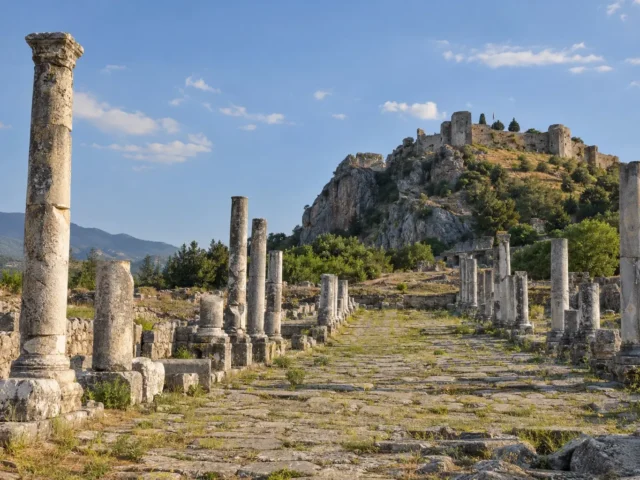
Kastabala Ancient City
Hierapolis-Kastabala in Osmaniye: the colonnaded street, theatre and castle of…
Toprakkale Castle
Toprakkale Castle near Osmaniye: Abbasid, Crusader, Armenian and Mamluk basalt…
Zorkun Plateau
Zorkun Plateau above Osmaniye: a 1,600 m summer yayla of…
Osmaniye
Osmaniye travel guide: Karatepe-Aslantaş and its Hittite bilingual, Kastabala, Toprakkale…
