Bitlis: Ahlat’s Tombstones and the Nemrut Crater
On this page
- What is Bitlis?
- How do you get to Bitlis?
- Where should you stay in Bitlis?
- What type of climate does Bitlis have?
- When is the best time to visit Bitlis?
- What is the history of Bitlis?
- What is Bitlis famous for?
- What are the historical places of Bitlis?
- What are the best things to do in Bitlis?
- What are the best places to visit in Bitlis?
- What is the traditional food of Bitlis?
- What should you buy in Bitlis?
- Frequently asked questions about Bitlis
- What do the official records say about Bitlis?
Key facts: Bitlis
- UNESCO Tentative List: “The Tombstones of Ahlat the Urartian and Ottoman citadel” has been on Türkiye’s Tentative List since 2000 (UNESCO). It is not an inscribed World Heritage Site.
- Region: Eastern Anatolia, on the western and northern shores of Lake Van, bordering Siirt, Muş, Ağrı and Van.
- Best known for: The Seljuk tombstones and kümbets of Ahlat, the crater lake inside Mount Nemrut, and an Ottoman-era stone town of madrasas, mosques and hans in a narrow river gorge.
What is Bitlis?
Bitlis is a province in eastern Türkiye that wraps around the western end of Lake Van, and also the name of its capital, a stone town squeezed into a steep valley where two streams meet below a castle rock. The town sits on the only natural pass between the Lake Van basin and the lowlands of southeastern Anatolia, which is why armies, caravans and now the main highway and the railway to Tatvan all funnel through it.
The province has three districts on the lake shore: Tatvan, a rail and ferry town at the western tip; Ahlat, the medieval capital of the Shah-Armens and home to Ahlat Seljuk Cemetery; and Adilcevaz, beneath the slopes of Mount Süphan. Above Tatvan rises Mount Nemrut, a dormant volcano whose caldera holds Nemrut Crater Lake.
For travellers, Bitlis works best as two distinct trips: the old town of Bitlis itself, with its 16th-century külliyes and caravanserais, and the north shore of the lake, where Ahlat’s cemeteries and tomb towers sit within an hour’s drive of the Nemrut caldera.
Places to visit in Bitlis
Ahlat Seljuk Cemetery
Ahlat Seljuk Cemetery in Bitlis: thousands of carved 12th–15th-century headstones on Lake…
Ahlat Kümbets
The kümbets of Ahlat, Bitlis: Ulu Kümbet, Emir Bayındır, Çifte Kümbet and…
Nemrut Crater Lake
Nemrut Crater Lake in Bitlis: Türkiye’s largest crater lake, inside a volcano…
Bitlis Castle
Bitlis Castle above the old Kalealtı bazaar, with the Ulu Cami, Şerefiye…
How do you get to Bitlis?
By air: Bitlis has no airport. The Ministry of Culture and Tourism lists the airports of Muş, Van, Batman and Diyarbakır as the ways in (Bitlis Culture and Tourism Directorate). Muş Sultan Alparslan Airport (MSR) is the closest to Tatvan and Ahlat, with Turkish Airlines and Pegasus flights from Istanbul and AJet from Ankara; Van Ferit Melen Airport is the better choice if you are combining Bitlis with Van.
By road: The main highway from Diyarbakır runs up the Bitlis gorge, through Bitlis town and on to Tatvan, then continues around the lake to Van. Intercity coaches stop at Bitlis and Tatvan, and minibuses link Tatvan with Ahlat and Adilcevaz along the north shore. A car makes a big difference here: Nemrut, the Ahlat cemeteries and the castles of Adilcevaz have little or no public transport.
By rail and ferry: Tatvan is the eastern terminus of the Lake Van Express (Vangölü Ekspresi) from Ankara, a journey of about 26 hours (route details). From Tatvan, ferries cross the lake to Van; the ministry notes that they sail without a fixed timetable, so check locally on the day.
Where should you stay in Bitlis?
Tatvan is the most practical base. It has the widest choice of hotels, it is the closest town to Nemrut, and Ahlat is about 40 minutes away along the lake. Ahlat has a few small hotels and guesthouses for those who want to see the cemetery at first or last light. Bitlis town itself is best visited as a half-day stop on the road between Tatvan and Diyarbakır or Siirt, though it does have business hotels.
Tours in Anatolia
−5% Istambul readers save 5% on every tour below — applied at checkout.
Partner listings via GetYourGuide · free cancellation on most
What type of climate does Bitlis have?
Bitlis has a harsh continental mountain climate. Winters are long, cold and very snowy: the town sits at around 1,500 m in a narrow gorge and is known in Türkiye for the depth of its snow, and Nemrut and Süphan stay white well into spring. Summers are warm and dry by the lake, while nights on the mountains remain cool even in August. Lake Van moderates temperatures on the shore a little, but the water is soda-rich and the lake does not warm up like the sea.
When is the best time to visit Bitlis?
June to early October. The road up to the Nemrut caldera is usually snowbound for around five months a year, so late spring and summer are the only reliable times to reach the crater lake. July and August bring the warmest weather for the Lake Van beaches at Ahlat and Adilcevaz. September is the best all-round month: clear air for photographing the Ahlat tombstones, and the walnut harvest in Adilcevaz. In winter, snow turns Bitlis town into a striking but difficult destination; the Ahlat cemetery is still visitable, but mountain roads may close.
What is the history of Bitlis?
The 2002 provincial inventory opens with a summary of the province’s past: “Bitlis, whose foundation goes back to around 2000 BC, is an old settlement that counts the Urartian, Persian, Macedonian, Roman and Byzantine periods in its past. Bitlis came to know Islam in the time of the Caliph Umar (641) and remained under the rule of the Umayyads, Abbasids and Marwanids; from 1071, when the Turks entered Anatolia, it passed under the rule of various Turkish principalities, and in the Ottoman period (in the 17th, 18th and 19th centuries) it became the cultural and artistic centre of the region. The madrasas, mosques, külliyes, hans and baths of the period still stand as evidence of that brilliant past.”
Local tradition holds that the town takes its name from Badlis, a commander of Alexander the Great, said to have built the castle around 312 BC. On the north shore, Ahlat (Khlat in Armenian sources) was held in turn by Armenian noble houses, Arab emirs and, briefly, Byzantium, before passing to the Seljuks after the Battle of Malazgirt in 1071 (Ahlat history). From around 1100 the Shah-Armens made Ahlat their capital, and the city became one of the great centres of eastern Anatolia until the Khwarazmian ruler Jalal al-Din sacked it in 1230 and an earthquake in 1246 completed the damage. Ilkhanid, Karakoyunlu and Akkoyunlu rule followed.
For several centuries Bitlis town was the seat of the Kurdish Rojiki emirs, the line of the Şerefhans who built many of its monuments. In the 16th century the area passed between the Safavids and the Ottomans before Süleyman the Magnificent secured it; Ahlat’s lakeside fortress was rebuilt on his orders in the 1550s. In 1597 Şeref Han, emir of Bitlis, completed the Şerefname, a Persian-language history of the Kurdish dynasties that is still one of the main sources for the region. The scholar and historian İdris-i Bitlisi, adviser to Selim I, was also from Bitlis.
During the First World War Bitlis was occupied by Russian forces in early 1916 and retaken in August of the same year; the town still marks its liberation on 8 August.
What is Bitlis famous for?
- The Ahlat tombstones. Tall carved headstones of the 12th–15th centuries, the reason for the UNESCO Tentative List entry.
- Kümbets. Cylindrical and polygonal Seljuk and later tomb towers scattered around Ahlat; the provincial directorate counts 14.
- Nemrut Crater Lake. A freshwater lake inside a volcanic caldera, with a hot-spring-fed smaller lake beside it.
- “Five minarets in Bitlis.” The town is known across Türkiye from the folk song Bitlis’te Beş Minare.
- Büryan. Pit-roasted goat, the local dish most people associate with Bitlis.
- Ahlat stone and Ahlat walking sticks. The volcanic tuff used across the region’s buildings, and a carved-cane craft the directorate describes as known nationwide.
What are the historical places of Bitlis?
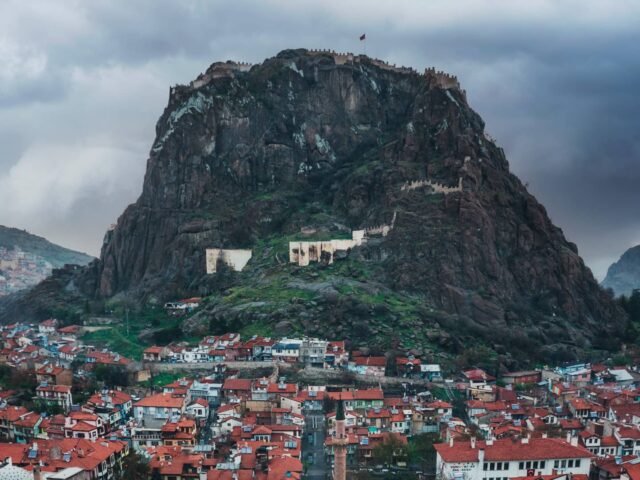
Bitlis Castle. The castle stands on a rock above the bazaar at the meeting of two branches of the Bitlis stream. Its walls dominate the town, though the interior is filled with earth and cannot be explored.
Ulu Cami. According to the inventory, the inscription records that the mosque was built in 1150 (H. 545) by Ebu’l Muzaffer Muhammed; the current directorate reads the same date as a repair. It stands in the lowest part of the town centre, is set on six arches, and the 2002 text calls it “one of the finest examples of Seljuk architecture”. Its minaret, a separate tower to the north, carries an inscription of 1492.
Şerefiye Külliyesi. A mosque, madrasa, imaret and tomb built in 1529 by Şeref Han IV, where the Kışla and Hosor streams meet. The inventory notes that because the east front is the one visible from the town, it was decorated with special care, and draws attention to the ornament of the minaret and mihrab.
İhlasiye Madrasa. Built in 1589 by Şeref Han V on Gökmeydan, the highest square in town. It is the largest of Bitlis’s madrasas and, in the inventory’s words, “very imposing from the outside”, with richly carved decoration.
Gökmeydan Mosque. Its inscription dates it to 1801; the minaret inscription of 1924 records a restoration under the governor Kazım Dirik Paşa and includes Atatürk’s name (Bitlis Culture and Tourism Directorate).
El-Aman Han. On the Bitlis–Tatvan road, a 16th-century caravanserai built by Hüsrev Paşa that formed a complex with shops, a mosque and a bath; the inventory calls it one of the largest caravanserais in Anatolia. Hatuniye (Hazo) Han beside the bridge of the same name was renewed in 1626, according to its inscription.
Ahlat. Ahlat Seljuk Cemetery, the Ahlat kümbets, the lakeside castle rebuilt for Süleyman the Magnificent in 1556, and the İskender Paşa Mosque of 1584.
Adilcevaz Castle. A fortress on steep rocks above the lake shore at Adilcevaz. Sources record that it once held 70 houses, the Süleyman Han Mosque, a magazine, granaries and cisterns; only ruins survive. Nearby, the Zal Paşa (Tuğrul Bey) Mosque on the Adilcevaz–Ahlat road is roofed by twelve small domes.
What are the best things to do in Bitlis?
- Drive up to the Nemrut caldera and walk down to the shore of the crater lake, then look for the warm lake on the caldera floor.
- Walk the Ahlat cemetery at the end of the day, when low sun brings out the carving on the headstones.
- Climb Mount Süphan. At 4,058 m it is one of the highest peaks in Türkiye, and a summer climb from the Adilcevaz side has views over the whole lake.
- Swim in Lake Van from the beaches at Ahlat and Adilcevaz in July and August. The water is alkaline and feels soapy, and there are no fish except a single species of pearl mullet.
- Cross Lake Van by ferry from Tatvan to Van, on the boats that also carry the railway wagons across the lake.
- Visit the BETAV Prof. Dr. Fuat Sezgin Science and Culture House in Bitlis, dedicated to the historian of Islamic science.
- Soak in a hot spring. The town lies on a fault line, and the inventory lists springs including Güroymak (Çukur), Ilıcak (Germav) and the springs of Mount Nemrut.
The inventory also lists local events, including the Nemrut Crater Lake festivities in July and a Culture, Arts and Walnut Festival in October. Check dates locally before planning around them.
What are the best places to visit in Bitlis?
Ahlat Seljuk Cemetery. The largest historic cemetery in Ahlat, a field of carved headstones of the 12th–15th centuries on the lake’s north shore.
Ahlat kümbets. The tomb towers of Ahlat’s emirs, from the 13th-century Ulu Kümbet to the 15th-century Emir Bayındır Kümbeti with its open colonnade.
Nemrut Crater Lake. The caldera lake of Mount Nemrut above Tatvan, reachable by road in summer.
Bitlis Castle. The castle rock above Bitlis’s old bazaar, with the town’s madrasas and mosques in the streets below.
Also worth your time: the Ahlat Museum, rebuilt and reopened in 2014; the Bitlis Ethnography Museum in a former governor’s residence built of Ahlat stone (Bitlis Culture and Tourism Directorate); El-Aman Han; and Adilcevaz Castle on the shore road towards Ağrı.
What is the traditional food of Bitlis?
Büryan is the dish to try. The provincial directorate describes it as goat meat salted and rested overnight, then cooked in a pit oven (tandır) fired with oak branches, hanging above a large pot of water so that it cooks in the steam. The best season is August to October, when the animals have fattened on fresh pasture, and it is traditionally eaten with grapes. Avşor is made from the fat-rich water collected from the büryan oven, simmered with lean meat and plenty of pepper and eaten in the morning (Bitlis Culture and Tourism Directorate).
What should you buy in Bitlis?
An Ahlat walking stick (Ahlat bastonu), hand-carved and sold in Ahlat. Hizan hazelnuts, Adilcevaz walnuts and Mutki honey are the food souvenirs the directorate recommends, along with küp peyniri, cheese matured in clay jars. Naturally dyed kilims are still woven in the districts (Bitlis Culture and Tourism Directorate).



Frequently asked questions about Bitlis
Is Bitlis worth visiting?
Yes, especially for Ahlat’s Seljuk tombstones and kümbets and the Nemrut crater lake, which have no real equivalent elsewhere in Türkiye. Bitlis town adds 16th-century madrasas, mosques and caravanserais.
What is the nearest airport to Bitlis?
Bitlis has no airport. Muş Sultan Alparslan Airport is the closest to Tatvan and Ahlat, and Van, Batman and Diyarbakır airports are the alternatives.
Where should I stay to visit Ahlat and Nemrut?
Tatvan. It is the closest town to the Nemrut caldera and about 40 minutes by road from Ahlat, with the widest choice of hotels in the province.
Is Nemrut in Bitlis the same as Mount Nemrut with the statues?
No. The mountain with the colossal stone heads is in Adıyaman. Nemrut in Bitlis is a volcano above Tatvan with a crater lake.
When is the best time to visit Bitlis?
June to early October. The road to the Nemrut caldera is usually closed by snow for about five months of the year.
Is Ahlat a UNESCO World Heritage Site?
Not yet. “The Tombstones of Ahlat the Urartian and Ottoman citadel” has been on Türkiye’s UNESCO Tentative List since 2000.
What food is Bitlis known for?
Büryan, goat meat steam-roasted in a pit oven, best from August to October. Avşor, a peppery broth made from the büryan oven’s juices, is the breakfast version.
What do the official records say about Bitlis?
Bitlis, built on the only crossing point linking Eastern and Southeastern Anatolia and the stage of many civilisations throughout history, has a very rich architectural heritage. It is also like a treasure in terms of its natural and cultural assets. With its unique, untouched nature, Bitlis has an important tourism potential.
Süphan, in the east of the province, at 4,058 metres is Türkiye’s second-largest mountain. On Mount Süphan there is a crater lake 400 metres in diameter. Another important mountain of the province is Mount Nemrut, 3,050 metres high, on which lies Türkiye’s largest crater lake. With this unique natural structure, Bitlis has a very suitable setting for winter tourism and mountain and nature walks. (Ministry of Culture and Tourism, Bitlis Provincial Tourism Inventory, 2002)
Ready to see Bitlis?
Hand-picked tours with good reviews and clear prices.
Partner listings via GetYourGuide · free cancellation on most
Before or after: Istanbul
Most trips start or end in Istanbul. Our own experiences there:

 Dinner, sunset and day cruises between Europe and Asia.See cruises bosporuscruise.com

 Historic Turkish baths in the old city — hand-picked hamams, booked direct.Book a hamam istanbulhamam.com

 Istanbul’s tallest viewpoint: both continents from 369 metres.Get tickets camlicatower.com

 Free audio guides in 15 languages, safe routes and local tips — plus 5% off GetYourGuide.Open the free guide localada.com