
Ahlat Kümbets: Tomb Towers of the Lake Van Emirs
On this page
- What are the Ahlat kümbets?
- How do you get to the Ahlat kümbets?
- When is the best time to visit the Ahlat kümbets?
- What is the history of the Ahlat kümbets?
- What are the Ahlat kümbets famous for?
- What can you see at the Ahlat kümbets?
- Frequently asked questions about the Ahlat kümbets
- What do the official records say about the Ahlat kümbets?
Key facts: Ahlat kümbets
- What they are: Monumental tomb towers (kümbet) built for the emirs and notables of Ahlat; the provincial directorate counts 14, mostly of the 13th century.
- Where: In and around Ahlat, on the north shore of Lake Van, Bitlis province.
- Period: 13th–15th centuries.
- UNESCO: Covered by the Tentative List entry “The Tombstones of Ahlat the Urartian and Ottoman citadel” (2000); not inscribed (UNESCO).
What are the Ahlat kümbets?
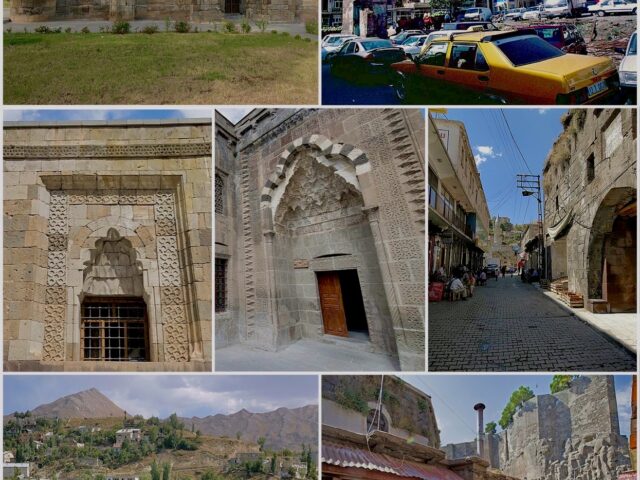
A kümbet is a tomb tower: a round or polygonal stone building with a conical or pyramidal roof, built over the grave of a ruler or notable. Ahlat, on the north shore of Lake Van in Bitlis province, has one of the largest groups of them in Anatolia. The Bitlis Provincial Directorate of Culture and Tourism lists 14, most of them from the 13th century (Bitlis Culture and Tourism Directorate).
The directorate explains their typical form: an underground burial chamber with a small prayer room (mescit) built above it. Like the headstones of Ahlat Seljuk Cemetery, they are built of the local volcanic stone, in shades from red-brown to grey.
How do you get to the Ahlat kümbets?
The kümbets are spread through Ahlat’s neighbourhoods and fields, most within 2–3 km of each other, so a car or taxi is the easiest way to link them. Ahlat is about 40 km from Tatvan along the north shore of Lake Van and about 60 km from Bitlis town; minibuses run from Tatvan.
Ulu Kümbet stands in fields close to the lake south of the Meydanlık cemetery, the Emir Bayındır Kümbeti is on the edge of the same cemetery, and the Çifte Kümbet and Emir Ali Kümbeti are in the İki Kubbe neighbourhood, whose name means “Two Domes”.
Tours in Anatolia
−5% Istambul readers save 5% on every tour below — applied at checkout.
Partner listings via GetYourGuide · free cancellation on most
When is the best time to visit the Ahlat kümbets?
From late May to early October. Late afternoon light falls on the west and south faces of the towers and brings out the inscriptions. Combine them with the cemetery on the same day; in winter, roads in Ahlat stay open but field paths to the outlying kümbets can be muddy or snowbound.
What is the history of the Ahlat kümbets?
Ahlat was the capital of the Shah-Armens from around 1100 and remained an important city under the Ayyubids, the Ilkhanids and the Karakoyunlu and Akkoyunlu (Ahlat history). Its ruling families and the Mongol-era emirs who governed it built kümbets for themselves and their families, and their inscriptions are among the best dated monuments in the town.
The 2002 inventory gives the dates of the main group. The Hasan Padişah Kümbeti was built in the second half of the 13th century, probably in 1274/75. The Bugatay Aka Kümbeti carries four inscriptions; according to them it was built for the emir Bugatay Aka and Şirin Hatun, both of whom died in 1281. The Emir Ali Kümbeti is most likely 14th-century, and the Emir Bayındır Kümbeti marks the grave of Bayındır Bey, who died in 1481. The Ulu Kümbet has no inscription, but researchers agree that it belongs to the 13th century.
What are the Ahlat kümbets famous for?
- Ulu Kümbet, the largest of the group.
- The Emir Bayındır Kümbeti, unlike any other tomb in Ahlat, with an open colonnade wrapped around its cylindrical body.
- The Çifte Kümbet (“twin kümbets”), a pair of tombs standing side by side.
- Dated inscriptions that record the names, titles and deaths of Ahlat’s emirs.
What can you see at the Ahlat kümbets?
Ulu Kümbet (Usta-Şagirt Kümbeti). The inventory describes it as standing in the middle of fields south of the Meydanlık cemetery, quite close to Lake Van, and as the largest of the Ahlat kümbets. Like other Seljuk kümbets it has two storeys: the burial crypt below and the tomb room above. Its alternative name, Usta-Şagirt, means “master and apprentice”.
Emir Bayındır Kümbeti. The inscription band running around the top of the tomb records that it is the grave of Melik Bayındır Bey ibn Rüstem, who died in Ramadan of 886 AH (1481), and sets out his titles and life story. The inventory singles out its form: from a square base, its cylindrical body opens outwards through columns and arches, and it is capped by a low conical roof that projects beyond the walls. The small Emir Bayındır Mosque stands beside it.
Çifte Kümbet and Bugatay Aka Kümbeti. In the İki Kubbe neighbourhood beside the road. The Bugatay Aka tomb, one of the pair, has inscriptions above its windows and portal: the western one records Şirin Hatun, daughter of Abdullah, who died in Rajab 680 AH, and the northern one Emir Bugatay Aka ibn Emir İnal Aka, who died in the same year. The remaining inscriptions are verses of the Qur’an and hadith.
Emir Ali Kümbeti. Also in İki Kubbe, on the road to the Harabe Şehir (“ruined city”). A broken marble inscription over the pointed arch of the front is unreadable except for the word “Ali”. In front of the square tomb room is a section whose walls step up towards the tomb.
Hasan Padişah Kümbeti. At the southern end of the Taht-ı Süleyman neighbourhood, built in the second half of the 13th century by Aka bin Mahmud, according to the inventory.



Frequently asked questions about the Ahlat kümbets
How many kümbets are there in Ahlat?
The Bitlis Provincial Directorate of Culture and Tourism counts 14, most of them from the 13th century.
Which Ahlat kümbet is the largest?
Ulu Kümbet, also called Usta-Şagirt Kümbeti, in the fields south of the Meydanlık cemetery near the lake shore.
What is a kümbet?
A tomb tower: a round or polygonal stone building with a conical or pyramidal roof, built over an underground burial chamber for a ruler or notable.
What is the Çifte Kümbet?
A pair of tomb towers side by side in Ahlat’s İki Kubbe neighbourhood. One of them is the tomb of Emir Bugatay Aka and Şirin Hatun, who died in 1281.
Can you see the kümbets and the Seljuk cemetery in one day?
Yes. They are within a few kilometres of each other, and half a day by car covers the cemetery, the main kümbets and the Ahlat Museum.
What do the official records say about the Ahlat kümbets?
The Emir Bayındır Kümbeti lies to the west of the İki Kubbe neighbourhood, at the edge of the Meydan cemetery. The inscription that runs around the upper part of the kümbet records that it is the tomb of Melik Bayındır Bey ibn Rüstem, who died in the month of Ramadan in the year 886 AH. The beautifully written inscription band contains Bayındır Bey’s titles and the story of his life.
It is the most interesting of the Ahlat kümbets and, with its cylindrical body opening towards the building through columns and arches from a square base, and its low conical roof projecting outwards, it is quite different from the other kümbets. (Ministry of Culture and Tourism, Bitlis Provincial Tourism Inventory, 2002)
Ready to see Ahlat Kümbets?
Hand-picked tours with good reviews and clear prices.
Partner listings via GetYourGuide · free cancellation on most
Before or after: Istanbul
Most trips start or end in Istanbul. Our own experiences there:

 Dinner, sunset and day cruises between Europe and Asia.See cruises bosporuscruise.com

 Historic Turkish baths in the old city — hand-picked hamams, booked direct.Book a hamam istanbulhamam.com

 Istanbul’s tallest viewpoint: both continents from 369 metres.Get tickets camlicatower.com

 Free audio guides in 15 languages, safe routes and local tips — plus 5% off GetYourGuide.Open the free guide localada.com
Nearby
All destinationsAhlat Seljuk Cemetery
Ahlat Seljuk Cemetery in Bitlis: thousands of carved 12th–15th-century headstones…
Bitlis Castle
Bitlis Castle above the old Kalealtı bazaar, with the Ulu…
Nemrut Crater Lake
Nemrut Crater Lake in Bitlis: Türkiye’s largest crater lake, inside…
Bitlis
Bitlis travel guide: Ahlat’s Seljuk tombstones and kümbets, the Nemrut…
