Trabzon: Old Trebizond on the Eastern Black Sea
On this page
- What is Trabzon?
- How do you get to Trabzon?
- Where should you stay in Trabzon?
- What type of climate does Trabzon have?
- When is the best time to visit Trabzon?
- What is the history of Trabzon?
- What is Trabzon famous for?
- What are the historical places of Trabzon?
- What are the best things to do in Trabzon?
- What are the best places to visit in Trabzon?
- What is the traditional food of Trabzon?
- What should you buy in Trabzon?
- Frequently asked questions about Trabzon
- What do the official records say about Trabzon?
Key facts: Trabzon
- UNESCO Tentative List: Sümela Monastery (The Monastery of Virgin Mary) has been on Türkiye’s Tentative List since 2000 (UNESCO). It is not an inscribed World Heritage Site.
- Region: Eastern Black Sea, between Giresun to the west and Rize to the east, with the Pontic Mountains rising directly behind the coast.
- Best known for: The cliff monastery of Sumela, the 13th-century church of Hagia Sophia, the lake at Uzungöl, summer plateaus (yayla) and Black Sea food: hamsi, kuymak and Akçaabat köfte.
What is Trabzon?
Trabzon is a province on Türkiye’s eastern Black Sea coast, and the name of its capital, the largest city between Samsun and the Georgian border. The city faces the sea along a narrow strip of coast; behind it the land climbs fast, through tea and hazelnut slopes and spruce forest, to summer pastures above 2,000 metres.
For more than two thousand years this was Trapezus, then Trebizond: a Greek colony, a Roman and Byzantine port, and from 1204 to 1461 the capital of the Komnenian Empire of Trebizond. The 2002 provincial inventory describes it as a province at the start of the transit road to the Caucasus and Iran, linked by sea to the ports of the other Black Sea countries, and as a tourist city that can be visited in all four seasons.
Most visitors come for three things: Sumela Monastery, built into a cliff above the Altındere valley; the lake village of Uzungöl; and the plateaus (yayla) where families still move with their animals each summer. The city itself has more to show than many expect, starting with the frescoed church of Hagia Sophia.
Places to visit in Trabzon

Sumela Monastery
Sumela Monastery near Trabzon: its history, frescoes and 2022 reopening after restoration,…
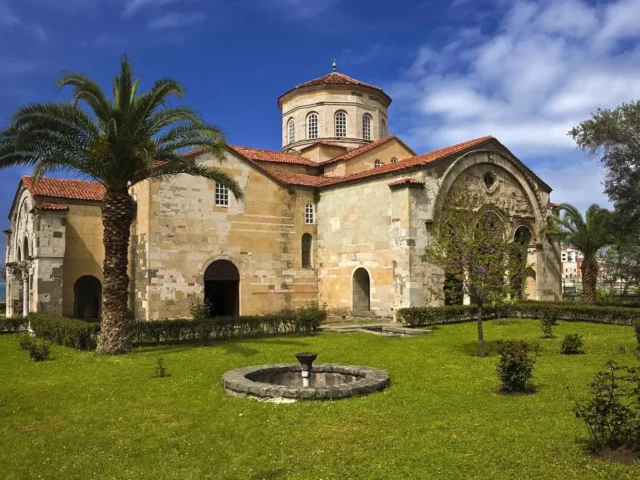
Hagia Sophia of Trabzon
Hagia Sophia in Trabzon: the 13th-century church of the Empire of Trebizond,…
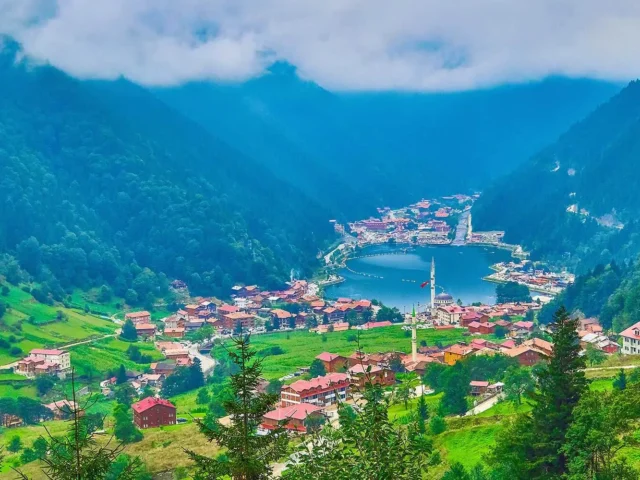
Uzungöl
Uzungöl in Çaykara, Trabzon: how a landslide made the lake, how to…

Atatürk Mansion, Trabzon
The Atatürk Mansion in Trabzon: a banker’s summer house at Soğuksu where…
How do you get to Trabzon?
By air: Trabzon Airport (TZX) has served the city since 1957 and sits on the coast in the Ortahisar district, close to the centre. There are frequent flights from Istanbul Airport and Sabiha Gökçen, and from Ankara, İzmir and Antalya. Year-round international routes include Baku and Düsseldorf, and in summer a long list of seasonal flights arrives from the Gulf. A new airport on land reclaimed from the sea has been announced; until it opens, all flights use the existing one.
By road: The Black Sea coastal highway runs through the city, linking it west to Giresun and Samsun and east to Rize, Hopa and the Georgian border at Sarp. Inland, the road south through Maçka crosses the mountains to Gümüşhane and Erzurum. Intercity coaches connect Trabzon with Istanbul, Ankara and most cities in the east.
Getting around: Trabzon has no passenger railway. Minibuses (dolmuş) cover the city and coast, and buses run to Maçka and Çaykara, but Sumela and Uzungöl are much easier by car, taxi or day tour. Plateau roads above the villages can be unsurfaced.
Where should you stay in Trabzon?
For a first visit, stay in the city centre around Meydan (Atatürk Alanı) and the Uzun Sokak shopping street. You can walk to the old walled quarter, the bazaar and the seafront, and buses and tours to Sumela and Uzungöl leave from here.
Uzungöl has its own cluster of hotels and wooden chalets around the lake, and staying a night lets you see the valley before and after the day-trip crowds. Smaller guesthouses on the plateaus and in villages around Maçka suit visitors who want quiet and walking. On holiday weekends, especially in July and August, book ahead in both the city and Uzungöl.
Book a Trabzon tour
−5% Istambul readers save 5% on every tour below — applied at checkout.
Partner listings via GetYourGuide · free cancellation on most
What type of climate does Trabzon have?
Trabzon has the mild, humid climate of the eastern Black Sea. Rain falls in every month, and cloud often sits on the mountains even when the coast is dry. Summers on the coast are warm and sticky rather than hot, with afternoon highs usually in the mid-20s °C. Winters on the coast are mild and wet, but snow closes many plateau roads from late autumn to spring, and the uplands can be cold even in June.
When is the best time to visit Trabzon?
June to September is the main season. The plateaus are open, the festivals take place (most in July), and Sumela and Uzungöl are at their greenest. Expect crowds at Uzungöl and Sumela during Turkish school holidays and on long weekends.
May and October are good for the city, Sumela and the coast, with fewer visitors and autumn colour in the forests, but bring rain gear. Winter visits work for the city and for snow scenes at Uzungöl, but high roads may be closed.
What is the history of Trabzon?
According to the 2002 inventory, the city was first founded by colonists from Miletus in the 5th century BC; classical tradition links its foundation with Sinope, itself a Milesian colony further west along the coast. Around 400 BC the Greek soldier and writer Xenophon reached Trapezus with the Ten Thousand at the end of their march out of Persia. The city was later part of the Kingdom of Pontus before passing to Rome.
Trabzon lived through the Roman and Byzantine periods and, as the inventory puts it, in 1204 became the capital of a Pontic state. This was the Empire of Trebizond, founded by members of the Komnenos dynasty in the year the Fourth Crusade took Constantinople. For two and a half centuries the city was the seat of its own emperors, rich from the trade route that ran inland to Tabriz and Persia. Hagia Sophia, the cathedral now known as the Fatih Mosque, and the endowments of Sumela all belong to this era.
Sultan Mehmed II took the city in 1461. Under the Ottomans, the inventory notes, Yavuz Sultan Selim served here as provincial governor while a prince, and Kanuni Sultan Süleyman was born in the city. The mosque complex built in 1514 for Selim’s mother, Gülbahar Hatun, still stands west of the old town.
In the 20th century the city was occupied by Russian forces from 1916 to 1918; the province still marks the liberation of each district in February. Atatürk stayed at a banker’s summer house at Soğuksu in September 1924 and again on his last visit to the city in June 1937; it is now the Atatürk Mansion.
What is Trabzon famous for?
Sumela. The monastery of the Virgin Mary, built into the rock face above the Altındere valley, is the best-known sight on the whole Black Sea coast and draws around half a million visitors a year.
The Empire of Trebizond. Few places in Türkiye have so much visible from this late Byzantine state: the walls of the old city, its former cathedral, and the frescoes of Hagia Sophia.
Plateau culture. The summer move to the high pastures, with its festivals, horon dancing and the kemençe (a small three-stringed fiddle), is still part of life in the inland districts.
Food. Hamsi (Black Sea anchovy), kuymak (a cornmeal and cheese fondue that received geographical-indication status), Akçaabat köfte, Vakfıkebir bread and butter from Tonya are known across the country.
Football. Trabzonspor was the first club from outside Istanbul to win the Turkish league, and its colours, claret and blue, are everywhere in the city.
What are the historical places of Trabzon?
In the city
Hagia Sophia. The 2002 inventory places it 3 km west of the city and describes a 13th-century church notable for its wall frescoes and garden, thought to have been built in 1238–1263 under Manuel I of the Komnenian state. It notes that the four-columned, three-apsed chapel to the north is older than the main building, that the bell tower 25 metres to the west was built in 1427, and that the building is very rich in stone carving and frescoes. See our full guide to Hagia Sophia in Trabzon.
Trabzon Castle. The inventory calls it the best-preserved monument in the area, running from the city centre down to the sea. The walls enclosed the old town in three parts, upper, middle (Ortahisar) and lower, between two ravines now crossed by the Zağnos and Tabakhane bridges.
Fatih Mosque (Panagia Chrysokephalos). In the Ortahisar quarter, on the open ground between the Zağnos and Tabakhane bridges, this was one of the city’s leading churches. The inventory notes the belief that it was built on an old Roman temple, that it was known as the cathedral of the Komnenoi, and that it was dedicated to the Virgin and called “Golden-Headed”. Its main plan is a Greek cross.
Yeni Cuma Mosque (Hagios Eugenios). East of the Tabakhane Bridge, a cross-plan church probably built in the 14th century and dedicated to St Eugenios, a 3rd-century Christian saint of Trabzon. The inventory notes that he was regarded as the city’s saviour and protector and appeared on its official coins. The building has three naves and three apses but no narthex.
Gülbahar Hatun Mosque. West of Ortahisar and south of Atapark, built in 1514 for Ayşe Gülbahar Hatun, mother of Yavuz Sultan Selim, as part of a complex near the Zağnos Bridge. It has no building inscription and belongs, in the inventory’s words, to the group of early Ottoman mosques with zaviye rooms, a distinct plan type.
Çarşı and İskender Paşa mosques. The Çarşı Mosque in Kemeraltı, facing the old covered market (bedesten), is the largest mosque in Trabzon; its inscription records that governor Hazinedarzade Osman Paşa built it in 1839, in a mix of Baroque and Empire styles. The İskender Paşa Mosque, behind the municipality building on Taksim Square, was built in the 16th century by governor İskender Paşa and has a marble mihrab and minbar with 19th-century Baroque decoration.
Santa Maria Church. In the Kemerkaya quarter, built between 1869 and 1874 on the orders of Sultan Abdülmecid for foreigners in the city. The inventory notes it is still used for worship by Christian visitors.
The Armoury (Fatih or Irene Tower). A 25-metre building of two concentric round towers with thick walls. With no inscription, its origin is uncertain: the inventory reports that it may have been built by Empress Irene (1340–1341) as a meeting place for Trabzon’s aristocracy, or by Abdülhamid II on the site of an older building. It is known to have been used as an armoury in 1877 and during the Russian occupation, and was damaged by an explosion in 1918.
Trabzon Museum. Housed in the Kostaki Mansion, an early 20th-century banker’s house, the museum reopened on 30 May 2025 after restoration and new displays. It covers the city from prehistory to the late Ottoman period, including Byzantine finds from Trabzon Castle and stone tools from Koskarlı Cave in Düzköy, evidence of people here about 10,000 years ago.
Atatürk Mansion. A summer house in the pine woods at Soğuksu, where Atatürk stayed in 1937. It is a museum; see our guide to the Atatürk Mansion.
In the mountains
Sumela Monastery. 45 km from the city, reached through Maçka and Altındere National Park. See our guide to Sumela Monastery.
Vazelon Monastery. In pine forest 14 km from Maçka and 35 km from Trabzon, reached by a ten-minute walk. Dedicated to St John, its founder and date are unknown, though the inventory notes that some researchers suggest AD 270 or 317. The Ministry of Culture and Tourism describes it as having been the richest monastery in the region, with frescoes of heaven, hell and the Last Judgement on its north wall. It is a ruin, so go with modest expectations.
What are the best things to do in Trabzon?
Go up to a plateau. The inventory lists more than a dozen, most of them in Maçka, Akçaabat and Tonya. Kadırga, at 2,300 metres and above the tree line, is the best known: on the third Friday of July tens of thousands of people come for the Kadırga festival, which the inventory compares to a great market fair, with folk dancing, contests, drum and zurna music, and tonnes of meat, bread and churned ayran. Hıdırnebi (1,742 m), reached from the Akçaabat–Düzköy road, has a three-day festival from 20 July and a hilltop viewpoint over the forest. Karadağ (1,946 m) is known for its clean air and wildlife.
Walk between the plateaus. The upland country between Trabzon and Uzungöl is good walking terrain. Erikbeli, at the junction of roads to Kadırga, Çatma Obası, Sazalanı and Zigana, is a natural base, and the inventory recommends the routes linking Erikbeli, Sazalanı, Ken, Sinlice, Şıkkıranı and Sis Dağı.
Spend a day at Uzungöl. The lake in its steep valley, the minarets of the village mosque and the mist on the slopes make the classic Black Sea picture. See our Uzungöl guide.
Picnic at Sera Lake. Just 7 km west of the city off the Akçaabat road, the lake has long been a camping and picnic spot, and the inventory notes you can fish from the shore.
Watch the city from Boztepe. The hill above the centre has tea gardens looking down over the old town and the harbour, best around sunset.
What are the best places to visit in Trabzon?
Sumela Monastery. The Monastery of the Virgin Mary, built against a cliff about 1,200 metres above sea level in Altındere National Park. Fully reopened since 2022 after years of restoration, with chapels and frescoes that were hidden before.
Hagia Sophia. The 13th-century church of the Empire of Trebizond, with carved porches and some of the finest late Byzantine frescoes in Türkiye. Now a mosque, open to visitors outside prayer times.
Uzungöl. A lake formed by an old landslide in the Haldizen valley, 95 km from the city, surrounded by forest and plateaus and now a busy resort village.
Atatürk Mansion. A white summer house in a pine grove at Soğuksu, where Atatürk stayed in June 1937 and made the decision to leave his property to the nation.
Also worth your time: the old walled quarter of Ortahisar and the Zağnos Valley park beneath its walls; the bazaar around the Çarşı Mosque; Trabzon Museum; Altındere National Park around Sumela; and the plateaus of Kadırga, Hıdırnebi and Karadağ.
What is the traditional food of Trabzon?
Trabzon cooking is built on corn, dairy, cabbage and fish. In winter the coast lives on hamsi, the Black Sea anchovy, fried in cornmeal, baked with rice in hamsili pilav or cooked in a tray. Kuymak (also called muhlama), cornmeal cooked with butter until stretchy cheese melts into it, is the classic breakfast, and Trabzon kuymak holds geographical-indication status.
Akçaabat köfte, small grilled meatballs from the town of Akçaabat west of the city, are served with piyaz and pickled peppers. Kara lahana (Black Sea kale) goes into soups and wraps. The large, crusty round loaves of Vakfıkebir bread and butter from Tonya are sold all over Türkiye. For dessert, look for laz böreği, a custard pastry, and the rice pudding of Hamsiköy, a village on the road to Sumela.
What should you buy in Trabzon?
Hasır jewellery. Trabzon’s jewellers make hasır bracelets, chains of fine gold or silver wire knitted into a supple “straw” mesh, alongside telkari filigree. Jewellers around the bazaar sell both.
Hazelnuts, butter and tea. Hazelnuts are the main crop of the coast, and many shops vacuum-pack Tonya butter and local cheeses for travel.
Knives from Sürmene and woven goods from the villages are also traditional local crafts.



Frequently asked questions about Trabzon
Is Sumela Monastery open in 2026?
Yes. After a long restoration it reopened fully on 1 May 2022 and stays open apart from short maintenance closures, such as the works of 8–16 June 2026. Check before you go, as rockfall work can close it at short notice.
How many days do you need in Trabzon?
Three days is a good minimum: one for the city (Hagia Sophia, the old walled quarter, the museum and the Atatürk Mansion), one for Sumela and one for Uzungöl. Add more if you want to stay up on a plateau.
How far is Uzungöl from Trabzon?
About 95 km southeast of the city centre, and 19 km from Çaykara. Allow around two hours each way by road.
What is the nearest airport to Trabzon?
Trabzon Airport (TZX), on the coast in the Ortahisar district close to the city. It has frequent flights from both Istanbul airports and Ankara, plus international and seasonal Gulf routes.
What is Trabzon famous for?
Sumela Monastery, the Hagia Sophia of Trebizond, its history as capital of the Komnenian Empire of Trebizond, its football club, and food such as hamsi, kuymak and Akçaabat köfte.
When is the best time to visit Trabzon?
June to September. That is the season for the high plateaus and festivals, and the weather is least likely to hide the mountains. Spring and autumn are quieter but wetter.
Can you visit the Hagia Sophia in Trabzon?
Yes. It has been a mosque since 2013 and is open to visitors outside prayer times; the frescoes are screened during prayers and uncovered again afterwards.
What do the official records say about Trabzon?
Trabzon lies in the Eastern Black Sea Region, at the beginning of the transit road to the Caucasus and Iran, and is a province with links to the ports of the other countries on the Black Sea coast. With its historical and natural beauty, it is a tourist city that can be visited in all four seasons. The city was first founded in the 5th century BC by colonists from Miletus. Having lived through the Roman and Byzantine periods, Trabzon became the capital of the Pontic state in 1204. In the city, taken by Fatih Sultan Mehmet in 1461, Yavuz Sultan Selim served as a prince, and Kanuni Sultan Süleyman was born here.
Kadırga plateau lies 14 km east of the Erikbeli Tourism Centre, which is 24 km from Tonya. At 2,300 metres, it is above the tree line. Tens of thousands of people come to the Kadırga Festival, celebrated every year on the third Friday of July. With folk-dance performances, contests and drum-and-zurna entertainment, during which tonnes of meat, bread and churned ayran are consumed, the Kadırga Festival resembles a great market and fair. (Ministry of Culture and Tourism, Trabzon Provincial Tourism Inventory, 2002)
Ready to see Trabzon?
Hand-picked tours with good reviews and clear prices.
Partner listings via GetYourGuide · free cancellation on most
Before or after: Istanbul
Most trips start or end in Istanbul. Our own experiences there:

 Dinner, sunset and day cruises between Europe and Asia.See cruises bosporuscruise.com

 Historic Turkish baths in the old city — hand-picked hamams, booked direct.Book a hamam istanbulhamam.com

 Istanbul’s tallest viewpoint: both continents from 369 metres.Get tickets camlicatower.com

 Free audio guides in 15 languages, safe routes and local tips — plus 5% off GetYourGuide.Open the free guide localada.com