
Rize: Tea Gardens, Plateaus and the Kaçkar Mountains
On this page
- What is Rize?
- How do you get to Rize?
- Where should you stay in Rize?
- What type of climate does Rize have?
- When is the best time to visit Rize?
- What is the history of Rize?
- What is Rize famous for?
- What are the historical places of Rize?
- What are the best things to do in Rize?
- What are the best places to visit in Rize?
- What is the traditional food of Rize?
- What should you buy in Rize?
- Frequently asked questions about Rize
- What do the official records say about Rize?
Key facts: Rize
- Region: Eastern Black Sea, between Trabzon and Artvin, with the Kaçkar range rising to 3,932 m along its southern edge.
- Protected areas: Kaçkar Mountains National Park, declared in 1994, covers the high mountains of Rize and neighbouring Artvin.
- Best known for: Tea, the Ayder plateau and its hot spring, the Fırtına Valley with Zilkale and its stone arch bridges, Anzer honey, and Hemşin and Laz village culture.
What is Rize?
Rize is a province on Türkiye’s eastern Black Sea coast, between Trabzon and Artvin, and the name of its capital, a port town backed by hills planted with tea. Almost the whole province is mountainside: from the shore the land climbs through tea gardens, then forest, to alpine plateaus and the granite peaks of the Kaçkar range, which reach 3,932 metres.
The 2002 provincial inventory describes Rize as showing the most characteristic features of the Eastern Black Sea, set apart from the rest of Anatolia by its culture as much as by its geography. It lists what makes it special: steep-sided valleys, mountain summits within reach, glacial lakes, emerald-green plateaus, historic arched bridges and castles, and rushing streams.
For visitors, Rize means two things. On the coast it is tea country, with factories, terraces and tea gardens everywhere. Inland, in the Çamlıhemşin and İkizdere valleys, it is one of the best walking regions in Türkiye, with Ayder, the Fırtına Valley and the Kaçkar Mountains National Park.
Places to visit in Rize
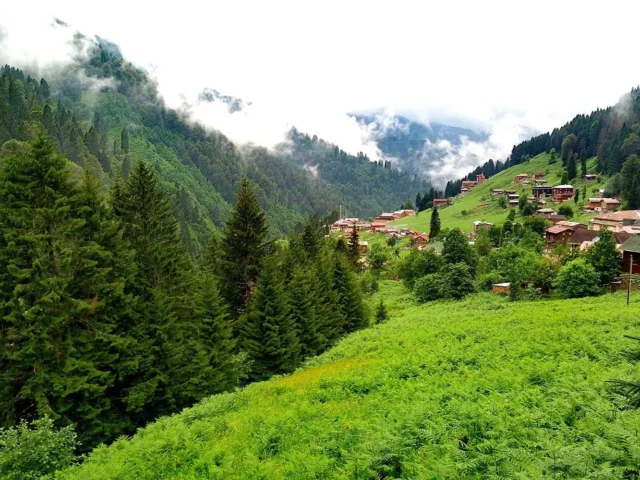
Ayder Plateau
Ayder plateau above Çamlıhemşin in Rize: the hot spring, waterfalls and wooden…
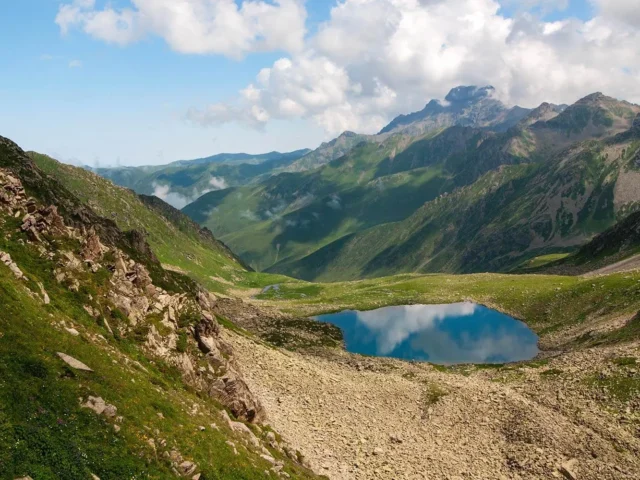
Kaçkar Mountains National Park
Kaçkar Mountains National Park on the Rize–Artvin border: glacial lakes, the 3,932…
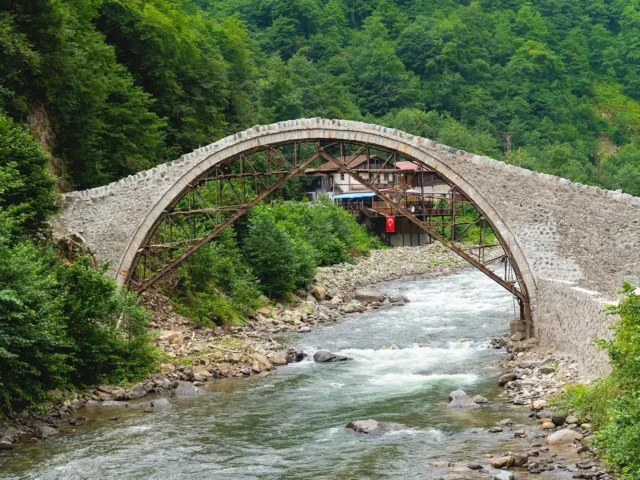
Fırtına Valley
The Fırtına Valley in Rize: the Storm river from Ardeşen to Çamlıhemşin,…

Zilkale
Zilkale (Zil Castle) above the Fırtına in Çamlıhemşin, Rize: a late medieval…
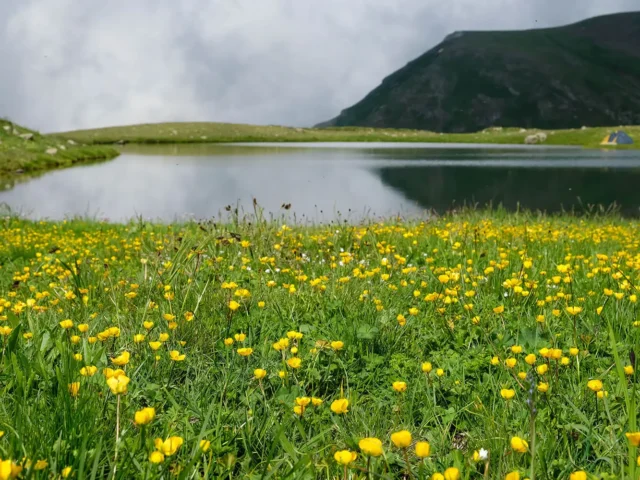
Anzer Plateau
Anzer plateau above İkizdere in Rize: alpine meadows with hundreds of flower…
How do you get to Rize?
By air: Rize–Artvin Airport (RZV) opened on 14 May 2022 on land reclaimed from the sea off Yeşilköy in Pazar district, about 34 km east of Rize and 75 km west of Artvin. Turkish Airlines flies from Istanbul Airport, AJet and Pegasus from Sabiha Gökçen, AJet from Ankara and Pegasus from İzmir, and there are seasonal flights from Saudi Arabia, Kuwait and Oman. The airport is also the closest to Ayder and the Fırtına Valley. Trabzon Airport, to the west, has more flights and is a good alternative.
By road: The coastal highway links Rize with Trabzon to the west and Hopa and the Georgian border at Sarp to the east. Intercity coaches run from Istanbul, Ankara and other large cities. Inland, the road up the İkizdere valley crosses the mountains to İspir and Erzurum.
Getting around: Minibuses connect Rize with the district towns, including Pazar, Ardeşen, Çamlıhemşin and İkizdere. To reach the higher plateaus, Zilkale or Anzer on your own schedule, a car or a local driver is far easier. Some plateau roads are unsurfaced and many close with snow from late autumn.
Where should you stay in Rize?
Most visitors come for the mountains and stay inland. Ayder has the widest choice, from wooden guesthouses to larger hotels, close to the hot spring and the trailheads. Small hotels and guesthouses along the lower Fırtına Valley and around Çamlıhemşin are quieter and closer to Zilkale.
The city of Rize works as a base for the coast and tea country, and for anyone arriving late by air. Pazar and Ardeşen, near the airport, are convenient for the eastern valleys. In July and August, and on Turkish holidays, book Ayder well ahead.
Book a Rize tour
−5% Istambul readers save 5% on every tour below — applied at checkout.
Partner listings via GetYourGuide · free cancellation on most
What type of climate does Rize have?
Rize is the wettest province in Türkiye. Rain falls throughout the year, heaviest in autumn and winter, and it is the reason for the deep green slopes, the tea and the many streams; the inventory notes that Rize has one of the highest densities of rivers in the country, fed by its rainfall and abundant underground springs. The coast is mild, with cool winters and warm, humid summers.
The mountains are another world. Ayder, at around 1,300 metres, is cool even in August, the high plateaus have snow until late spring, and the summits of the Kaçkar hold snowfields all summer. Fog rolls up the valleys most afternoons.
When is the best time to visit Rize?
June to September is the main season. The plateau roads are open, the villages are lived in, and the summer festivals take place. August and early September are the most reliable months for walking and climbing in the Kaçkar.
May is good for the coast and valleys, with waterfalls at their fullest and tea picking under way, though high routes are still snowbound. October brings autumn colour to the Fırtına Valley and fewer visitors. In winter the coast is wet and quiet, and most plateaus are closed.
What is the history of Rize?
According to the 2002 inventory, Rize is thought to have been founded by the Ionians and was later ruled by the Romans, the Byzantines, the Seljuks and the Ottomans. In the first centuries AD the site of Zilkale may have been the seat of a local Laz principality.
In the Middle Ages the region was part of the Empire of Trebizond, and it came under Ottoman rule after Mehmed II took Trebizond in 1461. Several of Rize’s oldest mosques are linked to that conquest: the inventory credits the Cafer Paşa Mosque at Çayeli to Cafer Paşa, “the conqueror of Rize”, and the Gülbahar Mosque in Rize to Gülbahar Hatun, mother of Yavuz Sultan Selim.
Like Trabzon, Rize was occupied by Russian forces during the First World War. Atatürk visited the town on 17 September 1924 and stayed in the house of Mataracı Mehmet Efendi, which later became the city’s Atatürk Museum.
The modern economy of the province was shaped by tea. A law of 1924 promoted tea, hazelnut and citrus growing around Rize and Borçka and required the state to set up nurseries and hand out free saplings. Farmers were slow to take it up at first, but the first harvest came in 1928, and in 1947 the first tea factory opened in Rize.
What is Rize famous for?
Tea. The terraced tea gardens on almost every slope near the coast supply most of Türkiye’s tea, and the city has a public tea garden on the hill above the centre.
Ayder and the plateaus. Ayder is the best-known plateau on the whole Black Sea coast, and Rize’s summer pastures, from Pokut and Elevit to Anzer, still follow the seasonal move of people and animals.
The Kaçkar Mountains. The highest range of the Black Sea mountains, with glacial lakes and permanent snowfields, and one of the main trekking and climbing areas in Türkiye.
Stone bridges and Zilkale. More than 20 Ottoman stone arch bridges cross the Fırtına and its tributaries, and the castle of Zilkale stands on a crag above the river.
Anzer honey. Produced from the alpine flowers of the Anzer plateau in İkizdere, it is one of the most prized honeys in Türkiye and received geographical-indication status in 2021.
Hawks and bulls. The inventory notes a custom found only here: hunting quail with sparrowhawks raised by local people. Ardeşen holds an atmaca (hawk) festival, and bull wrestling takes place at summer festivals in Çamlıhemşin.
What are the historical places of Rize?
Zilkale. The inventory dates this castle in Çamlıhemşin to the late Middle Ages. It is built of rubble stone on a mass of rock, with walls 1.5–2 metres thick, and its five-storey tower is thought to have been used as a military shelter. See our guide to Zilkale.
Rize Castle. The inventory describes it as a Genoese castle on a hill above the city, restored in 1987, with walls 15–20 metres high. It is a short walk or drive up from the centre and gives views over the town, the harbour and the tea slopes.
Kız Kalesi (Maiden’s Castle). At the western entrance to Pazar, built on a rock in the sea and dating from the Byzantine period. Today only a single watchtower stands.
Kala-i Bala and Zeleki Castle. The inventory lists Kala-i Bala, on a 150-metre hill 40 km south of Çamlıhemşin, which it suggests may date from around 200 BC, and the ruined Byzantine castle of Zeleki east of Çayeli.
İslam Paşa Mosque. In the bazaar of Rize, a 16th-century mosque of cut stone with a rectangular plan and a dome lit by 24 windows.
Gülbahar Hatun and Cafer Paşa mosques. The square-plan, single-domed Gülbahar Mosque was built in the 16th century by Gülbahar Hatun and repaired in 1952. The Cafer Paşa Mosque, at the entrance to Çayeli, is a simple 16th-century building with a pitched roof.
Atatürk Museum (Mataracı Mehmet Konağı). A three-storey house with a central hall plan and a large garden to the north. In the inventory’s description the ground floor held inscriptions and gravestones from the city, the first floor carved woodwork, weaving tools and ethnographic items, and the second floor the room where Atatürk slept in 1924, with his clothes and photographs. Check locally for current opening hours.
The stone bridges. Single high arches over the streams of Çamlıhemşin, Fındıklı, İkizdere and Pazar, most from the 18th and 19th centuries. The Şenyuva (Cin Civa) bridge on the Fırtına carried an inscription dated 1696 or 1699 that was lost in a flood in 1946.
What are the best things to do in Rize?
Walk in the Kaçkar. Beyond Ayder a road continues to the plateaus of Aşağı and Yukarı Kavrun; Yukarı Kavrun, at about 2,300 metres, is the first camp for climbers heading for Kaçkar summit. Day walks link the plateaus around Ayder and Çamlıhemşin, such as Pokut and Sal, and longer routes cross the range to Artvin.
Soak in the Ayder hot spring. The inventory gives the water as 50°C and lists it as good for rheumatism, stomach complaints and women’s ailments. It is the best way to end a day of walking.
Raft or walk the Fırtına. The inventory calls the Fırtına the most important river in Rize for water sports, with grade 3 to 5 sections depending on the flow. Rafting trips run on the river near Çamlıhemşin in season.
See the waterfalls. Ağaran waterfall, on the Şairler stream 12 km from Çayeli, is described in the inventory as “a true wonder of nature”. Between the Elevit and Palovit plateaus a high waterfall drops onto the rocks, and Palovit itself, with forest on one side and mountainside on the other, is one of the most beautiful plateaus in the province.
Visit Anzer in summer. The high plateau above İkizdere where Anzer honey is made, covered in wildflowers in July. See our guide to the Anzer plateau.
Go to a festival. Rize’s summer is full of plateau festivals (yayla şenlikleri), listed in the inventory from the Çamlıhemşin–Ayder festival in June to Çağırankaya and the Pazar culture festival in August, with horon dancing, tulum bagpipes, kemençe and, at some, bull wrestling.
Drink tea where it grows. Rize’s tea gardens overlook the town, and in May and June you can watch the leaf being picked on the slopes.
What are the best places to visit in Rize?
Ayder Plateau. The best-known plateau of the Black Sea, at around 1,300 metres in a forested valley above Çamlıhemşin, with a hot spring, waterfalls and wooden houses. The base for walks into the Kaçkar.
Kaçkar Mountains National Park. 52,970 hectares of glacial valleys, lakes and granite peaks along the Rize–Artvin border, rising to Kaçkar summit at 3,932 metres.
Fırtına Valley. The “Storm Valley” of the Fırtına stream, from Ardeşen up to Çamlıhemşin and beyond, lined with tea, forest, stone arch bridges and wooden villages.
Zilkale. A medieval castle on a crag high above the Fırtına, 12 km above Çamlıhemşin, with three rings of walls and a tall tower.
Anzer Plateau. A high plateau in İkizdere, more than 2,000 metres above sea level, famous for Anzer honey and its alpine flowers.
Also worth your time: Rize Castle and the city tea garden, the Kız Kalesi rock at Pazar, the Pokut, Elevit and Palovit plateaus, Ağaran waterfall near Çayeli, and the İkizdere valley.
What is the traditional food of Rize?
Rize cooking shares much with Trabzon. Hamsi is fried, baked with rice or cooked into bread in winter. Muhlama, cornmeal stirred into melted butter until local cheese stretches through it, is the plateau breakfast, often eaten straight from the pan. Kara lahana (Black Sea kale) goes into soup and stuffed rolls, and corn bread accompanies most meals.
The town is known for laz böreği, a flaky pastry filled with milk custard and dusted with sugar. Fresh trout comes from the mountain streams. And there is tea, drunk strong, from tulip-shaped glasses, all day long.
What should you buy in Rize?
Tea. Buy it at the source, from the factory shops or the markets, including the more expensive first-picking teas.
Anzer honey. Real Anzer honey is produced in small quantities and sold through the producers’ cooperative with laboratory certification; be wary of cheap jars sold under the name.
Rize bezi. A coarse, hand-woven cloth traditionally made in the villages, used for tablecloths, towels and bags.



Frequently asked questions about Rize
What is the nearest airport to Rize?
Rize–Artvin Airport (RZV), built on reclaimed land at Pazar, about 34 km east of Rize. It opened in May 2022 with flights from Istanbul, Ankara and İzmir. Trabzon Airport, to the west, is the alternative.
How far is Ayder from Rize?
About 88 km, roughly 1.5–2 hours: east along the coast to Ardeşen, then up the Fırtına valley via Çamlıhemşin, 17 km below Ayder.
When is the best time to visit Rize?
June to September, when the plateaus are open and the mountain roads are clear. Late spring is good for green valleys and waterfalls; expect rain at any time of year.
Is Rize the tea capital of Türkiye?
Yes. Tea planting began here after a 1924 law, the first harvest came in 1928 and the first tea factory opened in Rize in 1947. Tea gardens cover the slopes all along the coast.
How many days do you need in Rize?
Three to four days: one for the coast and tea country, one or two for Ayder, Zilkale and the Fırtına Valley, and one for a high plateau such as Anzer or a walk in the Kaçkar.
What food is Rize known for?
Hamsi (Black Sea anchovy), muhlama (cornmeal and cheese), laz böreği, kara lahana dishes and Anzer honey, plus endless glasses of Rize tea.
What do the official records say about Rize?
Located in the Eastern Black Sea Region, Rize shows the most characteristic features of the region. It differs from the other regions of Anatolia as much in its cultural structure as in its geographical structure. With its steep-sided valleys, mountains whose summits can be reached, glacial lakes, emerald-green plateaus, historic arched bridges and castles, and rushing streams, it is a very special tourist destination.
The plan types of the traditional houses are determined by the socio-economic and cultural structure of the family living in them. Natural factors show themselves more in the solutions concerning the building systems. The building systems used in Rize can be divided into three main groups. The first of these is the stacked-timber system: a load-bearing system built by laying timber horizontally one on top of another, without using posts. In Rize this type of building is found in the inner parts where wood is plentiful, and generally on the plateaus. (Ministry of Culture and Tourism, Rize Provincial Tourism Inventory, 2002)
Ready to see Rize?
Hand-picked tours with good reviews and clear prices.
Partner listings via GetYourGuide · free cancellation on most
Before or after: Istanbul
Most trips start or end in Istanbul. Our own experiences there:

 Dinner, sunset and day cruises between Europe and Asia.See cruises bosporuscruise.com

 Historic Turkish baths in the old city — hand-picked hamams, booked direct.Book a hamam istanbulhamam.com

 Istanbul’s tallest viewpoint: both continents from 369 metres.Get tickets camlicatower.com

 Free audio guides in 15 languages, safe routes and local tips — plus 5% off GetYourGuide.Open the free guide localada.com
Nearby
All destinations
Isparta
Isparta in Türkiye's lake district: rose fields and rose-oil production,…
Kırşehir
Kırşehir travel guide: Cacabey Madrasa, Ahi Evran’s tomb, the Kaman-Kalehöyük…
Mersin
Mersin is a city located in southern Turkey, on the…
Erzincan
Erzincan travel guide: Kemaliye and the Dark Canyon, Urartian Altıntepe,…
