
Sumela Monastery: The Cliff Monastery of the Virgin Mary
On this page
- What is Sumela Monastery?
- How do you get to Sumela Monastery?
- When is the best time to visit Sumela Monastery?
- What is the history of Sumela Monastery?
- What is Sumela Monastery famous for?
- What can you see at Sumela Monastery?
- Frequently asked questions about Sumela Monastery
- What do the official records say about Sumela Monastery?
Key facts: Sumela Monastery
- What it is: The Monastery of the Virgin Mary (Meryem Ana), a Greek Orthodox monastery built into a cliff, with a rock church, chapels, monks’ cells and a holy spring.
- Where: In Altındere National Park, Maçka district, about 45 km south of Trabzon city, at around 1,200 m above sea level.
- Period: Founded according to tradition in the late 4th century; it took its present form from the 13th century, and was abandoned in 1923.
- UNESCO: On the Tentative List since 2000 (UNESCO). Not an inscribed World Heritage Site.
What is Sumela Monastery?
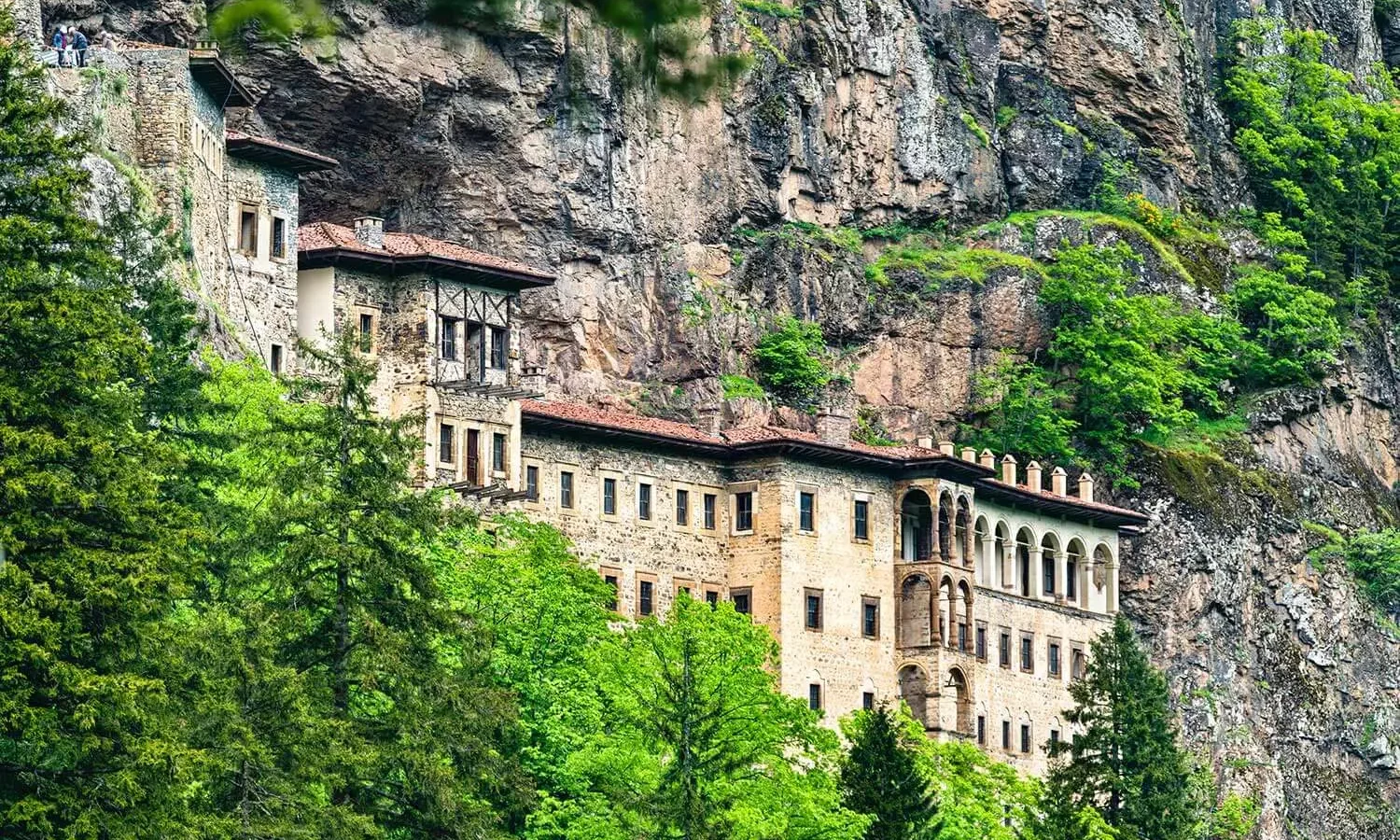
Sumela is a Greek Orthodox monastery dedicated to the Virgin Mary, built into a cave and along a ledge of a sheer cliff above the Altındere valley, south of Trabzon. In Turkish it is often called simply Meryem Ana, “Mother Mary”. From the valley floor you see a long, many-windowed façade that seems to hang from the rock, with forest below and above.
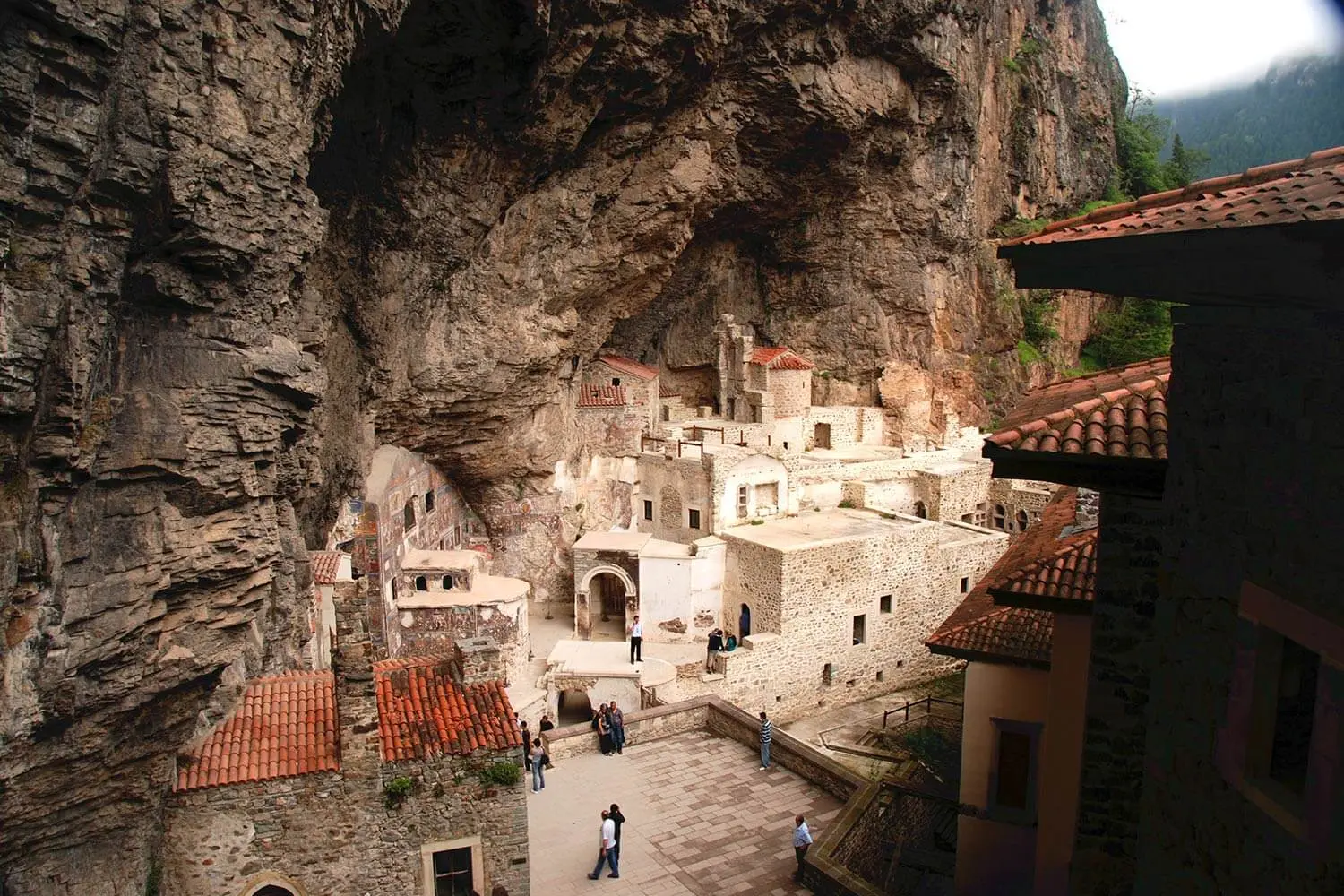
The complex held a rock church, chapels, a kitchen and refectory, monks’ cells, a guesthouse, a library and a holy spring. Its interiors are covered in frescoes. Monks left in 1923, and for most of the century that followed the buildings stood empty. Today it is a museum run by the Ministry of Culture and Tourism and the most visited sight in the eastern Black Sea, with more than 514,000 visitors in 2025.
How do you get to Sumela Monastery?
Sumela is about 45 km south of Trabzon. Take the road towards Gümüşhane as far as Maçka, then turn into Altındere National Park and follow the stream up the valley to the visitor area at the end of the road. By car or taxi the drive takes about an hour; tour minibuses run daily from central Trabzon in season.
From the valley you reach the monastery either on the forest footpath or by the shuttle vehicles that run up the slope, then on foot for the final section and the steps down into the courtyard. The 2002 inventory describes the walk as zigzagging up for about 45 minutes and calls the last part quite a hard climb, so wear proper shoes. Opening hours change between summer and winter, so check them before you set out.
Book a Sumela Monastery tour
−5% Istambul readers save 5% on every tour below — applied at checkout.
Partner listings via GetYourGuide · free cancellation on most
When is the best time to visit Sumela Monastery?
May to October is the best period, when the path is dry, the valley is green and all areas are normally open. Arrive at opening time or in the late afternoon in July and August, when tour groups and Turkish holidaymakers crowd the narrow courtyard at midday. Mist often fills the valley and can hide the façade from below, but it also makes for the classic photograph of the monastery floating above the clouds. In winter the path can be icy, and maintenance work sometimes brings temporary closures, as in June 2026.
What is the history of Sumela Monastery?
The 2002 inventory traces the story of the monastery’s foundation to the 4th century AD. Tradition credits two monks from Athens, Barnabas and Sophronios, who came here with an icon of the Virgin said to have been painted by St Luke. The Ministry of Culture and Tourism gives the traditional date as AD 385.
The monastery was restored and enlarged in the 6th century and took its present form in the 13th, under the Komnenian emperors of Trebizond. Alexios III (1349–1390) was its most important patron: a chrysobull of 1365 confirmed its autonomy and tax exemptions, and frescoes from his era line the inner wall of the rock church.
The Ottoman sultans kept its privileges after Mehmed II took Trebizond in 1461. According to the Ministry, Yavuz Sultan Selim granted land and gold after being treated by its monks, and by the 19th century the monastery’s holdings reached 15 villages.
After the population exchange between Greece and Türkiye, the community left in 1923, and in 1930 refugees from Pontus founded a new Panagia Soumela monastery on Mount Vermio in northern Greece. In 2010 Ecumenical Patriarch Bartholomew led the first liturgy here since 1923.
In September 2015 the monastery closed because of rockfall risk, and restoration began in February 2016. Parts reopened in 2019, 2020 and 2021; then a 360-tonne rock mass above the entrance forced another closure from November 2021. After it was anchored to the slope with 16-metre steel piles, the whole monastery reopened on 1 May 2022, including areas visitors had never seen before.
What is Sumela Monastery famous for?
- Its setting. Few buildings anywhere are so completely part of a cliff. The monastery stands roughly 250 metres above the valley floor, according to the Ministry.
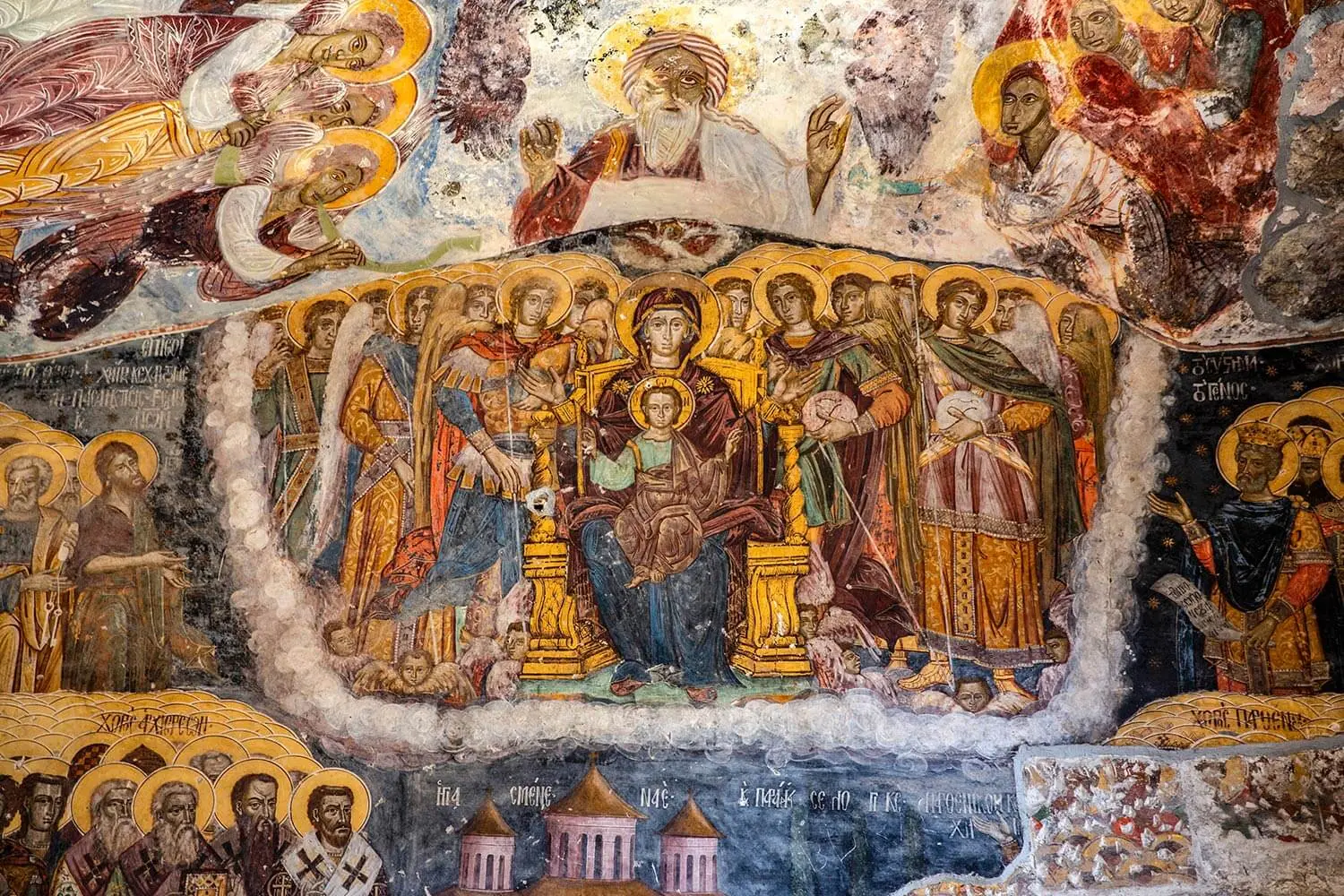
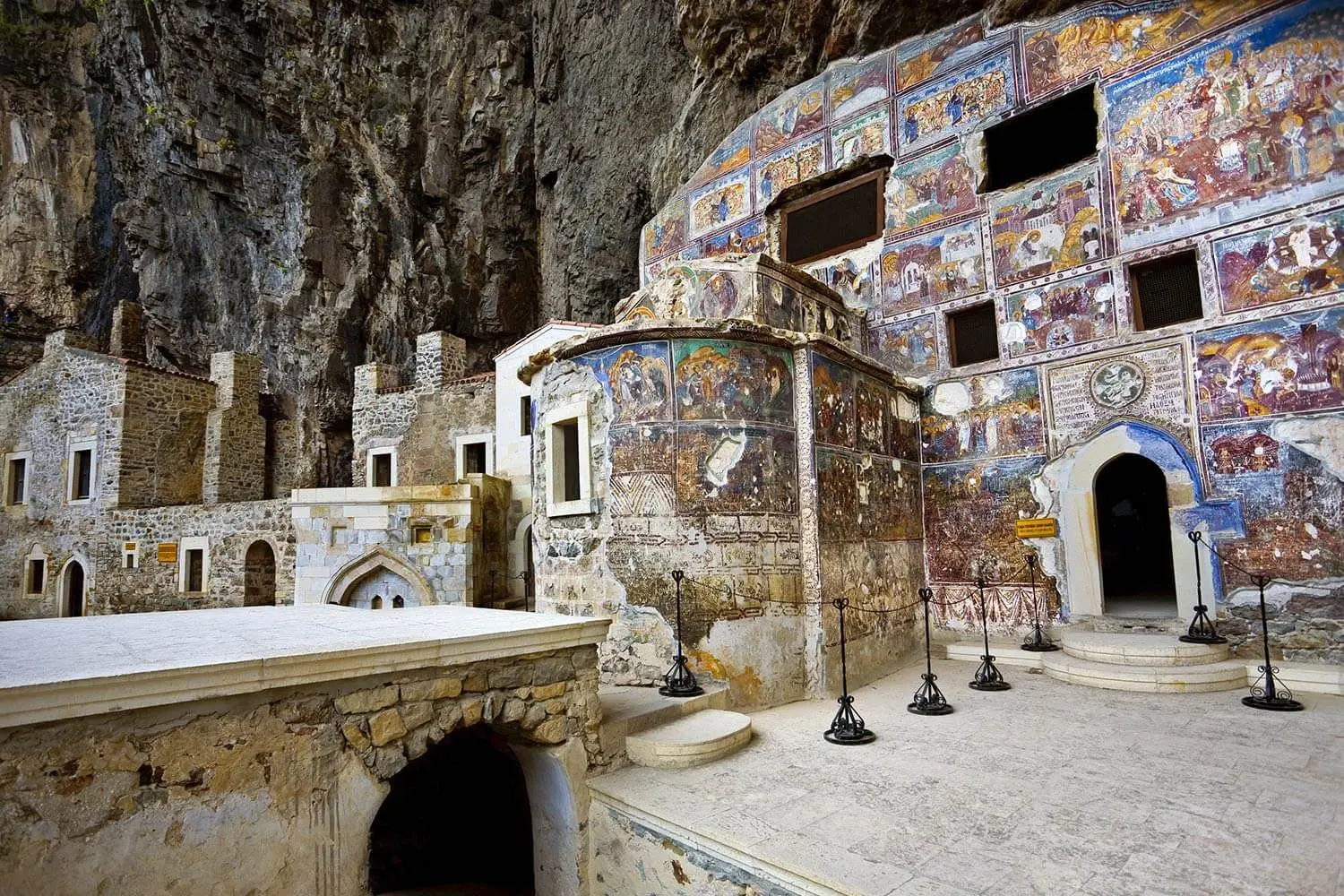
- Frescoes. The rock church and chapels are painted inside and out with scenes from the Bible, painted in several phases; the chapel frescoes date mostly from the early 18th century.
- The Panagia icon. The miracle-working icon of the Virgin, attributed by tradition to St Luke, made Sumela one of the great pilgrimage sites of the Orthodox world.
What can you see at Sumela Monastery?
The rock church. The heart of the monastery is a natural cave turned into a church. Its walls inside and out are covered in frescoes; the inventory describes this first section as decorated with subjects taken from the Bible.
The chapels uncovered in restoration. Since 2022, visitors can enter areas closed for the whole of the monastery’s museum history, including ten chapels to the right of the main rock church, a bell tower, a guesthouse, monk and student cells and cellars. Frescoes that had been covered were cleaned and are now visible. A further chapel found during the works, reached by a footpath, was still closed at the time of the reopening.
The residential block. The inventory describes the second section as four storeys of bedrooms, halls, libraries, larders, food stores and latrines. Officials put the number of rooms at 72.
The holy spring and aqueduct. Water from the mountain was brought in on the arches of an aqueduct along the cliff, and the spring (ayazma) inside was considered holy.
Altındere National Park. The approach valley is protected forest, with the Altındere stream, picnic areas and walking paths. The inventory notes that the drive through Maçka also offers a view of village life that is rare elsewhere.



Frequently asked questions about Sumela Monastery
Is Sumela Monastery open now?
Yes. It reopened fully on 1 May 2022 and has stayed open apart from short maintenance closures, the most recent from 8 to 16 June 2026. Rockfall work can close it at short notice, so check before you travel.
How far is Sumela from Trabzon?
About 45 km, roughly an hour by road via Maçka. The last stretch follows the Altındere valley through the national park.
How long does it take to visit Sumela?
Allow two to three hours on site, including the walk or shuttle up from the valley and time inside. Most people combine it with a half-day trip from Trabzon.
Is the walk to Sumela difficult?
The forest path from the valley floor is steep in places; the inventory puts the zigzag walk at about 45 minutes. Shuttles from the valley shorten it, but you still climb steps at the monastery itself.
Is there a church service at Sumela?
In 2010 the first Orthodox liturgy since 1923 was held at Sumela on 15 August, the Feast of the Dormition, and it has been repeated in later years with official permission. Entry that day is limited.
What do the official records say about Sumela Monastery?
It is 45 km from the city centre and can be reached by passing through the district of Maçka and Altındere National Park. As well as photo safaris, it is one of the rare places where village social life can also be seen. The monastery is reached by zigzagging for about 45 minutes. It is also possible to reach the monastery, which requires quite a hard climb (15 minutes), by car.
Within the monastery complex, whose foundation story goes back to the 4th century AD, there are a refectory, a kitchen, monks’ rooms, a holy spring (ayazma) and a rock church. The monastery consists of two parts. The first part is the one built first, and the inside and outside of the place of worship are decorated with frescoes of subjects taken from the Bible. The second part consists of four storeys containing bedrooms, halls, libraries, larders, food stores and latrines. (Ministry of Culture and Tourism, Trabzon Provincial Tourism Inventory, 2002)
Ready to see Sumela Monastery?
Hand-picked tours with good reviews and clear prices.
Partner listings via GetYourGuide · free cancellation on most
Before or after: Istanbul
Most trips start or end in Istanbul. Our own experiences there:

 Dinner, sunset and day cruises between Europe and Asia.See cruises bosporuscruise.com

 Historic Turkish baths in the old city — hand-picked hamams, booked direct.Book a hamam istanbulhamam.com

 Istanbul’s tallest viewpoint: both continents from 369 metres.Get tickets camlicatower.com

 Free audio guides in 15 languages, safe routes and local tips — plus 5% off GetYourGuide.Open the free guide localada.com
Nearby
All destinations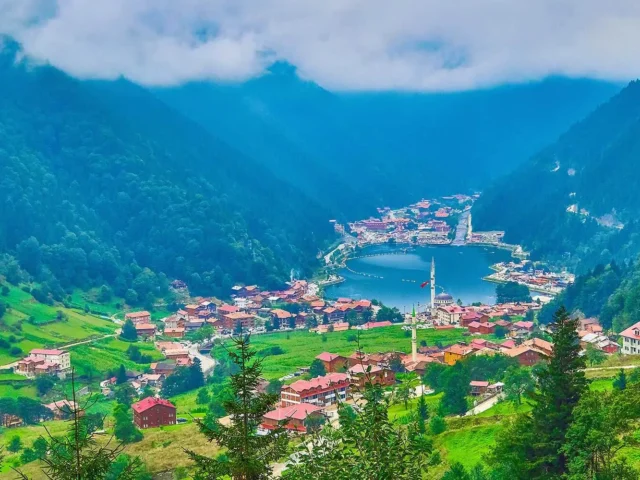
Uzungöl
Uzungöl in Çaykara, Trabzon: how a landslide made the lake,…

Atatürk Mansion, Trabzon
The Atatürk Mansion in Trabzon: a banker’s summer house at…
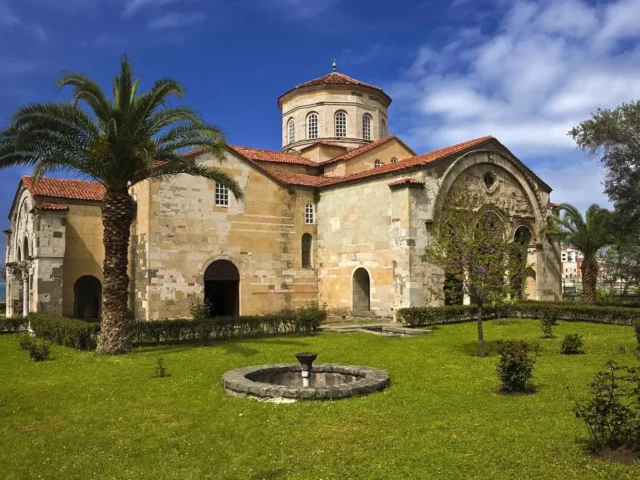
Hagia Sophia of Trabzon
Hagia Sophia in Trabzon: the 13th-century church of the Empire…
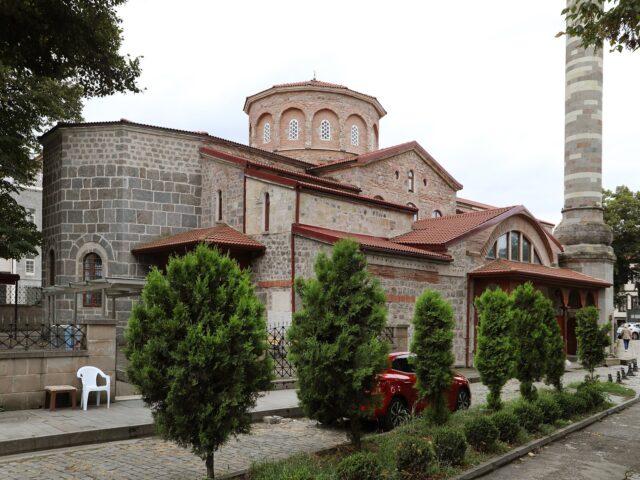
Trabzon
Trabzon travel guide: Sumela Monastery, the Hagia Sophia of Trebizond,…
