
Karabük: Safranbolu, Canyons and the Steel City
On this page
- What is Karabük?
- How do you get to Karabük?
- Where should you stay in Karabük?
- What type of climate does Karabük have?
- When is the best time to visit Karabük?
- What is the history of Karabük?
- What is Karabük famous for?
- What are the historical places of Karabük?
- What are the best things to do in Karabük?
- What are the best places to visit in Karabük?
- What is the traditional food of Karabük?
- What should you buy in Karabük?
- Frequently asked questions about Karabük
- What do the official records say about Karabük?
Key facts: Karabük
- UNESCO World Heritage: The City of Safranbolu, inscribed in 1994 for its Ottoman houses, bazaars and caravan-trade townscape (UNESCO).
- Region: Western Black Sea, inland from the coast, between Bartın, Kastamonu, Çankırı, Bolu and Zonguldak.
- Best known for: Safranbolu’s timber-framed mansions, the canyons and caves around it, and the steelworks that founded the modern city of Karabük in the 1930s.
What is Karabük?
Karabük is a small province in the western Black Sea region of Türkiye, and also the name of its capital. Most travellers know it through one town: Safranbolu, 8 km north of the provincial centre, whose Ottoman houses and bazaars were inscribed by UNESCO as a World Heritage Site in 1994.
The city of Karabük itself is a different place altogether. It was built in the 1930s around one of the Republic’s first iron and steel works, and its official tourism inventory opens by calling it one of the earliest examples of planned industrialisation and urbanisation in republican Türkiye. Karabük became a province in its own right in 1995, carved out of Zonguldak.
Beyond those two towns, the province is mostly forest and upland: more than half of it is wooded, cut by canyons such as Tokatlı, and dotted with yayla (summer pastures), rock tombs and village mosques. The Roman city of Hadrianopolis near Eskipazar has become the province’s second major draw since excavations began in 2003.
Places to visit in Karabük
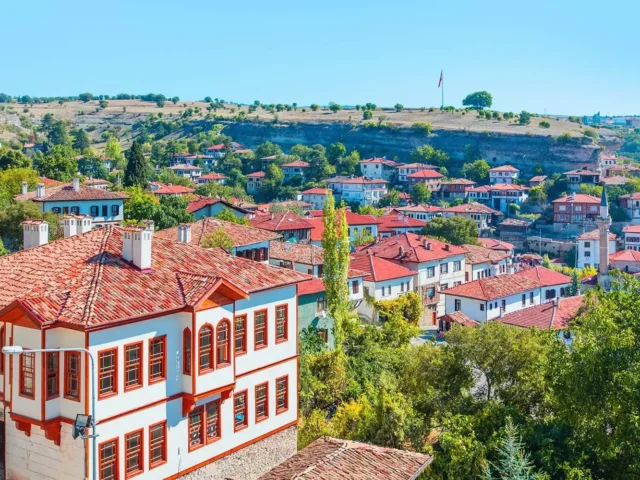
Safranbolu
Safranbolu, the UNESCO-listed Ottoman town: Çarşı bazaar, Cinci Han, Köprülü Mosque, house…
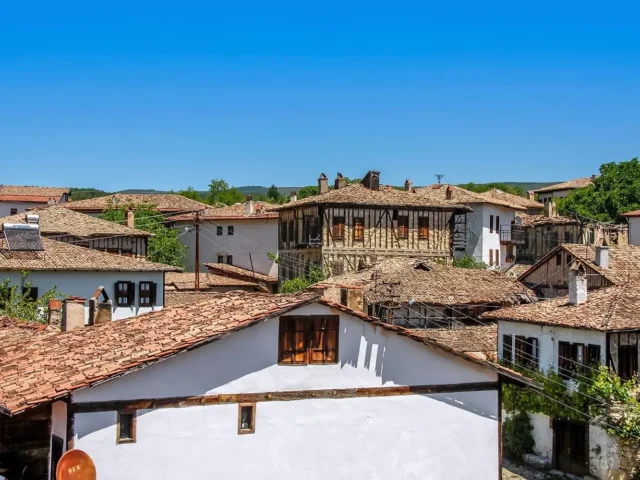
Yörük Village
Yörük Village near Safranbolu: a protected Turkmen village of whitewashed Ottoman houses,…
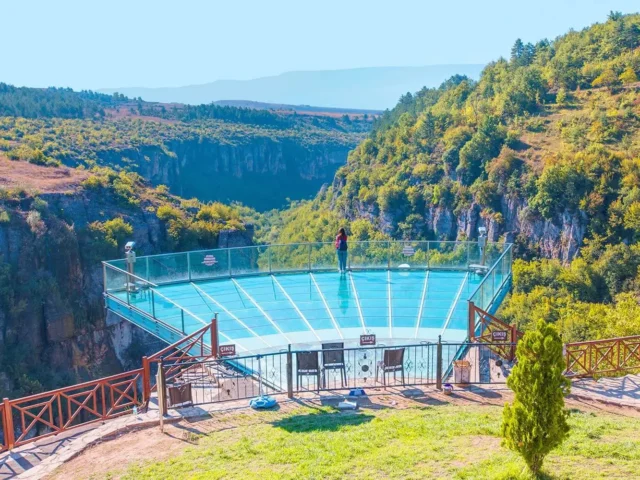
Tokatlı Canyon
Tokatlı Canyon near Safranbolu: the glass Crystal Terrace 80 m above the…
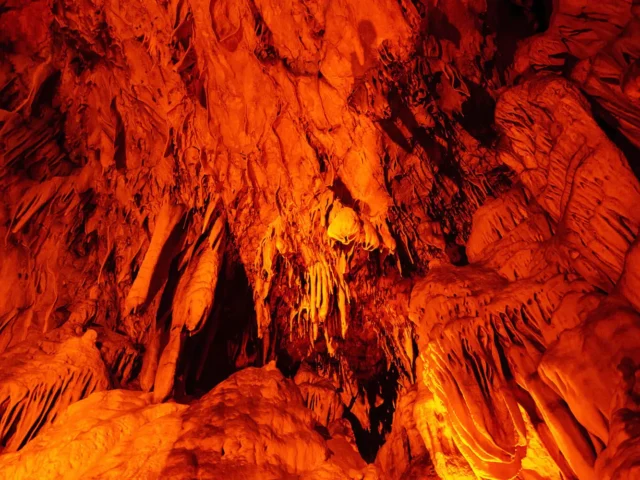
Bulak (Mencilis) Cave
Bulak (Mencilis) Cave near Safranbolu: a 6.5 km karst cave with a…
Hadrianopolis
Hadrianopolis near Eskipazar, Karabük: Roman and Byzantine baths, churches and mosaics of…
How do you get to Karabük?
By air: Karabük has no airport of its own. The closest is Kastamonu Airport, roughly 90 km from Safranbolu, with Turkish Airlines flights from Istanbul Airport; the flight takes about an hour and a quarter. Zonguldak Airport near Çaycuma, about 100 km away, also has flights from Istanbul. Many visitors fly into Ankara Esenboğa instead and continue by road; Safranbolu is about 220 km from Ankara.
By road: Most people arrive by intercity coach. Safranbolu is around 400 km from Istanbul, roughly five to six hours, and coaches from Istanbul and Ankara stop at Karabük and Safranbolu. Minibuses and municipal buses link Karabük city centre with Safranbolu’s old bazaar (Çarşı) in about 15 minutes.
By rail: Karabük station lies on the old Ankara–Zonguldak line. Regional trains run several times a day between Karabük and Zonguldak, a journey of about three hours. Between June and November the seasonal Turistik Karaelmas Ekspresi runs on selected weekends from Ankara to Zonguldak with a stop in Karabük.
Where should you stay in Karabük?
Stay in Safranbolu. Dozens of the old mansions in the Çarşı district have been converted into guesthouses and small hotels, with low wooden ceilings, built-in cupboards and the original room layouts. Rooms are often small and stairs are steep, but a night in one is the best way to understand how these houses worked. The 17th-century Cinci Han, a stone caravanserai in the centre of the bazaar, is also a hotel.
Bağlar, the higher garden suburb of Safranbolu, has quieter houses in larger gardens and is easier for drivers. Karabük city has modern business hotels near the station and is practical if you arrive late by train or bus. Yörük Village has a few village guesthouses for a quieter night.
Book a Karabük tour
−5% Istambul readers save 5% on every tour below — applied at checkout.
Partner listings via GetYourGuide · free cancellation on most
What type of climate does Karabük have?
Karabük sits in a basin south of the coastal mountains, so it is drier and sunnier than the Black Sea coast. Summers are warm to hot, and July and August afternoons often climb past 30°C in the valleys. Winters are cool and damp, with occasional snow, especially on the plateaus around Eflani and Ovacık. Safranbolu’s old town is in a deep, sheltered valley, which is exactly why its winter houses were built there and the summer houses up on the slopes of Bağlar.
When is the best time to visit Karabük?
May, June, September and October are the best months. The streets of Safranbolu are pleasant for walking, the canyons and yayla are green, and the light on the tiled roofs is good for photography. Late October brings the saffron harvest and Safranbolu’s saffron events.
Safranbolu is one of the most popular weekend destinations in northern Türkiye, so Saturdays and public holidays are busy. Come midweek if you can. Winter is quiet and atmospheric, with snow on the roofs, but some upland roads close and the canyon walks get muddy.
What is the history of Karabük?
Karabük lies in the ancient region of Paphlagonia. According to the 2002 provincial inventory, the province has 32 tumuli and four large mounds, and most of the 116 rock tombs recorded across Paphlagonia are in and around Karabük. These tombs date mainly from the 2nd and 3rd centuries AD, in the Roman period, with some later Byzantine examples.
The inventory describes the first rescue excavations in the province, carried out by the Çankırı Museum Directorate in April 1999. South of Bulak village, a tumulus revealed a tomb chamber and dromos (entrance passage) built of large cut stones without mortar, held together with bronze or copper clamps, with a barrel-vaulted roof. Inside were fragments of perfume and tear bottles and two finger bones; outside, in front of the dromos, lay a damaged stone carved with a lion. A second dig at Çavuşlar village near Safranbolu uncovered a building thought to be an Early Byzantine church.
In the Roman era the main city in the south of the province was Hadrianopolis, near Eskipazar, named after Emperor Hadrian in the 2nd century AD. Safranbolu, known to the Byzantines as Dadybra, came under Turkish rule in the late 12th century and grew into an important stop on the caravan routes by the 13th century. In the 17th century it flourished: the Cinci Han and Cinci Hamam, the Köprülü Mehmet Pasha Mosque (1661–62) and many of its mansions date from this period and the two centuries that followed.
The province’s modern history begins in the 1930s, when the young Republic chose Karabük, then a small settlement, as the centre of its new iron and steel industry. The works were built in 1939 and created the city almost from scratch; they still operate today as Kardemir.
What is Karabük famous for?
- Safranbolu’s Ottoman houses. Roughly 2,000 traditional houses from the 18th to early 20th centuries, about 800 of them under legal protection according to the 2002 inventory.
- Saffron. The town takes its name from the crocus spice, which is still grown at Davutobası east of Safranbolu.
- Safranbolu lokum. Turkish delight, often flavoured with saffron, sold all over the bazaar.
- Steel. Karabük was the first heavy-industry city of the Republic, and Kardemir’s works still dominate the centre.
- Canyons and caves. Tokatlı Canyon with its glass viewing terrace, Bulak (Mencilis) Cave, and the canyons of Yenice’s forests.
What are the historical places of Karabük?
Safranbolu’s mosques and tombs. The 2002 inventory lists more than a dozen historic mosques in Safranbolu alone. The Köprülü Mosque was built by the grand vizier Köprülü Mehmet Pasha and opened for worship in 1661/62; its courtyard has a sundial, a timekeeper’s room (muvakkithane) and an ablution fountain. The İzzet Mehmet Pasha Mosque of 1796, built of cut stone by a grand vizier who was born in Safranbolu, is described in the inventory as a small model of Istanbul’s Nuruosmaniye Mosque. Hıdırlık Hill (the Namazgah) above the town has an open-air prayer place with two stone mihrabs, the octagonal tomb of Hasan Pasha (1845) and one of the best views over the old town.
Kıranköy church. In Kıranköy, Safranbolu’s former Greek quarter, the church of St Stephen was repaired in 1872 and converted into a mosque, the Ulu Cami, in 1956.
Rock tombs. The inventory records rock-cut tombs along the Soğanlı stream and around Safranbolu, Eskipazar and Ovacık. The Gerdek Boğazı tomb near Pürçükören, Ovacık, has a pedimented entrance and three interconnecting rooms, with ceilings carved to imitate timber beams and column capitals decorated with palm leaves. At Budaklar near Eskipazar, the Deliklikaya tombs are arranged in two rows of seven and six chambers.
Hadrianopolis and Kimistene. The Roman and Early Byzantine city near Eskipazar has baths, two churches with mosaic floors, a theatre and rock tombs. The nearby settlement of Kimistene (Asar Tepe) produced a temple and a series of Greek funerary inscriptions.
Küre-i Hadid Mosque, Eflani. The most important historic mosque in Eflani, built in 1451 for İsmail Bey of the İsfendiyaroğulları (Candarid) dynasty, according to its inscription.
Museums. Safranbolu’s City History Museum occupies the old government house on the castle hill, built in 1904–06 and opened as a museum in the mid-2000s. Kaymakamlar Museum House shows a furnished mansion. In Karabük city, the inventory lists Kardemir’s Iron and Steel Museum, set up in 1984 with photographs and equipment from the founding of the works and its first iron production.
What are the best things to do in Karabük?
- Walk the Çarşı and Bağlar districts of Safranbolu, and climb Hıdırlık Hill at sunset.
- Visit a house museum. Kaymakamlar House and other open mansions show the harem and selamlık rooms, carved ceilings and built-in cupboards.
- Take a Turkish bath at the Cinci Hamam, still working, with separate sessions for men and women.
- Stand on the glass terrace over Tokatlı Canyon and walk the trail along the canyon floor.
- Go underground at Bulak (Mencilis) Cave, about 10 minutes by car from Safranbolu.
- Hike the forests of Yenice. Şeker Canyon, roughly 6.5 km long, and the linden-shaded viewing terrace at Ihlamur are the best-known spots in the Yenice forests.
- Go up to the yayla. The inventory lists Sarıçiçek Yayla at 1,700 m, with coniferous forest, cycling and camping, and Uluyayla at 1,100 m, a flat meadow 6.5 km long with a pond and picnic areas. Dede Yayla near Kulat village holds a commemoration for Bahattin Gazi each July.
- Time your visit for the Saffron Festival in October, with harvest events, food and exhibitions in Safranbolu.
What are the best places to visit in Karabük?
Safranbolu: the UNESCO-listed Ottoman town, with its timber-framed houses, bazaars, mosques, caravanserai and baths.
Yörük Village: a small Turkmen village about 11 km east of Safranbolu, protected since 1997, with 93 registered historic buildings and an old communal laundry.
Tokatlı Canyon: a limestone gorge north of Safranbolu, with the 18th-century İncekaya Aqueduct and a glass terrace about 80 m above the canyon floor.
Bulak (Mencilis) Cave: a multi-level karst cave northwest of Safranbolu, with about 400 m of lit walkway.
Hadrianopolis: the Roman and Early Byzantine city near Eskipazar, known for church mosaics showing the four rivers of Paradise and a menagerie of animals.
Also worth seeing: the Iron and Steel Museum in Karabük, the Küre-i Hadid Mosque in Eflani, and the Yenice forests with Şeker Canyon.
What is the traditional food of Karabük?
Home cooking in Safranbolu leans on what households used to put by for winter: grape molasses (pekmez), tarhana, homemade erişte noodles, tomato paste and vine leaves for stuffing. Kuyu kebabı, lamb slow-cooked in a pit oven, is associated with the southern part of the district, and keşkek, wheat pounded with meat, is cooked in wood-fired ovens for religious holidays. Breakfasts come with thin, handmade yufka bread. Finish with saffron tea and a plate of lokum.
What should you buy in Karabük?
Safranbolu lokum in every flavour, saffron (check that it is local; much of what is sold is imported), and handmade leather goods from the Yemeniciler Arastası, the old shoemakers’ arcade where yemeni slippers have been made for centuries. The inventory notes that master yemeni-maker Ahmet Demirezen set up a small museum of the trade’s tools in shop no. 3 of the arcade in 1989. The blacksmiths’ bazaar (Demirciler Çarşısı) still has working forges, and the Sipahioğlu Arastası sells copper and wooden crafts.



Frequently asked questions about Karabük
Is Safranbolu in Karabük province?
Yes. Safranbolu is a district of Karabük province, about 8 km north of Karabük city. Karabük became a separate province in 1995; before that both were in Zonguldak.
What is the nearest airport to Karabük and Safranbolu?
Kastamonu Airport, about 90 km from Safranbolu, and Zonguldak Airport near Çaycuma, about 100 km away; both have flights from Istanbul. Ankara Esenboğa is about 220 km away.
How many days do you need in Karabük?
Two days cover Safranbolu, Yörük Village, Tokatlı Canyon and Bulak Cave. Add a third for Hadrianopolis near Eskipazar or the Yenice forests.
Can you reach Karabük by train?
Yes. Karabük station is on the Ankara–Zonguldak line, with regional trains to Zonguldak several times a day and a seasonal tourist train from Ankara on selected weekends.
When is the best time to visit Safranbolu?
May–June and September–October. Weekdays are much quieter than weekends, and late October coincides with the saffron harvest.
What is Karabük famous for?
Safranbolu’s UNESCO-listed Ottoman houses, saffron and lokum, and the steelworks that created the modern city in the 1930s.
What do the official records say about Karabük?
Besides being one of the first examples of planned industrialisation and urbanisation under the Republic, Karabük also has wide potential in tourism. With its important historical monuments, canyons, aqueducts, rock tombs, caves, highland pastures of unique beauty and the historic Safranbolu houses, the province is an example of the strong tourism potential of the Black Sea Region.
The province’s highland pastures, rich forests, flora and fauna, outstanding landscapes and medicinal herbs make it a tourism paradise. Walking in cool, clean, oxygen-rich air for a healthy life, living for a short while with people in the countryside, pitching a tent, sitting and talking around a campfire, watching and photographing wild animals in their natural surroundings and studying plant species offer people a different atmosphere, and the yayla are attracting growing interest. (Ministry of Culture and Tourism, Karabük Provincial Tourism Inventory, 2002)
Ready to see Karabük?
Hand-picked tours with good reviews and clear prices.
Partner listings via GetYourGuide · free cancellation on most
Before or after: Istanbul
Most trips start or end in Istanbul. Our own experiences there:

 Dinner, sunset and day cruises between Europe and Asia.See cruises bosporuscruise.com

 Historic Turkish baths in the old city — hand-picked hamams, booked direct.Book a hamam istanbulhamam.com

 Istanbul’s tallest viewpoint: both continents from 369 metres.Get tickets camlicatower.com

 Free audio guides in 15 languages, safe routes and local tips — plus 5% off GetYourGuide.Open the free guide localada.com
Nearby
All destinations
Şanlıurfa
Şanlıurfa travel guide: Göbeklitepe, Balıklıgöl, Harran’s beehive houses, Halfeti, the…
Erzincan
Erzincan travel guide: Kemaliye and the Dark Canyon, Urartian Altıntepe,…
Yalova
Yalova travel guide: Termal hot springs, Atatürk’s mansion and Yürüyen…
Niğde
Niğde travel guide: Gümüşler Monastery, the Alaaddin Mosque, Hüdavend Hatun…
