
Bayburt: Castle, Çoruh Valley and the Land of Dede Korkut
On this page
- What is Bayburt?
- How do you get to Bayburt?
- Where should you stay in Bayburt?
- What type of climate does Bayburt have?
- When is the best time to visit Bayburt?
- What is the history of Bayburt?
- What is Bayburt famous for?
- What are the historical places of Bayburt?
- What are the best things to do in Bayburt?
- What are the best places to visit in Bayburt?
- What is the traditional food of Bayburt?
- What should you buy in Bayburt?
- Frequently asked questions about Bayburt
- What do the official records say about Bayburt?
Key facts: Bayburt
- UNESCO: The “Heritage of Dede Qorqud/Korkyt Ata/Dede Korkut, epic culture, folk tales and music”, shared by Azerbaijan, Kazakhstan and Türkiye, was inscribed on the Representative List of the Intangible Cultural Heritage of Humanity in 2018 (UNESCO). The tomb attributed to Dede Korkut is in Masat village, Bayburt. The province has no World Heritage Site.
- Region: Northeastern Türkiye, on the upper Çoruh River and the old Erzurum–Trabzon road, between the Kop and Vavuk passes; the city lies at about 1,550 m.
- Best known for: Bayburt Castle above the Çoruh, the award-winning Baksı Museum, the Dede Korkut tradition, highland pastures and tel helvası.
What is Bayburt?
Bayburt is one of Türkiye’s smallest provinces, a high, open country of plains and bare mountains where Eastern Anatolia meets the Black Sea ranges. Its capital, also called Bayburt, lies on the banks of the young Çoruh River beneath a long castle on a rocky ridge. The 2002 provincial inventory places it on the historic Silk Road between Erzurum and Trabzon, which connected Eastern Anatolia with the Black Sea: the Kop Pass leads to Erzurum, and the Vavuk Pass to Gümüşhane and Trabzon.
Most travellers pass through on the way between Erzurum and the coast, but the province rewards a stop. Bayburt Castle is one of the largest in the region; the Baksı Museum, on a hill above the Çoruh valley, won the Council of Europe Museum Prize in 2014; and Aydıntepe has rock-cut galleries under its streets. Bayburt also claims Dede Korkut, the wise bard of the Oghuz Turkic epics, whose tomb is venerated in Masat village.
Places to visit in Bayburt
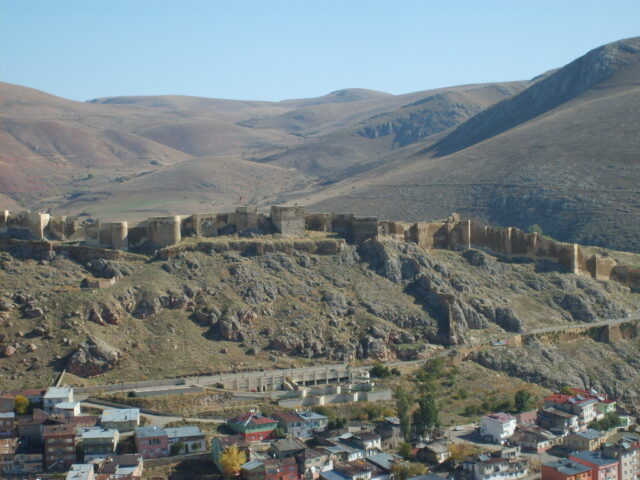
Bayburt Castle
Bayburt Castle: walls over 2 km long on a ridge above the…
Baksı Museum
Baksı Museum near Bayburt: contemporary art and village crafts on a hilltop…
Aydıntepe Underground City
Aydıntepe Underground City in Bayburt: rock-cut galleries and vaulted rooms beneath a…
Sırakayalar Waterfalls
Sırakayalar Waterfalls near Bayburt: two falls in a steppe village, a summer…
How do you get to Bayburt?
By air: Bayburt has no airport yet. A shared Bayburt–Gümüşhane Airport is under construction, but in July 2026 it was reported to be only about a quarter complete. The nearest airports are Erzurum (ERZ), roughly an hour and a half away by road, and Trabzon (TZX), about two and a half hours away; both have direct flights from Istanbul.
By road: Bayburt’s bus terminal, in the south of the city, has coaches to Erzurum, Trabzon, Gümüşhane, Ankara and Istanbul. The road to Erzurum crosses the Kop Pass, and the road to Gümüşhane and Trabzon crosses the Vavuk Pass; both can be affected by snow in winter.
Getting around: The castle and city centre are walkable. For the Baksı Museum, Aydıntepe, Masat and Sırakayalar you need a car or taxi.
Where should you stay in Bayburt?
Bayburt city has a small choice of hotels in the centre, close to the castle and the Çoruh, and it is the practical base for the province. Many visitors combine Bayburt with Erzurum or the Black Sea coast and stay a single night.
The Baksı Museum is in a remote village about 45–50 km from the city; contact the museum in advance if you want to stay overnight there or plan to visit in winter.
Tours in Anatolia
−5% Istambul readers save 5% on every tour below — applied at checkout.
Partner listings via GetYourGuide · free cancellation on most
What type of climate does Bayburt have?
Bayburt has a cold continental climate, shaped by its height of about 1,550 m. January has an average daily maximum just below freezing and a mean of about −5 °C; July has an average daily maximum near 28 °C and a mean of about 19 °C. Winters are long and snowy, and the passes on the roads to Erzurum and Trabzon can close in storms. Summers are dry, sunny and mild, with cool nights.
When is the best time to visit Bayburt?
June to September. The highland pastures (yayla) are open, the Çoruh valley is green, and the roads over the passes are clear. The inventory gives the third week of July for the Dede Korkut Culture and Art Festival, which in recent years has been an international event with folk dance, music and bard contests; check current dates.
Winter brings snow from late autumn into spring. It is the season for tel helvası, the local spun-sugar sweet, but sightseeing at the castle and Baksı is harder.
What is the history of Bayburt?
According to the inventory, the history of the city on the banks of the Çoruh goes back to around 3000 BC. Azzi, Hayasa, Urartian, Cimmerian, Scythian, Median, Persian, Roman, Byzantine, Arab, Seljuk and Ottoman rule followed one another in Bayburt.
The town is probably the Baiberdon that the Byzantine historian Procopius describes being fortified by Emperor Justinian in the 6th century, and excavations at the castle have found two cisterns from his reign. The Seljuks raided the area in 1054, and after Manzikert in 1071 it passed into Turkish hands. In the early 13th century Mugisüddin Tuğrulşah, the Seljuk ruler of Erzurum, rebuilt the castle. Marco Polo visited Bayburt in the 13th century.
After a period under the Akkoyunlu, Bayburt passed to the Ottomans in 1514, and its castle was repaired under Süleyman the Magnificent and Murad III. Evliya Çelebi, visiting in 1647, wrote of a quarter of 300 houses inside the walls. In the Russo-Turkish war of 1828–29 Russian forces under General Paskevich captured the town and largely destroyed the fortifications.
In 1916, after the Russian capture of Erzurum, the Ottoman army held the Kop heights between Bayburt and Erzurum from March to July. Some 9,700 Ottoman soldiers died. On the centenary, 31 October 2016, the battlefield was declared the Mount Kop Defence National Historic Park, shared between Bayburt and Erzurum provinces. Bayburt became a province in its own right in 1989.
What is Bayburt famous for?
Bayburt Castle. Walls more than 2 km long on a steep ridge above the Çoruh, described by its excavators as Türkiye’s third-largest settlement castle.
Dede Korkut. The tomb attributed to Dede Korkut, the bard and sage of the Book of Dede Korkut, stands in Masat village, about 30 km from the city, and was restored in 1994. The epic tradition is on UNESCO’s Intangible Cultural Heritage list.
The Baksı Museum. Contemporary art and village crafts in a building on a hilltop above the Çoruh, founded by the artist Hüsamettin Koçan in his home village.
Weaving. The inventory notes that marble and copper working and kilim and ehram weaving are important in Bayburt, and that the kilim motifs are original to the province.
What are the historical places of Bayburt?
Bayburt Castle. Built on sheer rock north of the city. The inventory notes that it is not known for certain who built it, and that before the Turks took it, it was held by the Romans, Byzantines, Arabs and the Komnenoi of Trebizond.
Aydıntepe Underground City. Galleries and vaulted rooms carved 2–2.5 m below the surface into tuff, beneath the town of Aydıntepe.
Dede Korkut Tomb. In Masat village, the centre of the annual festival.
Village mosques. The inventory names the Ferhat Bey Mosque in Pulur (Gökçedere) and the Kutlu Bey Mosque in Sünür (Çayıryolu), together with the Dede Korkut Tomb, as the most important religious buildings in the province.
Other castles. The inventory lists Bayrampaşa Castle, thought to have been built as a watchtower; Saruhan Castle, 35 km from the city, thought to be one of 75 castles built for defence across the Gümüşhane–Kelkit–Bayburt–Erzincan region; and Kitre Castle, another lookout.
Mounds. Excavations at Çiftetaş-II hill took place in 1993–95. Many other mounds, including Yazıbaşı, Çorakköy, the Kitre tumulus and Akşar, have been declared archaeological sites but not excavated.
Mount Kop Defence National Historic Park. The 1916 battlefield on the Erzurum road, with a memorial on the summit erected in 1963, restored trenches and war graves, and a visitor centre and museum built since 2018.
What are the best things to do in Bayburt?
- Walk the castle walls. Climb from the Çoruh to the ridge for views over the town and the river.
- Visit the Baksı Museum. Contemporary art and Anatolian crafts on a hilltop above the Çoruh valley.
- Go up to the yayla. The inventory calls Bayburt very rich in highland pastures, among them Kop Dağı, Sultan Murat, Aydıntepe, Yazyurdu, Yoncalı, Çavdar and many others.
- Raft or canoe the Çoruh. The Çoruh rises in two branches, from the Mescit and Otlukbeli mountains, which join below Dikmetaş village. The inventory notes that canoeing and rafting are done on the stretch from Dikmetaş to Aslandede, where the river leaves the province.
- Fish for trout. The inventory names the Masat, Kopuz, Beşpınar, Ozansu, Yoncalı, Yazyurdu, Kılıçkaya and Çatıksu streams as rich in trout.
- Trek the high mountains. The Kemer, Soğanlı, Kop, Otlukbeli and other ranges rise to between 2,000 and over 3,000 m and, the inventory says, suit horse riding, mountain walking and hiking.
- See the Helva ice cave. In Helva village, south of the Masat valley and 33 km from the city, a cave with ice stalactites and stalagmites that villagers have used as a cold store.
- Attend the Dede Korkut festival. Held in July, with a visit to the tomb in Masat, concerts and folk performances.
What are the best places to visit in Bayburt?
Bayburt Castle stretches along the rocky ridge above the Çoruh in the city itself; excavations since 2017 have revealed Justinian-era cisterns and an 11th-century church.
Baksı Museum brings contemporary art and traditional crafts together in Bayraktar village, and won the Council of Europe Museum Prize in 2014.
Aydıntepe Underground City is a network of rock-cut galleries and rooms under a district town, probably of the Roman period.
Sırakayalar Waterfalls are two waterfalls in a village off the Erzurum road, a summer picnic spot that freezes in winter.
Also worth your time: the Dede Korkut Tomb in Masat, the Kop battlefield park on the way to Erzurum, and the road north over the Vavuk Pass towards Trabzon. Erzincan lies to the south.
What is the traditional food of Bayburt?
The inventory notes that the general feature of Bayburt’s local dishes is that flour-based dishes and meat dishes come in more varieties than vegetable and olive-oil dishes. Among them are tel helvası, tatlı çorba (sweet soup), galaçoş, ekşi lahana (sour cabbage), lor dolması (dumplings with curd cheese) and yalancı dolma.
Tel helvası is a fine, thread-like halva made in winter; local makers say it needs cold, snowy weather to set properly. Bayburt ketesi, a buttery bread baked in a tandır oven and eaten at breakfast, was registered as a geographical indication in 2021.
What should you buy in Bayburt?
Ehram. A woollen weave particular to the region. The inventory notes that waistcoats, tablecloths, bedspreads, prayer rugs, curtains and even ties made from ehram are of interest.
Kilims. Woven with motifs that the inventory describes as Bayburt’s own and original.
Tel helvası and kete. Both travel well and are sold in the city centre.



Frequently asked questions about Bayburt
Is Bayburt worth visiting?
Yes, as a stop between Erzurum and the Black Sea: the castle, the Baksı Museum, Aydıntepe’s underground galleries and the Dede Korkut tomb can fill one or two days.
Does Bayburt have an airport?
Not yet. The Bayburt–Gümüşhane Airport is under construction; use Erzurum (about 1.5 hours) or Trabzon (about 2.5 hours).
Where is Dede Korkut’s tomb?
In Masat village, about 30 km from Bayburt city. It is the focus of the Dede Korkut festival held in July.
What is the Baksı Museum?
A museum of contemporary and traditional art founded by the artist Hüsamettin Koçan in Bayraktar village, about 45 km from Bayburt. It won the Council of Europe Museum Prize in 2014.
What food is Bayburt known for?
Tel helvası, a thread-like winter halva, and Bayburt ketesi, a tandır-baked bread with geographical-indication status; tatlı çorba and lor dolması are also local.
When is the best time to visit Bayburt?
June to September, when the highland pastures are open and the mountain passes are free of snow.
What do the official records say about Bayburt?
Bayburt is on the historic Erzurum–Trabzon Silk Road, which connects Eastern Anatolia to the Black Sea. It is linked to Erzurum by the Kop Mountain pass, and to Gümüşhane and Trabzon by the Vavuk Mountain pass. The history of the city, on the bank of the Çoruh River, goes back to 3000 BC. Azzi, Hayasa, Urartian, Cimmerian, Scythian, Median, Persian, Roman, Byzantine, Arab, Seljuk and Ottoman rule held sway in Bayburt.
In Bayburt, marble and copper working and kilim and ehram weaving are important. The kilim motifs produced in particular belong to Bayburt and are original. Ehram weaving is also a weave particular to the region. (Ministry of Culture and Tourism, Bayburt Provincial Tourism Inventory, 2002)
Ready to see Bayburt?
Hand-picked tours with good reviews and clear prices.
Partner listings via GetYourGuide · free cancellation on most
Before or after: Istanbul
Most trips start or end in Istanbul. Our own experiences there:

 Dinner, sunset and day cruises between Europe and Asia.See cruises bosporuscruise.com

 Historic Turkish baths in the old city — hand-picked hamams, booked direct.Book a hamam istanbulhamam.com

 Istanbul’s tallest viewpoint: both continents from 369 metres.Get tickets camlicatower.com

 Free audio guides in 15 languages, safe routes and local tips — plus 5% off GetYourGuide.Open the free guide localada.com
Nearby
All destinations
Kırıkkale
Kırıkkale travel guide: the Seljuk Çeşnigir Bridge, Hasandede and Haydar…
Niğde
Niğde travel guide: Gümüşler Monastery, the Alaaddin Mosque, Hüdavend Hatun…
Kilis
Kilis travel guide: Ravanda Castle, Oylum Höyük, Mamluk mosques, Kilis…

Kars
Kars travel guide: the UNESCO ruins of Ani, Kars Castle,…
