
Diyarbakır: Black Basalt City on the Tigris
On this page
- What is Diyarbakır?
- How do you get to Diyarbakır?
- Where should you stay in Diyarbakır?
- What type of climate does Diyarbakır have?
- When is the best time to visit Diyarbakır?
- What is the history of Diyarbakır?
- What is Diyarbakır famous for?
- What are the historical places of Diyarbakır?
- What are the best things to do in Diyarbakır?
- What are the best places to visit in Diyarbakır?
- What is the traditional food of Diyarbakır?
- What should you buy in Diyarbakır?
- Frequently asked questions about Diyarbakır
- What do the official records say about Diyarbakır?
Key facts: Diyarbakır
- UNESCO World Heritage: “Diyarbakır Fortress and Hevsel Gardens Cultural Landscape”, inscribed in 2015: the city walls, the inner citadel (İçkale), the Hevsel Gardens and the Ten-Eyed Bridge over the Tigris (UNESCO).
- UNESCO Tentative List: Zerzevan Castle and Mithraeum, submitted in 2020; not inscribed (UNESCO).
- Region: Southeastern Anatolia, on a basalt plateau above the right bank of the Tigris.
- Best known for: Black basalt city walls about 5.8 km long, the Great Mosque, Ottoman hans, and liver kebab eaten late at night.
What is Diyarbakır?
Diyarbakır is the largest city in southeastern Türkiye and the capital of the province of the same name. Its historic core, the district of Sur, sits inside a ring of black basalt walls on a ledge above the Tigris (Dicle). Below the eastern walls the ground drops to the Hevsel Gardens, a belt of orchards and vegetable plots that has fed the city for centuries, and beyond them the river.
The province is a large, mostly flat stretch of upper Mesopotamia ringed by the Taurus foothills to the north. Its towns include Ergani, near the Neolithic site of Çayönü; Silvan, the medieval Mayyafariqin; Eğil on the Tigris gorge; and Çermik, known for its hot springs. The 2002 provincial inventory describes Diyarbakır as having been, throughout history, the centre of thought, art, culture and science of Southeastern Anatolia, and a trading centre since the earliest ages, a role it still keeps.
For a traveller, the draw is the walled city: the walls themselves, the Great Mosque, basalt mansions, working churches, caravanserais turned into tea gardens, and a food culture that runs late into the night.
Places to visit in Diyarbakır
Diyarbakır City Walls
Diyarbakır City Walls: the UNESCO-listed basalt circuit of 82 towers and four…

Great Mosque of Diyarbakır
Great Mosque of Diyarbakır: the Seljuk-era Ulu Cami with reused Roman columns,…
Ten-Eyed Bridge
Ten-Eyed Bridge (On Gözlü Köprü): Diyarbakır's ten-arched basalt bridge of 1065 over…
Malabadi Bridge
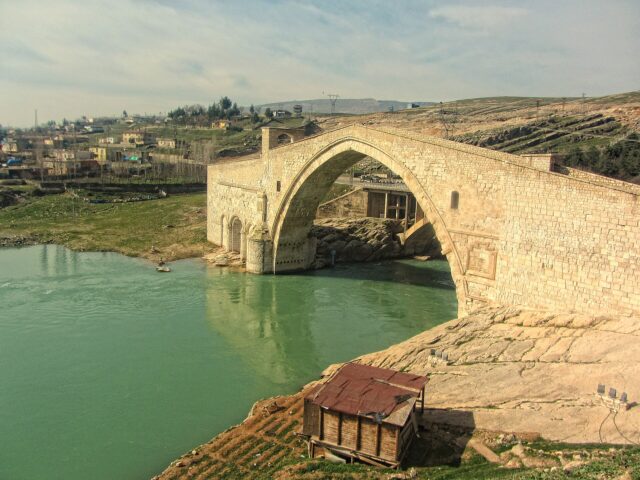
Malabadi Bridge near Silvan, Diyarbakır: the 12th-century Artuqid bridge with a 38.6…
Zerzevan Castle
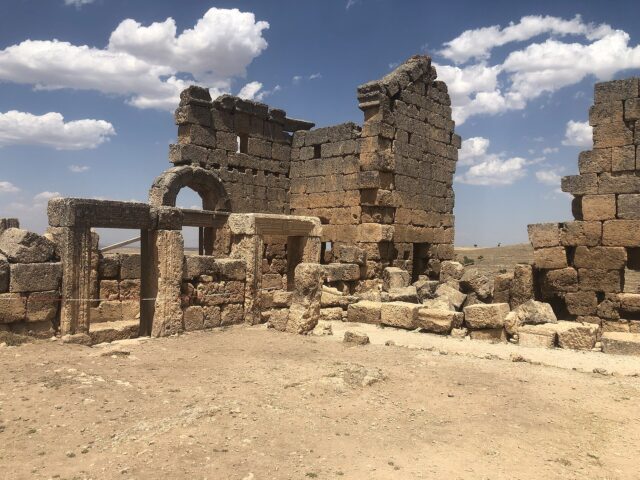
Zerzevan Castle near Çınar, Diyarbakır: a 4th-century Roman frontier garrison with an…
How do you get to Diyarbakır?
By air: Diyarbakır Airport (DIY) is the main airport of the region. Turkish Airlines flies from Istanbul Airport; AJet and Pegasus fly from Sabiha Gökçen and Ankara; Pegasus and SunExpress fly from İzmir, and SunExpress from Antalya. There are also a few international routes, mainly to Germany, some of them seasonal. The airport is on the edge of the city, a short taxi ride from Sur.
By road: Coaches link Diyarbakır with Istanbul, Ankara and every city in the region. Road distances given by the provincial culture and tourism directorate include 94 km to Mardin, 162 km to Elazığ, 263 km to Malatya and 383 km to Van. Minibuses run to Mardin, Batman and Siirt.
By rail: The Elazığ–Diyarbakır railway opened in 1935, and the city is on the line from Ankara east to Kurtalan in Siirt province, served by an overnight train.
Getting around: Sur is best explored on foot. Most sights inside the walls are within a 20-minute walk of each other. Taxis or a hired car are needed for Malabadi Bridge, Zerzevan and Çayönü.
Where should you stay in Diyarbakır?
Stay inside or just outside the walls if you want to walk to the Great Mosque, the hans and the evening food stalls. Sur has a handful of hotels in restored stone buildings, including a caravanserai that the 2002 inventory already listed as converted into a hotel. The modern districts of Yenişehir and Kayapınar, west and northwest of the walls, have larger business hotels with parking, better suited to drivers and families. Diyarbakır also makes a practical base for day trips to Mardin, Batman and Hasankeyf.
Book a Diyarbakır tour
−5% Istambul readers save 5% on every tour below — applied at checkout.
Partner listings via GetYourGuide · free cancellation on most
What type of climate does Diyarbakır have?
Summers are very hot and dry: the average July high is close to 39°C, and the black basalt of the old city holds the heat. Winters are chilly, with an average January high around 7°C and frost at night; snow is common between December and March. Most rain falls between November and April.
When is the best time to visit Diyarbakır?
April to early June and mid-September to October are the most comfortable months. In spring the Hevsel Gardens are green and the Tigris is high; in autumn the heat breaks and the harvest is in. July and August are for early mornings and late evenings only. Diyarbakır is famous for its watermelons, and the city holds an annual watermelon festival, traditionally in September according to the 2002 inventory.
What is the history of Diyarbakır?
The 2002 inventory records that the first people of the written-history period to live here were the Hurrians and the Mitanni. As the Mitanni kingdom weakened, its lands, once under Hittite oversight, passed to the Assyrians; Assyrian texts already name the city as Amidi. The Medes took the region in the late 7th century BC, and in 550 BC power passed from the Medes to the Persians.
As Roman Amida, the city became a fortress on the frontier with Persia. The provincial directorate notes that sources differ on the exact date of the walls but all point to the mid-4th century AD. In 359 the Sasanian king Shapur II took Amida after a siege of 73 days. The city fell to the Muslim armies in 639, during the caliphate of Umar, and the inventory records that its largest church was then turned into a mosque.
From 983 to 1085 Amida was ruled by the Marwanids, a Kurdish dynasty who built the Ten-Eyed Bridge in 1065. The Seljuks took the city in 1085 and began the present Great Mosque around 1091. Local dynasties under Seljuk suzerainty, then the Artuqids, repaired and extended the walls and built a palace in the citadel, whose carved arch of 1206–1207 still stands in İçkale. The Akkoyunlu held the city in the 15th century, and after a brief Safavid period it passed to the Ottomans under Selim I in the mid-1510s.
Under Ottoman rule Diyarbakır was the seat of a large province on the routes to Baghdad, Aleppo and Tabriz. Governors built mosques, hammams and caravanserais: the Deliller Han in 1527, the Behram Pasha Mosque in 1564–1572 and the Hasan Pasha Han in 1573. The city was given its present name in 1937.
In recent history, armed clashes and curfews between late 2015 and spring 2016 caused heavy damage in parts of Sur, and large areas were afterwards demolished and rebuilt. Turkish heritage groups criticised the scale of the losses, and UNESCO has reviewed the property’s state of conservation regularly since 2016. Much of the district has since been restored and reopened to visitors.
What is Diyarbakır famous for?
The walls. With İçkale, the circuit runs about 5.8 km, with 82 towers on the outer walls and 19 more around the citadel, according to the provincial directorate. They carry dozens of inscriptions and reliefs from Roman to Ottoman times. See our guide to the walls.
Black and white stone. The city is built of dark basalt, often banded with white limestone, as on the Great Mosque, the Four-Legged Minaret and the hans.
Hevsel Gardens. UNESCO describes the gardens as a green link between the city and the Tigris that has long supplied it with food and water.
Watermelons and liver kebab. The inventory notes the city’s giant watermelons and the ciğer kebabı sold from street stalls late in the evening.
Poets and writers. Diyarbakır is the birthplace of the thinker Ziya Gökalp and the poet Cahit Sıtkı Tarancı, and both their family homes are museums.
What are the historical places of Diyarbakır?
Inside the walls (Sur)
The Great Mosque (Ulu Cami). The inventory says it is known in the Islamic world as the fifth Harem-i Şerif. After the city was conquered, its largest Christian temple, the Church of Mar Toma, was converted into a mosque in 639. It was repaired in 1091 under the Great Seljuk sultan Malik Shah, badly damaged in an earthquake and fire in 1115, and repaired again with the help of the townspeople. See our Great Mosque guide.
Behram Pasha Mosque. Built in 1564–1572 by the governor Behram Pasha and attributed to Mimar Sinan. The inventory calls it one of the finest examples of Ottoman architecture and its richly decorated minbar a work of art.
Sheikh Mutahhar Mosque and the Four-Legged Minaret. The inventory dates the mosque and its minaret to 1500, under the Akkoyunlu Sultan Kasım. The square minaret stands apart from the mosque on four single-stone columns. According to a local belief, a wish is granted to anyone who passes between the columns seven times.
Safa Mosque. An Akkoyunlu building, also called the İparlı or İpariye (fragrant) Mosque. Its slender minaret is carved with Kufic inscriptions, and it is said that aromatic herbs were mixed into its mortar.
Church of the Virgin Mary (Meryem Ana). The inventory describes a 6th-century church that has been repaired many times, with a Byzantine-era niche, a Roman-style door and the tombs of several saints. It belongs to the Syriac Orthodox Church and is the only church in the city still in regular use, by the small Syriac community that remains.
Hasan Pasha Han and Deliller Han. The Hasan Pasha Han, east of the Great Mosque, was built in 1573 around a courtyard with a domed fountain. The Deliller Han near Mardin Gate was built in 1527 by the governor Hüsrev Pasha; it takes its name from the guides (delil) who led pilgrims bound for the Hijaz and stayed here. Both, says the inventory, still have shops selling carpets, kilims and silverwork, as in the past.
İçkale. The inner citadel in the northeast corner of the walls was the city’s seat of government until recently. Its restored buildings include the 4th-century Church of St George, turned into a palace bath by the Artuqids and now an art gallery; an Artuqid arch of 1206–1207 carved with lions attacking bulls; the 1890s courthouse; and the 1902 headquarters building, opened as an Atatürk museum in 2017. The Diyarbakır Museum Directorate occupies several restored buildings here.
Ziya Gökalp Museum House. The inventory describes it as a typical example of Diyarbakır’s civil architecture, a two-storey house of black basalt built in 1808. The thinker Ziya Gökalp was born here in 1876; the house was bought from his heirs in 1953 and opened as a museum on 23 March 1956, showing his belongings alongside local ethnographic pieces.
Cahit Sıtkı Tarancı Museum House. In the inventory’s words, one of the most beautiful surviving examples of Diyarbakır’s civil architecture, now an ethnography museum.
Around the province
Ten-Eyed Bridge (On Gözlü Köprü). A ten-arched basalt bridge of 1065 over the Tigris, about 3 km south of Mardin Gate. See our Ten-Eyed Bridge guide.
Malabadi Bridge. In Silvan district over the Batman River, built by the Artuqid ruler Timurtaş from 1147. The inventory calls its arch the widest of any stone bridge in the world. See our Malabadi Bridge guide.
Zerzevan Castle. A 4th-century Roman frontier garrison on the road to Mardin, with an underground Mithraic temple. See our Zerzevan Castle guide.
Çayönü. The inventory places this prehistoric settlement in Ergani district, 65 km northwest of Diyarbakır on the Elazığ road, and records it as one of the first places where people adopted a settled way of life. Excavated from 1964 to 1991, first by Robert Braidwood and Halet Çambel, it was occupied in roughly the 9th to 7th millennia BC and may be one of the places where the pig was first domesticated. The inventory notes that grinding stones, flint, and tools of bone and copper from the site are shown in the Diyarbakır Archaeology Museum.
Haburman Bridge. In Çermik district over the Sinek stream; an inscription dates it to 1179. It has a large pointed central arch flanked by two smaller round ones.
Hilar Caves. Rock-cut caves in Ergani district, listed by the provincial directorate among the province’s archaeological sites.
What are the best things to do in Diyarbakır?
- Walk the walls at sunset. The southern and eastern stretch, between Mardin Gate and Yeni Kapı (the Tigris Gate), looks over the Hevsel Gardens and the river.
- Breakfast in a han. The courtyard of the Hasan Pasha Han fills with breakfast tables from early morning.
- Visit the bazaars. The inventory recommends the Cheese and Yoghurt Bazaar, where every kind of cheese and yoghurt is sold, and the Sipahi Bazaar, where felt, clogs (takunya) and many other traditional goods are made and sold.
- Walk down to the Tigris. Follow the path through the Hevsel Gardens to the Ten-Eyed Bridge, which is closed to traffic.
- Eat liver kebab late at night. The stalls stay busy long after dark.
- Take the waters at Çermik. The inventory describes Çermik as an important centre of health tourism, with hot springs 3 km from the town centre used for skin and muscle complaints and rheumatic conditions.
- Join a spring festival. The inventory lists Nevruz on 21 March and Hıdrellez on 6 May among the province’s celebrations.
What are the best places to visit in Diyarbakır?
Diyarbakır City Walls are the heart of the UNESCO property: a basalt circuit of towers and gates enclosing the old city, with İçkale in its northeast corner.
The Great Mosque of Diyarbakır is one of the oldest mosques in Anatolia, with a courtyard lined with reused Roman columns and capitals.
The Ten-Eyed Bridge is the Marwanid bridge of 1065 over the Tigris, part of the UNESCO property and the classic viewpoint for the city and the Hevsel Gardens.
Malabadi Bridge, east of Silvan, is a 12th-century Artuqid bridge with a main arch of 38.6 m and rooms for travellers built into the structure.
Zerzevan Castle is a Roman frontier fort under excavation since 2014, with a church, cisterns and one of the best-preserved Mithraic temples in the region.
Also worth your time: the Four-Legged Minaret, the Behram Pasha Mosque, the Church of the Virgin Mary, the Ziya Gökalp and Cahit Sıtkı Tarancı museum houses, and, across the provincial border, Mardin and the relocated monuments of Hasankeyf in Batman.
What is the traditional food of Diyarbakır?
The 2002 inventory says that Diyarbakır, known for its giant watermelons, is also very rich in food culture. Liver kebab, known as cartlak kebabı and sold from stalls in the late evening, is among its traditional dishes. One of its heaviest dishes is kibebumbar: tripe and intestines filled with a mixture of meat, rice, mint, pepper and salt. Alongside these, the inventory lists içli köfte, çiğ köfte, bulgur pilaf, kaburga (stuffed ribs), keşkek, kibukudur and lebeni, and among sweets burma kadayıf and Nuriye.
Breakfast is a big occasion: herbed cheese (otlu peynir), braided cheese (örgü peynir), honey and kaymak are spread out in the courtyards of the hans.
What should you buy in Diyarbakır?
Silverwork, carpets and kilims are sold in the Hasan Pasha and Deliller hans. The inventory also lists grape-based pestil (fruit leather) and sucuk (walnuts threaded and dipped in grape must), herbed and braided cheeses and sumac, all of which travel well.



Frequently asked questions about Diyarbakır
Is Diyarbakır a UNESCO World Heritage Site?
Yes. The Diyarbakır Fortress and Hevsel Gardens Cultural Landscape was inscribed in 2015. It covers the city walls, İçkale, the Hevsel Gardens and the Ten-Eyed Bridge.
How long are the walls of Diyarbakır?
About 5.8 km including the inner citadel, according to the provincial culture and tourism directorate, with 82 towers on the outer walls and 19 around İçkale.
How many days do you need in Diyarbakır?
Two days cover the walls, the Great Mosque, the hans and the Ten-Eyed Bridge. Add a day for Zerzevan Castle or Malabadi Bridge.
What is the nearest airport to Diyarbakır?
Diyarbakır Airport (DIY), on the edge of the city, with direct flights from Istanbul, Ankara, İzmir and Antalya and a few international routes to Germany.
What food is Diyarbakır known for?
Liver kebab grilled late at night, kibebumbar, içli köfte, burma kadayıf and very large watermelons. Big breakfasts with herbed cheese are served in the old hans.
When is the best time to visit Diyarbakır?
April to early June and mid-September to October. July and August are very hot, with average highs near 39°C.
How far is Diyarbakır from Mardin?
About 94 km by road, according to the provincial culture and tourism directorate. Minibuses run between the two cities throughout the day.
What do the official records say about Diyarbakır?
Diyarbakır has been the centre of thought, art, culture and science of Southeastern Anatolia throughout history. A major trading centre since the earliest ages, the city keeps this character today.
The Diyarbakır Walls, famous as the longest walls after the Great Wall of China, are 5.5 km long and 7–8 m high. Built of black basalt with 16 fortresses and 5 exit gates, they are the most interesting place in the city. Forming a magnificent example of medieval military architecture, these walls are decorated with inscriptions and reliefs. (Ministry of Culture and Tourism, Diyarbakır Provincial Tourism Inventory, 2002)
Main photo: Cemallamec, CC BY-SA 4.0, via Wikimedia Commons.
Ready to see Diyarbakır?
Hand-picked tours with good reviews and clear prices.
Partner listings via GetYourGuide · free cancellation on most
Before or after: Istanbul
Most trips start or end in Istanbul. Our own experiences there:

 Dinner, sunset and day cruises between Europe and Asia.See cruises bosporuscruise.com

 Historic Turkish baths in the old city — hand-picked hamams, booked direct.Book a hamam istanbulhamam.com

 Istanbul’s tallest viewpoint: both continents from 369 metres.Get tickets camlicatower.com

 Free audio guides in 15 languages, safe routes and local tips — plus 5% off GetYourGuide.Open the free guide localada.com
Nearby
All destinations
Karabük
Karabük travel guide: UNESCO-listed Safranbolu, Yörük Village, Tokatlı Canyon, Bulak…
Düzce
Düzce travel guide: the Roman theatre and museum at Konuralp,…
Kilis
Kilis travel guide: Ravanda Castle, Oylum Höyük, Mamluk mosques, Kilis…
Bingöl
Bingöl travel guide: the floating islands of Solhan, the lakes…
