Diyarbakır City Walls: 5.8 km of Black Basalt
On this page
- What are the Diyarbakır City Walls?
- How do you get to the Diyarbakır City Walls?
- When is the best time to visit the Diyarbakır City Walls?
- What is the history of the Diyarbakır City Walls?
- What are the Diyarbakır City Walls famous for?
- What can you see at the Diyarbakır City Walls?
- Common misconceptions about the Diyarbakır City Walls
- Frequently asked questions about the Diyarbakır City Walls
- What do the official records say about the Diyarbakır City Walls?
Key facts: Diyarbakır City Walls
- What it is: The basalt fortifications of old Diyarbakır: an outer circuit with 82 towers and four main gates, plus the inner citadel (İçkale) with 19 towers.
- UNESCO World Heritage: Core of the “Diyarbakır Fortress and Hevsel Gardens Cultural Landscape”, inscribed in 2015 (UNESCO).
- Period: Mid-4th century AD in their Roman form, repaired and extended by the Marwanids, Seljuks, Artuqids, Akkoyunlu and Ottomans.
What are the Diyarbakır City Walls?
The walls of Diyarbakır enclose the old city, the district now called Sur, on a basalt ledge above the Tigris. They are built of the same dark volcanic stone as most of the old town, and they are still almost complete: towers, curtain walls, four main gates and an inner citadel in the northeast corner.
According to the Diyarbakır Provincial Directorate of Culture and Tourism, the fortress has two parts, İçkale (the inner citadel) and Dış Kale (the outer fortress). The outer circuit is about 5,200 m around; with the 599 m of İçkale wall that lies inside the old city, the total length is about 5,800 m. Opening hours change through the year, so check them before you visit. UNESCO notes that the circuit carries 63 inscriptions from different periods and shows repeated damage, repair and reinforcement since Roman times.
How do you get to the Diyarbakır City Walls?
The walls ring the centre of Diyarbakır, so you reach them by walking from anywhere in Sur. Gazi Caddesi, the main street of the old city, runs north to south between Dağ Kapı and Mardin Kapı, the two most visited gates. From the modern districts of Yenişehir and Kayapınar, city buses and taxis drop at Dağ Kapı square. Diyarbakır Airport is a short taxi ride away.
The four main gates, with their older names from the provincial directorate, are:
- Dağ Kapı (Harput Gate), opening north.
- Urfa Kapı (Rum or Aleppo Gate), opening west.
- Mardin Kapı (Tell Gate), opening south.
- Yeni Kapı (Water or Tigris Gate), opening east towards the river.
Book a Diyarbakır City Walls tour
−5% Istambul readers save 5% on every tour below — applied at checkout.
Partner listings via GetYourGuide · free cancellation on most
When is the best time to visit the Diyarbakır City Walls?
Go early in the morning or in the two hours before sunset. Black basalt soaks up the sun, and in July and August the stone is too hot for a midday walk. Spring (April–May) is the best season: the Hevsel Gardens below the eastern walls are green and the Tigris is full. Autumn light is clear and the heat has gone by October.
The walls are an open structure rather than a ticketed site. Some stretches can be climbed by stone stairs; edges are often unguarded, so take care, especially with children.
What is the history of the Diyarbakır City Walls?
İçkale, in the northeast of the city, is thought to have been the core of the first settlement. The provincial directorate notes that sources give different dates for the construction of the walls, but all point to the middle of the 4th century AD, when Amida was a Roman fortress on the frontier with Sasanian Persia. In 359 the Sasanian king Shapur II captured the city after a siege of 73 days.
After the Muslim conquest of 639 the walls were kept and repaired by each new power. The inscriptions record work under the Marwanids, the Seljuks, the Artuqids, the Akkoyunlu and the Ottomans. Under Suleiman the Magnificent, İçkale was enlarged with 16 towers and two new gates. Until the early 20th century the city gates were closed at night to control who came and went.
The 20th century took its toll. Investigations summarised by the directorate found that 3 of the 82 outer towers were demolished in the early 1930s and 4 more collapsed over time; in all, about 645 m of wall has been demolished or has fallen. The walls were inscribed on the World Heritage List in 2015, together with the Hevsel Gardens, and UNESCO has reviewed their state of conservation regularly since 2016.
What are the Diyarbakır City Walls famous for?
- Scale. About 5.8 km of fortification, with 82 towers on the outer walls and 19 around İçkale.
- Black basalt. The walls give Diyarbakır its old nickname of the black city.
- Inscriptions and reliefs. The 2002 inventory describes the walls as a magnificent example of medieval military architecture, decorated with inscriptions and reliefs.
- Named towers. The inventory singles out the Keçi Burcu (Goat Tower), the Yedi Kardeş Burcu (Seven Brothers Tower) and the Evli Beden or Ben-u Sen tower as the most important towers that have kept their character.
- The view. From the southern and eastern walls you look down over the Hevsel Gardens to the Tigris and the Ten-Eyed Bridge.
What can you see at the Diyarbakır City Walls?
The towers. The directorate explains that the defensive towers usually have three or four storeys. Their enclosed spaces are on two floors: the ground floor was used for storage, and the upper floors housed soldiers. Some towers have two terrace levels. Their plans are circular, rectangular or polygonal, and the circular towers have the thickest walls.
Heights and thickness. Towers and walls range from about 8 to 22 m high, and many towers measure around 20 m. Their original height was greater, because the earth heaped against the walls is not part of the original structure. Opening hours change through the year, so check them before you visit.
The gates. Dağ Kapı and Mardin Kapı are the easiest to see up close, and the stretch near Mardin Kapı is a good place to climb up for the view south.
İçkale. The inner citadel has four gates of its own: Saray Kapı and Küpeli Kapı open into the city, and Oğrun Kapı and Fetih Kapı open outside the walls. Inside are the 4th-century Church of St George, later an Artuqid palace bath and now an art gallery; an Artuqid arch of 1206–1207 carved with a lion attacking a bull on either side of the entrance; the excavated remains of an early 13th-century Artuqid palace on the Virantepe mound, with a decorated pool and iwans on four sides; a late 19th-century courthouse; and the 1902 headquarters building, opened as an Atatürk museum in 2017. A café in the former 7th Corps building looks over the Hevsel Gardens.
The Hevsel Gardens. UNESCO describes the gardens as a green link between the city and the Tigris that has long supplied Diyarbakır with food and water, and notes that they have kept their historical and functional links to the city.
Common misconceptions about the Diyarbakır City Walls
Are they the longest walls in the world after the Great Wall of China?
What people often assume: That Diyarbakır’s walls are the second-longest in the world, a claim repeated in the 2002 provincial inventory itself.
What the record says: No measured ranking supports the claim. The provincial culture and tourism directorate gives the length as about 5,800 m including İçkale, and UNESCO gives about 5.8 km; both describe the walls by their completeness and inscriptions rather than by world rank (Diyarbakır Culture and Tourism Directorate).



Frequently asked questions about the Diyarbakır City Walls
How long are the Diyarbakır City Walls?
About 5,800 m including the inner citadel, or about 5,200 m for the outer circuit alone, according to the provincial culture and tourism directorate.
How many towers do the walls have?
There are 82 towers on the outer walls and 19 around İçkale, although several outer towers were demolished in the early 1930s or collapsed later.
Can you walk on the walls of Diyarbakır?
Yes, several stretches can be climbed by stone stairs, for example near Mardin Kapı. Edges are often unguarded, so take care.
When were the walls built?
Sources differ, but all point to the mid-4th century AD, when Amida was a Roman frontier fortress. Later dynasties repaired and added to them.
Are the walls a UNESCO World Heritage Site?
Yes. Together with the Hevsel Gardens they form the Diyarbakır Fortress and Hevsel Gardens Cultural Landscape, inscribed in 2015.
What do the official records say about the Diyarbakır City Walls?
The Diyarbakır Walls, famous as the longest walls after the Great Wall of China, are 5.5 km long and 7–8 m high. Built of black basalt with 16 fortresses and 5 exit gates, the walls are the most interesting place in the city. Forming a magnificent example of medieval military architecture, they are decorated with inscriptions and reliefs.
The walls have four main gates (Dağkapı, Urfakapı, Mardinkapı and Yenikapı) and 82 towers. The important towers that have not lost their character even today are the Keçi Burcu, the Yedi Kardeş Burcu and the Evli Beden (Ben-u Sen) Burcu. (Ministry of Culture and Tourism, Diyarbakır Provincial Tourism Inventory, 2002)
Ready to see Diyarbakır City Walls?
Hand-picked tours with good reviews and clear prices.
Partner listings via GetYourGuide · free cancellation on most
Before or after: Istanbul
Most trips start or end in Istanbul. Our own experiences there:
 Dinner, sunset and day cruises between Europe and Asia.See cruises bosporuscruise.com
 Historic Turkish baths in the old city — hand-picked hamams, booked direct.Book a hamam istanbulhamam.com

 Istanbul’s tallest viewpoint: both continents from 369 metres.Get tickets camlicatower.com
 Free audio guides in 15 languages, safe routes and local tips — plus 5% off GetYourGuide.Open the free guide localada.com
Nearby
All destinationsTen-Eyed Bridge
Ten-Eyed Bridge (On Gözlü Köprü): Diyarbakır's ten-arched basalt bridge of…
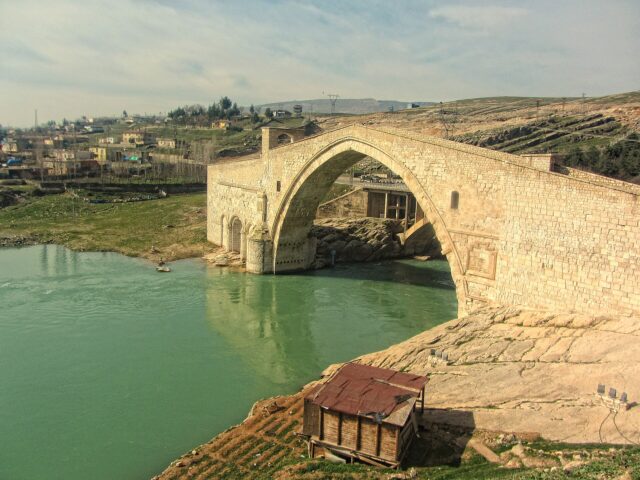
Malabadi Bridge
Malabadi Bridge near Silvan, Diyarbakır: the 12th-century Artuqid bridge with…

Great Mosque of Diyarbakır
Great Mosque of Diyarbakır: the Seljuk-era Ulu Cami with reused…
Zerzevan Castle
Zerzevan Castle near Çınar, Diyarbakır: a 4th-century Roman frontier garrison…