
Tokat Castle: The Citadel on the Rock
On this page
Key facts: Tokat Castle
- What it is: A citadel built on two outcrops of steep rock above the old town, with walls, towers, cisterns and a long rock-cut stairway.
- Where: Northwest of central Tokat, overlooking the city.
- Period: Roman–Byzantine in origin; taken by the Danishmends in 1074 and repaired under the Seljuks and Ottomans. Closed to visitors for restoration, according to the provincial directorate.
What is Tokat Castle?
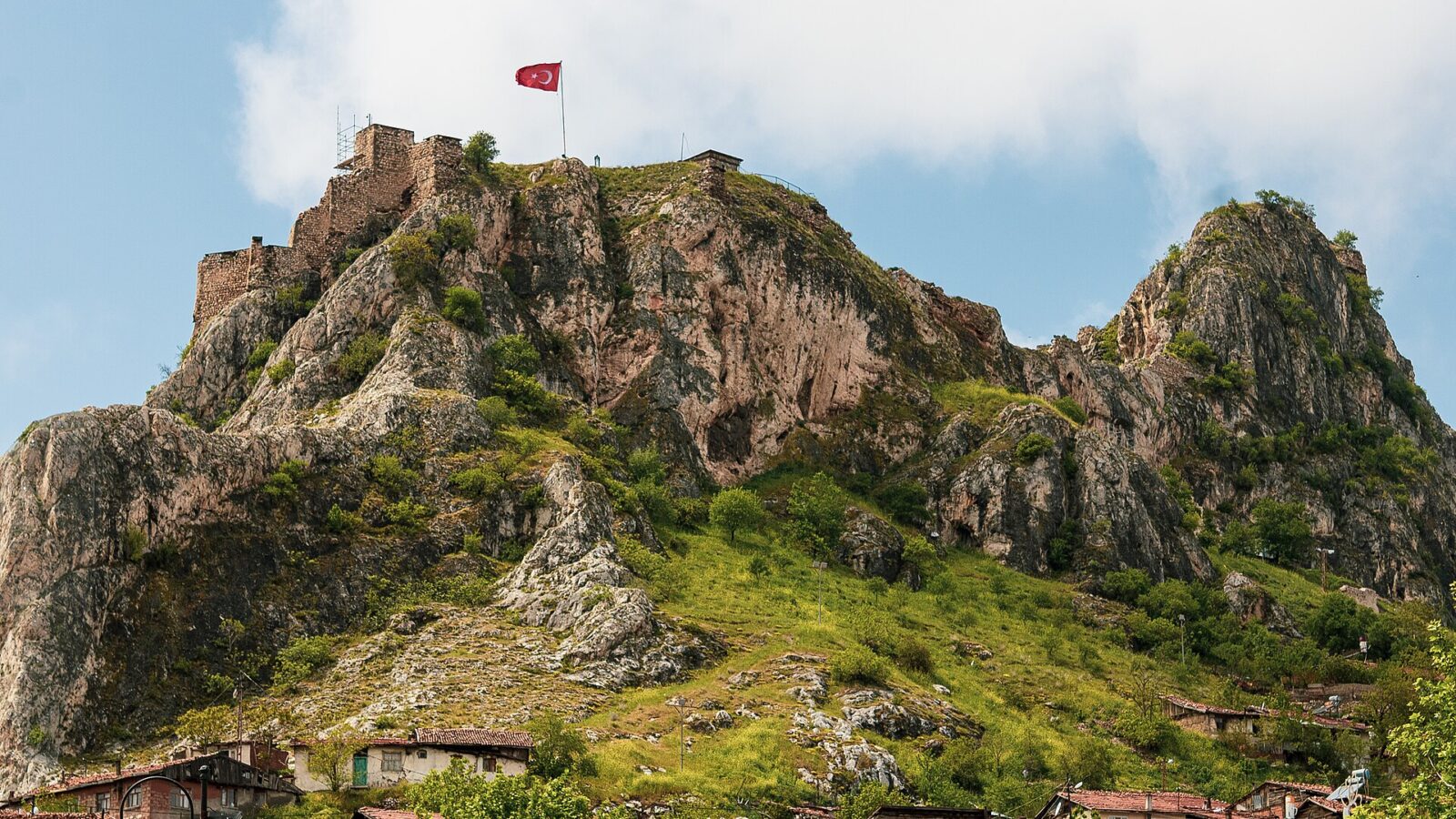
Tokat Castle (Tokat Kalesi) is the fortress on the rock that rises straight out of the old town of Tokat. The 2002 inventory stresses that it is not a walled city on flat ground like Kayseri or Diyarbakır: it is a natural stronghold built on steep, sheer rocks, high enough to command the whole area.
From the town you see its walls and towers following the ridge. Wikipedia describes it as a hilltop citadel with 28 towers.
How do you get to Tokat Castle?
The castle is on the northwest side of the city centre, above the old quarters. On foot, lanes and stairs climb from the old town; by car, a road reaches the upper side.
Current status: the Tokat Culture and Tourism Directorate has announced that the castle is closed to visitors because of restoration work (Tokat Culture and Tourism Directorate). Check locally before you climb; even when the gates are shut, the walls are a fine sight from the streets below and from Gaziosmanpaşa Bulvarı.
Tours in Anatolia
−5% Istambul readers save 5% on every tour below — applied at checkout.
Partner listings via GetYourGuide · free cancellation on most
When is the best time to visit Tokat Castle?
Once it reopens, go in the late afternoon for the light on the town and the valley, and in spring or autumn to avoid summer heat on the exposed rock. In winter the paths can be icy.
What is the history of Tokat Castle?
The provincial directorate dates the castle to the Roman period, built to secure the road, after which it remained under Byzantine rule for about 500 years. The 2002 inventory notes that in this period it was known as Evdoksia and Dokeia. It was taken for the first time in 1074 by the Danishmend Melik Ahmet Gazi, changed hands at short intervals, and passed in turn to the Seljuks and the Ottomans, with the Ilkhanids, Eretnids and Kadı Burhaneddin in between.
It was repaired often under the Seljuks and Ottomans, with new defence and look-out positions added. Inside, the inventory records, there were once storehouses for every kind of provision, a cistern, an armoury, service buildings, rooms for deposits and a mosque; today only vaulted structures and foundations remain. The site of the mosque, thought to have been built or restored by Bayezid I, is not known. Earthquakes destroyed the north and south walls entirely, while the walls on the main bastion and the Ayar rock survived.
In the Ottoman period its dungeon, called Çardak-ı Bedevi, held many famous prisoners; the inventory names the Byzantine emperor Diogenes first among them. The provincial directorate adds that Vlad III, the Wallachian prince later known as Dracula, was held here under guard before being sent to Edirne to join Prince Mehmed, the future Mehmed the Conqueror.
What is Tokat Castle famous for?
- Its site. A fortress on bare rock rising directly from the town.
- Vlad III. The castle where the future Vlad the Impaler was held as a young hostage of the Ottomans.
- The rock stairway. A stairway of 362 steps cut down through the rock to the foot of the castle, much of which has been opened up.
- Three empires in its walls. The inventory notes that Byzantine, Seljuk and Ottoman work can all be read in the masonry.
What can you see at Tokat Castle?
The walls and towers. The castle sits on two rock groups rising east to west, protected by outer and inner walls, with towers, bastions and loopholes, built of cut stone and rubble.
The entrance. According to the inventory, the castle is entered through a hollow in the rock on its north side.
Reused gravestones. In the wall of one of the large surviving towers on the south side, stone Muslim grave chests (sanduka) were used as building material.
The rock tomb. To the southwest of the castle a very ancient tomb is carved into the rock, with a column at its mouth and two chambers, one large.
Vaults and foundations. Remains of the storerooms, cisterns and service buildings.
The view. The whole of Tokat below, with the minarets, the domes of the bathhouses and the Yeşilırmak valley.



Frequently asked questions about Tokat Castle
Is Tokat Castle open to visitors?
The Tokat Culture and Tourism Directorate has announced that it is closed for restoration. Check locally before going.
Was Vlad the Impaler held at Tokat Castle?
Yes. The provincial directorate states that Vlad III was held here under guard before being sent to Edirne to join Prince Mehmed.
How old is Tokat Castle?
It is Roman or Byzantine in origin; the 2002 inventory suggests the 5th or 6th century AD. The Danishmends took it in 1074.
How many steps does Tokat Castle’s rock stairway have?
The provincial directorate gives 362 steps for the stairway cut down through the rock to the foot of the castle.
What do the official records say about Tokat Castle?
The castle, which historical events and records suggest may have been founded in the 5th or 6th century AD, remained under Byzantine rule for about 500 years; in this period it was known by the names Evdoksia and Dokeia. Conquered for the first time in 1074 by the Danishmend Melik Ahmet Gazi, it changed hands at short intervals and passed in turn to the rule of the Seljuks and the Ottomans. Built on steep, sheer rocks, the castle is a natural fortress. It is not a walled city founded on flat ground and surrounded by high walls, as in Kayseri and Diyarbakır.
Examining the castle walls, it is possible to see traces of the Byzantines, the Seljuks and the Ottomans. (Ministry of Culture and Tourism, Tokat Provincial Tourism Inventory, 2002)
Main photo: Amardarouich, CC BY-SA 4.0, via Wikimedia Commons.
Ready to see Tokat Castle?
Hand-picked tours with good reviews and clear prices.
Partner listings via GetYourGuide · free cancellation on most
Before or after: Istanbul
Most trips start or end in Istanbul. Our own experiences there:

 Dinner, sunset and day cruises between Europe and Asia.See cruises bosporuscruise.com

 Historic Turkish baths in the old city — hand-picked hamams, booked direct.Book a hamam istanbulhamam.com

 Istanbul’s tallest viewpoint: both continents from 369 metres.Get tickets camlicatower.com

 Free audio guides in 15 languages, safe routes and local tips — plus 5% off GetYourGuide.Open the free guide localada.com
Nearby
All destinationsSebastopolis
Sebastopolis at Sulusaray, Tokat: a Hellenistic and Roman city with…
Niksar
Niksar in Tokat: ancient Neocaesarea, a huge castle with the…
Gök Medrese
Gök Medrese in Tokat: the 13th-century Seljuk madrasa and hospital…

Ballıca Cave
Ballıca Cave near Pazar, Tokat: five levels and eight halls…
