
Çeşnigir Bridge: Seljuk Crossing of the Kızılırmak
On this page
- What is Çeşnigir Bridge?
- How do you get to Çeşnigir Bridge?
- When is the best time to visit Çeşnigir Bridge?
- What is the history of Çeşnigir Bridge?
- What is Çeşnigir Bridge famous for?
- What can you see at Çeşnigir Bridge?
- Frequently asked questions about Çeşnigir Bridge
- What do the official records say about Çeşnigir Bridge?
Key facts: Çeşnigir Bridge
- What it is: A stone arch bridge of the Seljuk period across the Kızılırmak, 110 m long and 6 m wide, with twelve arches.
- Where: On the Kızılırmak between Karakeçili and Köprüköy (Keskin), Kırıkkale province, at the head of the Kapulukaya Dam lake.
- Period: Probably 13th century; rebuilt under Selim I; closed to vehicles since 1989 and open to pedestrians.
What is Çeşnigir Bridge?
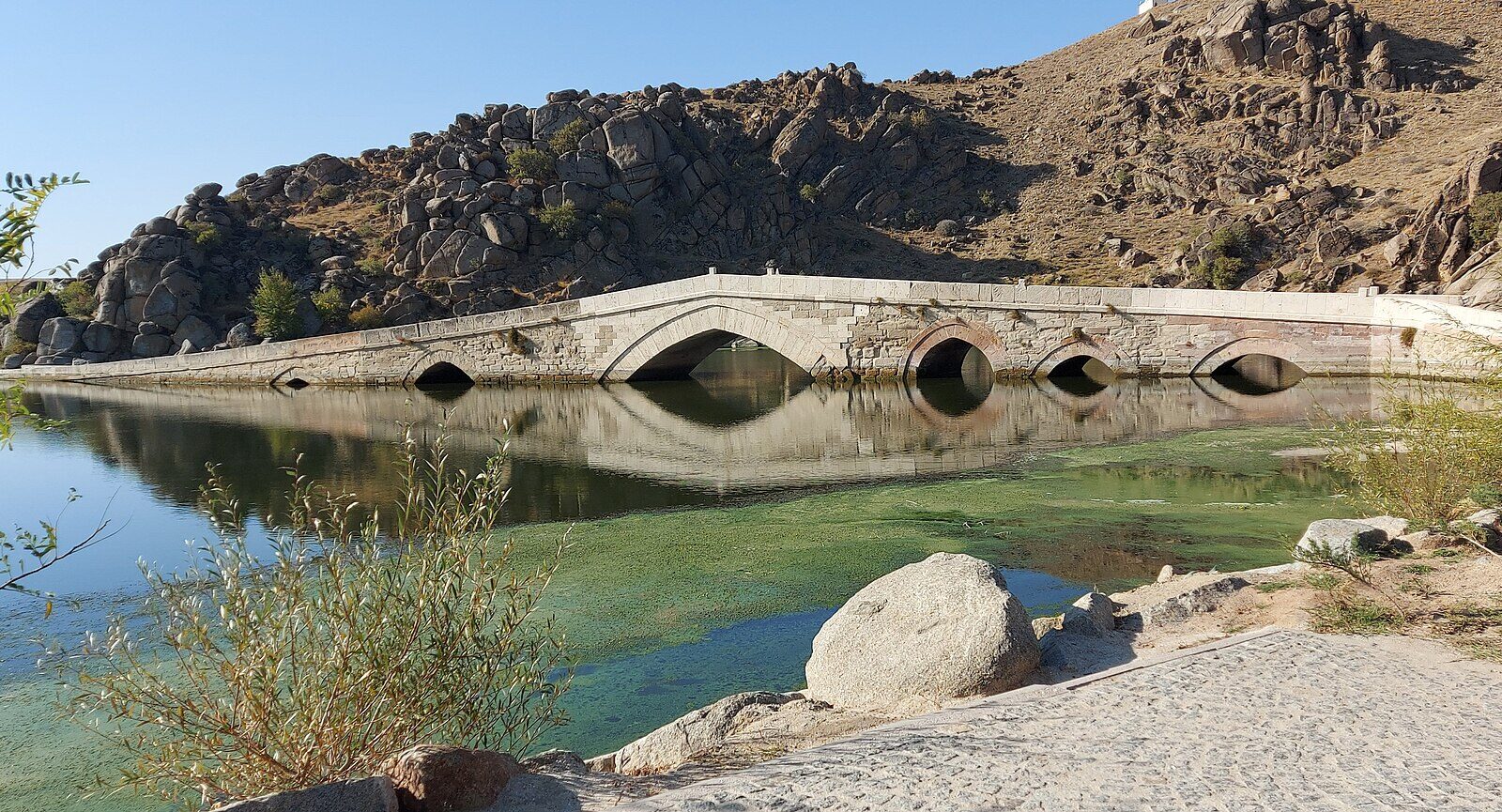
The Çeşnigir Bridge (Çeşnigir Köprüsü) is a long stone bridge over the Kızılırmak in Kırıkkale province, built in the Seljuk period and repaired many times since. For centuries it carried one of the main roads of Central Anatolia across the river, linking the Ankara side of the river with Keskin and the uplands to the east.
Today it no longer carries traffic. When the Kapulukaya Dam was built downstream, the water rose around its piers, and since 1989 the bridge has been open only to people on foot. What remains is a quiet, slightly humped stone causeway across a wide stretch of green river, with the rocky banks it was built on still visible at each end.
How do you get to Çeşnigir Bridge?
The bridge spans the Kızılırmak between Karakeçili and Köprüköy, in the west of the province, south of Kırıkkale city. There is no public transport aimed at visitors, so come by car or taxi from Kırıkkale; check the route on a map before setting out, as the modern road crosses the river elsewhere and the final approach is on local roads.
Kırıkkale itself is about 80 km east of Ankara by road, and the high-speed train from Ankara stops at Kırıkkale YHT station, so a visit can be made as a day trip from the capital.
Tours in Anatolia
−5% Istambul readers save 5% on every tour below — applied at checkout.
Partner listings via GetYourGuide · free cancellation on most
When is the best time to visit Çeşnigir Bridge?
Spring and early autumn are best. In April and May the river banks are green and the light is soft; in September and October the plateau is dry and golden and the weather is settled. Summer middays are hot and shadeless. Early morning and late afternoon give the best photographs, with low light along the arches and reflections on the water when the river is calm.
What is the history of Çeşnigir Bridge?
According to known sources, the 2002 inventory says, the Çeşnigir Bridge and the han near it belonged to the Seljuks. Its date of construction is not known for certain, but it is thought to be a work of the 13th century. It is said that in 1402 Timur’s army used this bridge as it advanced to the Battle of Ankara, where it defeated the Ottoman sultan Bayezid I.
The inventory goes on: the Çeşnigir Bridge was rebuilt by Mimar Sinan during Yavuz Sultan Selim’s Egyptian campaign. That campaign took place in 1516–1517 and the attribution to Sinan is a tradition repeated by most sources rather than a documented commission.
The bridge stayed in use for centuries after that, with further repairs in the 20th century. Before the Kapulukaya Dam came into operation it was used as part of the road, but afterwards its piers were left standing in the dam water. It was closed to traffic in 1989, and restoration work was carried out in 2010 by the regional highways directorate.
No building inscription naming the original patron survives, which is why the bridge is dated by its architecture and by the historical sources rather than by a precise year.
What is Çeşnigir Bridge famous for?
- Its length. 110 metres of cut stone across the Kızılırmak, on twelve arches.
- The Timur story. The tradition that Timur’s army crossed here on the way to the Battle of Ankara in 1402.
- The Sinan connection. The rebuilding attributed to Mimar Sinan, the greatest Ottoman architect, at the start of his career.
- Engineering. Relieving arches above the main spans, a design meant to let floodwater through and reduce the weight on the piers.
What can you see at Çeşnigir Bridge?
The arches. The inventory describes the bridge, 110 m long and 6 m wide, as resting on solid foundations on rocky ground. So that it could sit on firm ground in the bed of the Kızılırmak, the middle section has a marked slope. With a central opening of 18.60 m, the bridge has twelve arches: three set higher up, to let the water flow when the river rises and to lighten the bridge, and nine below.
The cut-stone masonry. The faces are of dressed stone. Walking across, you can see where different repairs have been made, with changes in stone colour and size.
The river and the dam lake. With the Kapulukaya reservoir backing up below, the river here is broad and slow. The inventory notes that amateur line fishing is done on the dam lake and in the Kızılırmak valley, and anglers are a common sight.
The site of the han. The 2002 inventory mentions a Seljuk han near the bridge. Little of it is visible to a casual visitor today, so do not expect a standing caravanserai.



Frequently asked questions about Çeşnigir Bridge
Can you walk across the Çeşnigir Bridge?
Yes. It has been closed to vehicles since 1989, after the Kapulukaya Dam raised the water, and is open to pedestrians.
How old is the Çeşnigir Bridge?
It is believed to date from the 13th century, in the Seljuk period. There is no surviving building inscription.
Did Mimar Sinan build the Çeşnigir Bridge?
Tradition and the 2002 tourism inventory say Sinan rebuilt it during Selim I’s Egyptian campaign of 1516–1517. The original bridge is older.
How long is the Çeşnigir Bridge?
It is 110 m long and 6 m wide, with twelve arches, nine main spans and three higher relieving arches.
Do you need a car to reach the Çeşnigir Bridge?
In practice, yes. There is no visitor transport, so drive or take a taxi from Kırıkkale.
What do the official records say about Çeşnigir Bridge?
According to known sources, the Çeşnigir Bridge and the han near it belonged to the Seljuks. Although its date of construction is not known exactly, it is estimated to be a work of the 13th century. It is said that the army of Timur, advancing to the Battle of Ankara in 1402, used this bridge.
The Çeşnigir Bridge was rebuilt by Mimar Sinan during Yavuz Sultan Selim’s Egyptian campaign. While it was used as a road before the Kapulukaya Dam came into operation, its piers were later left within the dam water. (Ministry of Culture and Tourism, Kırıkkale Provincial Tourism Inventory, 2002)
Main photo: Egeasln, CC BY-SA 4.0, via Wikimedia Commons.
Ready to see Çeşnigir Bridge?
Hand-picked tours with good reviews and clear prices.
Partner listings via GetYourGuide · free cancellation on most
Before or after: Istanbul
Most trips start or end in Istanbul. Our own experiences there:

 Dinner, sunset and day cruises between Europe and Asia.See cruises bosporuscruise.com

 Historic Turkish baths in the old city — hand-picked hamams, booked direct.Book a hamam istanbulhamam.com

 Istanbul’s tallest viewpoint: both continents from 369 metres.Get tickets camlicatower.com

 Free audio guides in 15 languages, safe routes and local tips — plus 5% off GetYourGuide.Open the free guide localada.com
Nearby
All destinationsHaydar Sultan Complex
Haydar Sultan in Keskin, Kırıkkale: a dervish shrine over a…
Hasandede Mosque and Tombs
Hasandede in Kırıkkale: the 1605 mosque and 17th-century tombs of…
Kırıkkale
Kırıkkale travel guide: the Seljuk Çeşnigir Bridge, Hasandede and Haydar…
Isparta
Isparta in Türkiye's lake district: rose fields and rose-oil production,…
