
Sivrihisar Great Mosque: 67 Wooden Columns, UNESCO-Listed
On this page
- What is the Sivrihisar Great Mosque?
- How do you get to the Sivrihisar Great Mosque?
- When is the best time to visit the Sivrihisar Great Mosque?
- What is the history of the Sivrihisar Great Mosque?
- What is the Sivrihisar Great Mosque famous for?
- What can you see at the Sivrihisar Great Mosque?
- Common misconceptions about the Sivrihisar Great Mosque
- Frequently asked questions about the Sivrihisar Great Mosque
- What do the official records say about the Sivrihisar Great Mosque?
Key facts: Sivrihisar Great Mosque
- What it is: A medieval wooden hypostyle mosque, its roof carried on 67 wooden columns.
- Where: Sivrihisar town centre, Sivrihisar district, Eskişehir province, on the road between Eskişehir and Ankara.
- UNESCO World Heritage: Inscribed in 2023 as part of “Wooden Hypostyle Mosques of Medieval Anatolia” (UNESCO). Built 1274–75.
What is the Sivrihisar Great Mosque?
The Sivrihisar Great Mosque (Sivrihisar Ulu Camii) is one of the largest wooden-columned mosques in Anatolia. From the outside it is a plain, low stone building in the centre of the small town of Sivrihisar; inside, a forest of 67 wooden columns holds up a flat timber roof over a prayer hall of about 1,485 m².
In 2023 it became one of the five components of the UNESCO World Heritage Site “Wooden Hypostyle Mosques of Medieval Anatolia”, together with the Great Mosque of Afyon, the Ahi Şerefeddin (Aslanhane) Mosque in Ankara, the Eşrefoğlu Mosque in Beyşehir and the Mahmut Bey Mosque in Kastamonu (UNESCO).
How do you get to the Sivrihisar Great Mosque?
Sivrihisar lies east of Eskişehir on the main road to Ankara, roughly 100 km from Eskişehir, so it fits easily into a drive between the two cities. Buses link the town with Eskişehir and Ankara. The mosque is in the town centre below the rocky peaks that give Sivrihisar (“pointed fortress”) its name. Pessinus, the ancient sanctuary of Cybele at Ballıhisar, is about 13 km away.
Book a Sivrihisar Great Mosque tour
−5% Istambul readers save 5% on every tour below — applied at checkout.
Partner listings via GetYourGuide · free cancellation on most
When is the best time to visit the Sivrihisar Great Mosque?
Any time of year, as the interior is the main attraction. Visit between prayer times, avoid Friday midday prayers, and dress modestly. The interior is dim, so a bright day helps for photographs through the open doors. Spring and autumn are the most pleasant seasons to combine the mosque with Pessinus and the town’s other monuments.
What is the history of the Sivrihisar Great Mosque?
According to the Eskişehir Provincial Directorate of Culture and Tourism, the mosque was built in 1274 by Emineddin Mikail, a disciple of Mevlana Celaleddin Rumi and a deputy of the Seljuk sultan Gıyaseddin Keyhüsrev II (Eskişehir Culture and Tourism Directorate). UNESCO dates it to 1274–75.
An inscription records that the minaret was built in 1409 by Hacı Habib, son of Osman. In 1440 the mosque was repaired by Hızır Bey, a judge of the period who later became the first kadı of Istanbul under Mehmed the Conqueror.
The wooden hypostyle mosques are a distinctive Anatolian type of the late 13th and 14th centuries: rectangular stone shells with interiors of wooden columns, beams and flat roofs, often with carved and painted woodwork. Sivrihisar is one of the largest of the group.
What is the Sivrihisar Great Mosque famous for?
- 67 wooden columns in rows across the prayer hall, six of them carved with motifs.
- Reused Byzantine capitals on some of the columns.
- A carved wooden minbar, made by Horasanlı İbni Mehmet using kündekari joinery.
- UNESCO World Heritage status since 2023.
What can you see at the Sivrihisar Great Mosque?
The columns. The tops of the decorated columns carry rosettes, palmettes, geometric patterns and floral designs. Look for the stone capitals from the Byzantine period reused on some of the wooden shafts.
The minbar. The directorate describes the minbar as an artistic masterpiece. It was made in the kündekari technique, in which small carved panels are fitted together without nails or glue.
Walnut cabinet doors carved with fine decoration, and inscriptions on the right and left wings of the building.
Sivrihisar kilims. Examples of local flatweave kilims are displayed in the mosque.
Pessinus nearby. At Ballıhisar, about 13 km away, lie the ruins of Pessinus, the main sanctuary of the Phrygian Mother Goddess Cybele. The 2002 provincial inventory describes it as a city founded in honour of Cybele that kept its sanctity and importance in Roman times, entered Roman rule under Augustus in 25 BC as part of the province of Galatia, and was neglected in the Byzantine period, when its old buildings were dismantled for simple building material. In 204 BC the Romans took its sacred black stone to Rome. Belgian archaeologists from Ghent University have excavated here since 1967, uncovering the foundations of a temple and a monumental stepped canal through the valley.
The town. The directorate also lists Sivrihisar’s Kurşunlu Mosque, the Surp Yerrortutyun Armenian Church and the house of Nasreddin Hoca, the folk humorist associated with the district.
Common misconceptions about the Sivrihisar Great Mosque
Is the whole mosque from 1274?
What people often assume: That the building as you see it dates entirely from the Seljuk period.
What the record says: The mosque was founded in 1274, but its minaret was added in 1409 and the building was repaired in 1440 under Hızır Bey (Eskişehir Culture and Tourism Directorate).



Frequently asked questions about the Sivrihisar Great Mosque
Is the Sivrihisar Great Mosque a UNESCO site?
Yes. It was inscribed in 2023 as one of the five Wooden Hypostyle Mosques of Medieval Anatolia.
How many columns does the Sivrihisar Great Mosque have?
Sixty-seven wooden columns carry its flat roof; six of them are decorated.
When was the Sivrihisar Great Mosque built?
In 1274–75, by Emineddin Mikail. The minaret was added in 1409 and the building repaired in 1440.
How far is Sivrihisar from Eskişehir?
Roughly 100 km east, on the main road to Ankara.
What else is there to see near Sivrihisar?
Pessinus, the ancient sanctuary of Cybele at Ballıhisar about 13 km away, and the town’s Armenian church and Nasreddin Hoca house.
What do the official records say about the Sivrihisar Great Mosque?
It is in Sivrihisar. Formerly a caravanserai, it was converted into a mosque by E. Mikail in the Hijri year 673. It is one of the largest wooden-columned mosques in Anatolia. It covers an area of 1,484 m². Its flat roof is carried by 67 wooden columns. (Ministry of Culture and Tourism, Eskişehir Provincial Tourism Inventory, 2002)
The 2002 inventory gives this description under the name “Kılıç Mescidi”; the founder, date and column count are those of the Great Mosque, and Hijri 673 corresponds to 1274–75.
Ready to see Sivrihisar Great Mosque?
Hand-picked tours with good reviews and clear prices.
Partner listings via GetYourGuide · free cancellation on most
Before or after: Istanbul
Most trips start or end in Istanbul. Our own experiences there:

 Dinner, sunset and day cruises between Europe and Asia.See cruises bosporuscruise.com

 Historic Turkish baths in the old city — hand-picked hamams, booked direct.Book a hamam istanbulhamam.com

 Istanbul’s tallest viewpoint: both continents from 369 metres.Get tickets camlicatower.com

 Free audio guides in 15 languages, safe routes and local tips — plus 5% off GetYourGuide.Open the free guide localada.com
Nearby
All destinations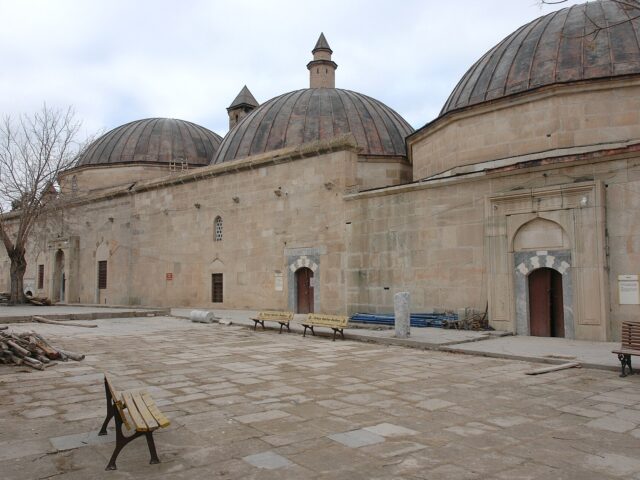
Seyyid Battal Gazi Complex
Seyyid Battal Gazi Complex at Seyitgazi: a 1207 Seljuk shrine…

Sazova Park
Sazova Park in Eskişehir: the Fairy Tale Castle, pirate ship,…
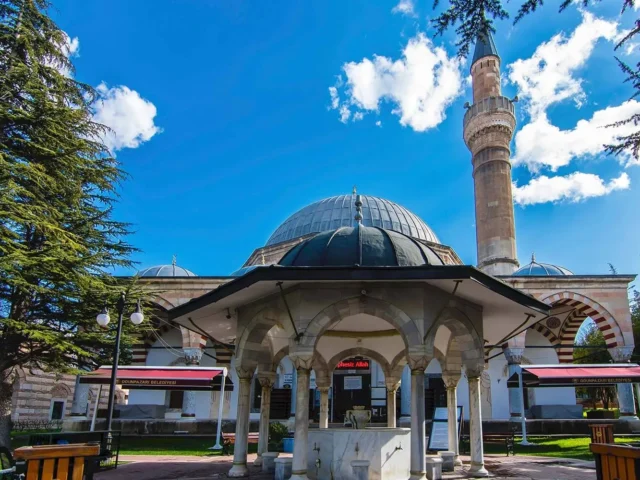
Kurşunlu Mosque Complex
Kurşunlu Mosque Complex in Odunpazarı, Eskişehir: the 1517–1525 külliye of…
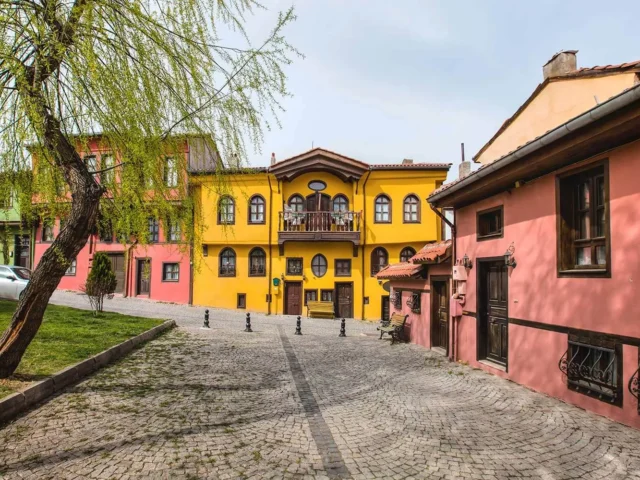
Odunpazarı
Odunpazarı, Eskişehir’s Ottoman quarter: painted timber houses, Kengo Kuma’s Modern…
