

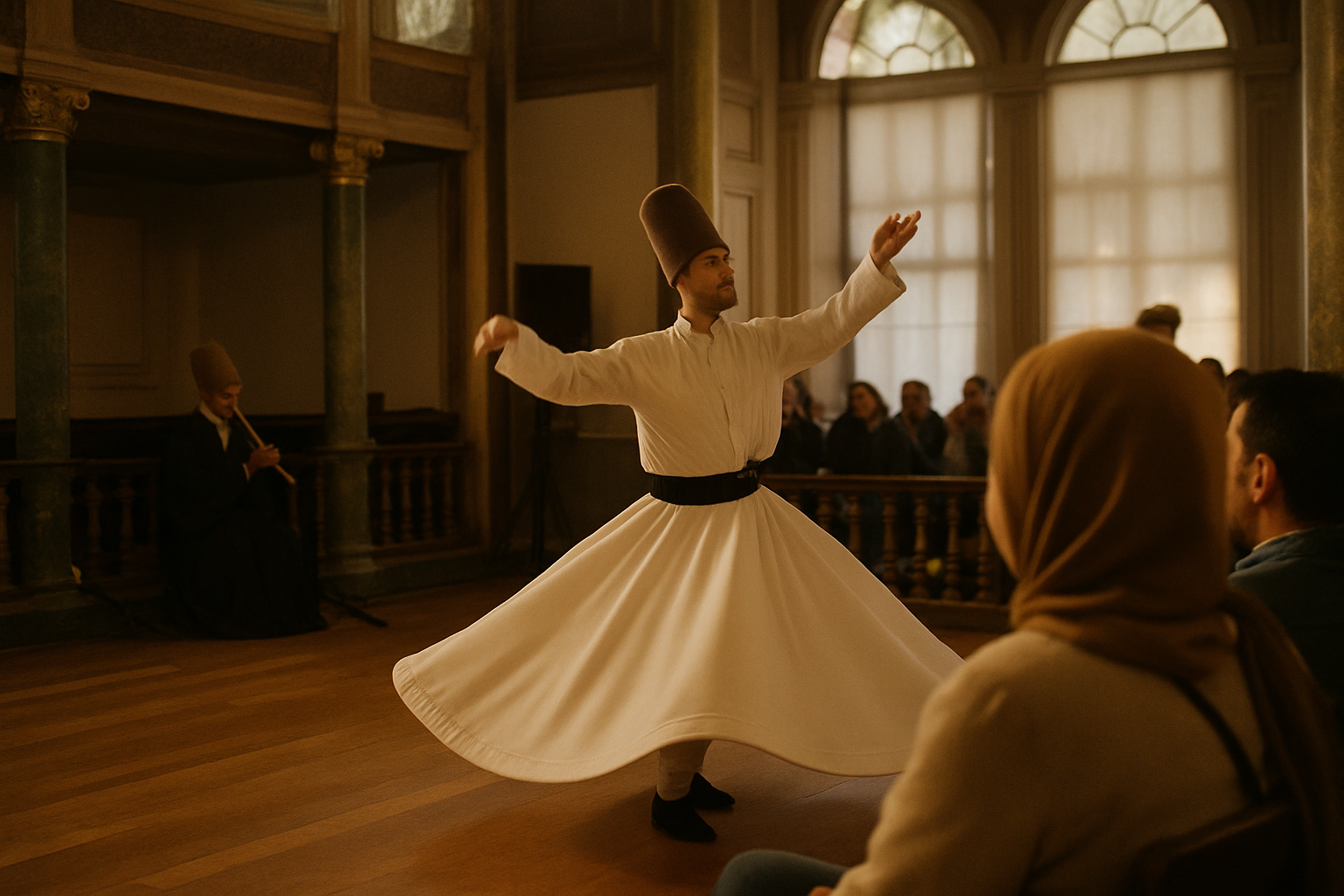
Istanbul’s whirling dervish ceremonies, known as Sema, are staged at a handful of dedicated venues rather than as one citywide show. The most reliable options are Galata Mevlevihanesi in Beyoğlu district’s historic streets, the ceremony hall near Sirkeci train station, and the evening performance held inside the Cistern of Theodosius in the old city. Most performances run in the early evening, several nights a week, and the smaller halls fill before showtime.
- Typical duration: roughly 60 to 90 minutes, depending on the venue.
- Nearest transport: the T1 tram serves Sultanahmet Square in the old city for cistern and old-city venues; the M2 metro’s Şişhane stop is closest to Galata Mevlevihanesi, about a ten-minute walk.
- Dress code: modest, comfortable clothing; no photography during the actual whirling at most halls.
- Booking: worth doing ahead for smaller halls and for evening slots that combine a light show with the performance.
What is a whirling dervish ceremony?
A whirling dervish ceremony, or Sema, is a ritual of the Mevlevi Sufi order founded on the teachings of the 13th-century poet Rumi, in which dervishes turn in slow, sustained rotation as a form of devotional meditation. The dervish who performs the turn is called a semazen, and the tall felt hat worn during the ceremony, symbolising a tombstone of the ego, is known as a sikke. The music accompanying the ritual is live, built around the reed flute called the ney, whose sound is central to Mevlevi practice. In Istanbul today the ceremony is presented respectfully as a cultural and historical performance rather than a live religious service, though its origins and symbolism are treated seriously at every venue that stages it.
Where to watch whirling dervish ceremonies in Istanbul
Galata Mevlevihanesi is the original Mevlevi lodge for the city, a preserved 15th-century building that now operates as a museum and periodically hosts Sema performances in its restored ceremonial hall. The hall near Sirkeci train station has staged evening Sema performances for visitors for decades and sits within easy walking distance of the Sultanahmet area. A different format is offered inside the Cistern of Theodosius, an underground Byzantine water reservoir now open to the public, where an evening programme combines a projection-mapping light show with a live dervish performance and Sufi music; if you want the fuller background on the site itself, our earlier guide to the Cistern of Theodosius covers the history and the daytime visit as well. Each venue has its own atmosphere, so choosing between a museum lodge, a purpose-built ceremony hall, and an underground cistern setting comes down to whether you want history, tradition, or spectacle to lead the evening.
When are dervish ceremonies held in Istanbul?
Times differ by venue, and the clearest published schedule is the one for the Cistern of Theodosius’s evening programme. As of September 2026, according to the venue’s own ticket page, entrance for the evening show is at 7:45pm, the projection-mapping light show begins at 8:15pm, the dervish performance follows at 8:30pm, and the full session ends at 9:15pm, for a total running time of about an hour and a half. That schedule includes snacks and drinks alongside the performance itself, so there is no separate interval to plan around. Galata Mevlevihanesi and the Sirkeci hall run on their own weekly rhythms rather than daily, so it is worth checking each venue’s current calendar before building an evening around a specific date, particularly if you are visiting outside the main summer season.
What should you wear and how should you behave?
Modest, comfortable clothing is the standard expectation at every Sema venue in Istanbul, in keeping with the ceremony’s religious roots. Shoulders and knees covered is a safe baseline for both men and women, and there is no need for headscarves unless a specific hall requests one on arrival. Photography rules are stricter than at most tourist sites: flash photography during the actual whirling is discouraged everywhere, and at the Cistern of Theodosius professional photography specifically requires written permission from the venue in advance. Visitors are generally asked to stay seated and quiet once the music and the turning begin, since the ceremony is presented as a continuous performance rather than one with pauses for applause.
Booking ahead for dervish shows
Booking ahead matters more for whirling dervish ceremonies than for most Istanbul sightseeing, because the halls are small and the performances run on a fixed schedule rather than continuously through the day. The Cistern of Theodosius evening slot is a single scheduled session each night, running from 7:45pm to 9:15pm as of September 2026, so a seat needs to be confirmed rather than assumed. Galata Mevlevihanesi’s ceremonies are tied to its museum calendar, and demand rises noticeably around national holidays and the peak summer months when overall visitor numbers in the city are highest. If a Sema performance is the centrepiece of a particular evening rather than a spontaneous add-on, reserving a place a few days ahead removes the main source of disappointment.
Frequently Asked Questions
How long does a whirling dervish ceremony last?
About 60 to 90 minutes, depending on the venue; the Cistern of Theodosius evening programme runs for roughly an hour and a half in total.
Is photography allowed during the ceremony?
No, flash photography is discouraged at every venue during the actual whirling, and at the Cistern of Theodosius professional photography needs written permission arranged in advance.
Do I need to book tickets ahead of time?
Yes, especially for smaller halls like Galata Mevlevihanesi and for evening slots such as the cistern’s combined light show and performance, which run on a single fixed schedule each night.
Is the whirling dervish ceremony a religious service or a performance?
Both, in a sense: it is rooted in genuine Mevlevi Sufi practice, but the versions staged for visitors in Istanbul today are presented as respectful cultural performances rather than live acts of worship.
What should I wear to a dervish ceremony?
Modest, comfortable clothing covering shoulders and knees is the standard expectation, and no special headwear is required unless a specific venue asks for it.
Are whirling dervish ceremonies held every night?
Only on scheduled evenings rather than daily at most venues; the Cistern of Theodosius runs a fixed evening slot, while Galata Mevlevihanesi and the Sirkeci hall follow their own weekly calendars. Seeing a whirling dervish ceremony in Istanbul is straightforward once you know that it means picking one of a small number of specific venues and matching your evening to their timetable rather than expecting a performance on demand. Checking current opening arrangements through an official source such as Türkiye’s national museums portal or the country’s own official tourism portal before you travel is the simplest way to avoid a wasted trip to a closed hall. Beyond that, book the evening you actually want, dress modestly, and let the music and the turning hold your attention for the hour or so it takes.

Comment (0)