

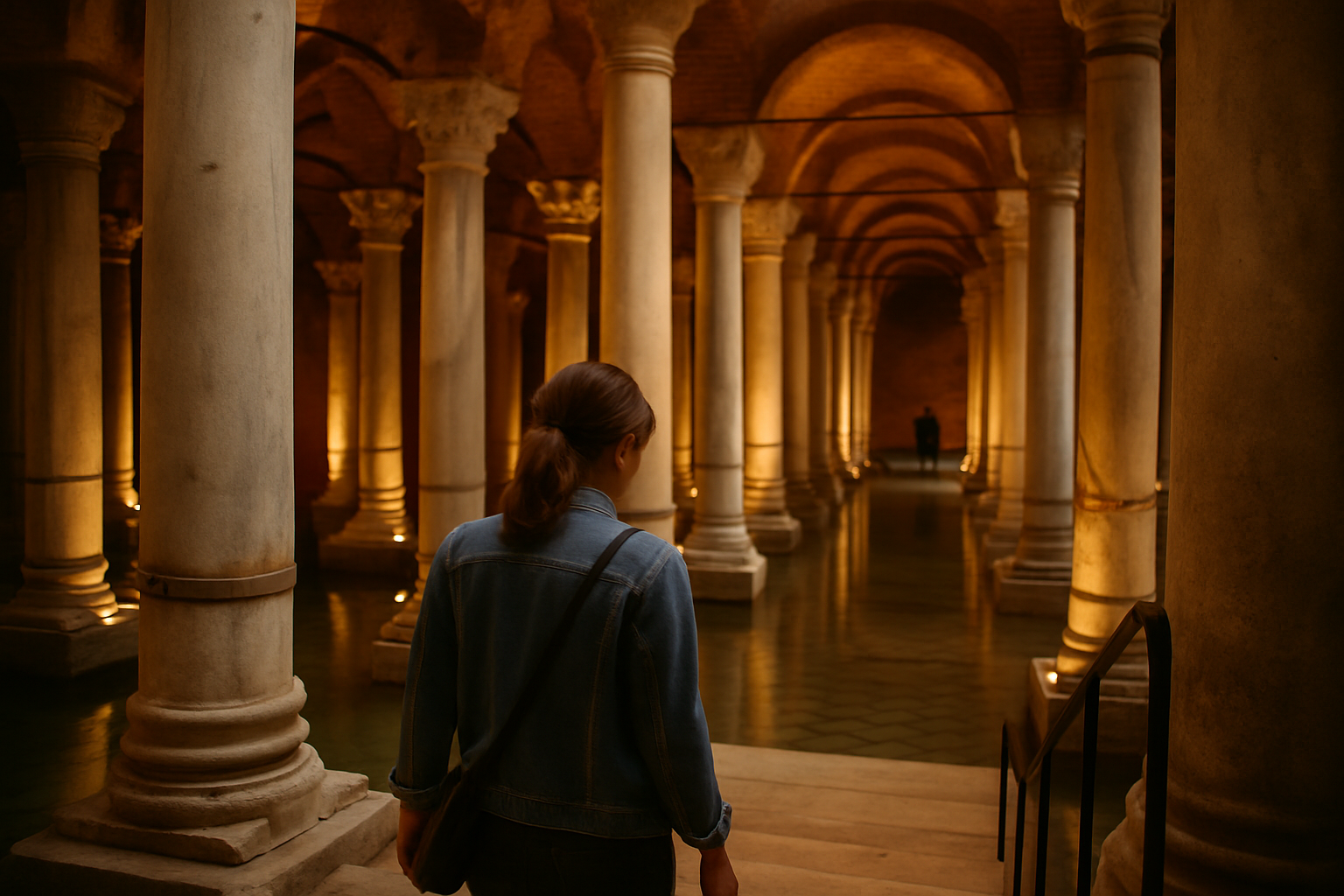
You visit the Şerefiye Cistern by choosing either a daytime session, which runs with a mapping light show, or an evening slot that adds live Sufi music and a whirling dervish performance, then walking down stone steps into the restored fifth-century basilica cistern near Sultanahmet.
Daytime sessions run from 9am to 6pm; the evening show begins with entrance at 7:45pm, as of September 2026, according to the operator’s own ticket pages.
- Time needed: about 45–60 minutes for a daytime visit; roughly 1.5 hours for the evening dervish show, which runs from entrance to close of performance.
- Best time to go: daytime for the architecture and mapping projections; evening for the music and dervish performance, which is a separate, timed session.
- Nearest tram: Sultanahmet or Beyazıt-Kapalıçarşı stop on the T1 tram line, both a five- to eight-minute walk away.
- Dress code: none specific; the space is not a place of worship, but the stone steps are uneven, so flat shoes help.
- Booking ahead: recommended for the evening dervish show, since seating for the performance is limited and the format is fixed.
- What’s not allowed: large luggage cannot be brought inside, and professional photography needs written permission from the site.
What Is the Şerefiye Cistern?
The Şerefiye Cistern is a fifth-century underground water reservoir, also known as the Cistern of Theodosius, built to supply the palaces and public buildings of Byzantine Constantinople. A cistern, in this context, is a covered stone basin designed to store rainwater and water carried in by aqueduct, rather than a natural spring or well.
The structure follows a rectangular basilica plan, meaning rows of marble columns support a vaulted brick ceiling in the same layout used for early Christian churches, which is why guides sometimes call it an underground basilica.
Şerefiye sat forgotten and partly filled with debris for centuries before archaeologists cleared and restored it, and it now operates as a cultural venue rather than a working reservoir. Inside, the original columns and capitals remain visible, and the water level is kept shallow and lit so visitors can see the stonework clearly.
For the fuller history of how the site was built, buried and rediscovered, our detailed guide to the Theodosius Cistern covers the archaeology in more depth than fits here.
How Do You Get to the Şerefiye Cistern?
The Şerefiye Cistern sits in the old city, close enough to Sultanahmet Square to reach on foot from most of the area’s hotels and monuments. The T1 tram line stops at both Sultanahmet and Beyazıt-Kapalıçarşı, and either stop leaves a walk of five to eight minutes to the entrance, mostly along flat pedestrian streets.
If you’re coming from the airport or a district further out, plan the tram connection using an Istanbulkart, the rechargeable transport card used across the city’s trams, metro and ferries.
Travellers combining the cistern with other Sultanahmet sights (Hagia Sophia, the Blue Mosque, the Grand Bazaar) will find it sits within the same compact walking radius as all three, so there’s no need to plan a separate trip across the city.
For details on how to load and use the card itself, the Istanbulkart official site covers top-up points and fares for the tram and metro network.
What Are the Opening Hours and Ticket Types?
The Şerefiye Cistern runs two distinct kinds of session rather than a single all-day open-door format.
Daytime tickets cover the window between 9am and 6pm and include access to the space along with a 360-degree mapping light show projected onto the cistern walls, cycling between two programmes: “From Past to Present” and “Istanbul: City of Water Civilization.” The evening ticket is a fixed-format experience: entrance at 7:45pm, the mapping show at 8:15pm, then a live whirling dervish performance with Sufi musicians at 8:30pm, finishing by 9:15pm, according to the operator’s own schedule as of September 2026.
A whirling dervish is a member of the Mevlevi Sufi order who performs a slow, spinning devotional dance known as the sema, traditionally accompanied by reed flute and drum. The evening ticket also includes snacks and drinks as part of the seated experience, which the daytime ticket does not.
Because the evening show runs on a set schedule with limited capacity, it’s worth booking ahead rather than turning up and hoping for a seat, particularly in the busier summer months.
What Happens Inside During a Visit?
Once inside, the path leads down a staircase into the cistern hall, where marble columns rise out of shallow water lit from below and around.
During the daytime session, the walls and vaulted ceiling become the surface for the mapping projection, which uses the cistern’s own architecture rather than a flat screen, so the columns and arches appear to shift and move with the imagery.
Visitors are free to walk the perimeter walkway at their own pace during this window, stopping wherever the light and column spacing are most striking.
In the evening format, the mapping show runs first, then the space is reconfigured for the musical and dervish performance, with seating arranged around a central area. The Sufi music is performed live, not recorded, and the dervish’s spin is unhurried and continuous rather than theatrical in the way it’s sometimes staged for tourists elsewhere.
Because the acoustics of the vaulted stone hall carry sound differently than an open room, the music reads as fuller and closer than it would above ground. Photography is generally fine for personal use, but anyone shooting for professional or commercial purposes needs written permission from the site beforehand.
Şerefiye Cistern versus Basilica Cistern
The two cisterns are separate sites a short walk apart, and confusing them is the single most common planning mistake for first-time visitors. The Basilica Cistern in Istanbul is the larger, more famous of the two, best known for its Medusa-head column bases and its scale, and it draws far heavier daytime footfall as a result.
Şerefiye is smaller, quieter, and built around a different kind of experience, the mapping projections and the evening dervish show give it a distinct identity rather than making it a scaled-down version of its neighbour.
If you only have time for one, the Basilica Cistern suits visitors who want the classic photograph and the scale; Şerefiye suits those who want a quieter space, a light show, or the evening cultural performance.
Neither replaces the other, and travellers with a full day in the old city often manage both without much difficulty given how close they sit. For a side-by-side look at what each cistern actually involves, our comparison of Istanbul’s cisterns lays out the practical differences in more detail.
Tips for a Smooth Visit
A few practical habits make the visit easier, particularly for anyone combining it with the rest of Sultanahmet in a single day. Wear flat, closed shoes, since the stone steps down into the cistern can be uneven and slightly damp near the water’s edge.
Leave large bags or suitcases at the hotel, since luggage isn’t permitted inside the site.
If the evening dervish show is the priority, book it a few days ahead in high season, since the fixed timing and limited seating mean walk-ins aren’t guaranteed a place.
- Arrive a little before your chosen session time rather than exactly on it, particularly for the evening show.
- Pair the visit with nearby Sultanahmet sights on the same walk, since everything sits within a few minutes of each other.
- Check general visitor guidance for museums and heritage sites via Türkiye’s Ministry of Culture and Tourism if you’re planning a wider circuit of historic sites in the same trip.
Frequently Asked Questions
Is the Şerefiye Cistern the same as the Basilica Cistern?
No. They are two separate underground cisterns a short walk apart in the old city, and Şerefiye is the smaller of the two.
How long does a visit to the Şerefiye Cistern take?
About 45 to 60 minutes for the daytime session, or roughly 1.5 hours for the evening dervish show from entrance to finish.
Do I need to book the evening dervish show in advance?
Yes, booking ahead is recommended, since the performance runs on a fixed schedule with limited seating.
What’s included in the evening ticket that isn’t in the daytime one?
The evening ticket adds the live Sufi music and whirling dervish performance plus snacks and drinks, none of which are part of the daytime session.
Is there a dress code for visiting?
No. The Şerefiye Cistern is not a religious site, so there’s no dress requirement, though flat shoes help on the stone steps.
Can I take photos inside?
Only for personal use without special arrangement; professional or commercial photography needs written permission from the site beforehand.
For most visitors, the simplest way to plan the visit is to decide first whether you want the quieter daytime light show or the fuller evening format with live music and the dervish performance, then book directly through the site’s own ticket pages at the Cistern of Theodosius’s official booking site, since sessions are timed and seating for the evening show is limited.

Comment (0)