
Ani: Medieval City on the Armenian Border
On this page
Key facts: Ani
- UNESCO World Heritage: “Archaeological Site of Ani”, inscribed in 2016 (UNESCO).
- Where: Ocaklı (Ani) village, about 42 km east of Kars, on a plateau above the Arpaçay gorge, which forms the border with Armenia.
- Period: Settled since the Bronze Age; at its height in the 10th and 11th centuries as capital of the Armenian Bagratid kingdom; largely abandoned by the 18th century.
What is Ani?
Ani is a ruined medieval city on a triangular plateau in Kars province, bounded by the Arpaçay (Akhurian) gorge on the east and the Bostanlar valley on the west. Across the river is Armenia; the border runs down the middle of the gorge.
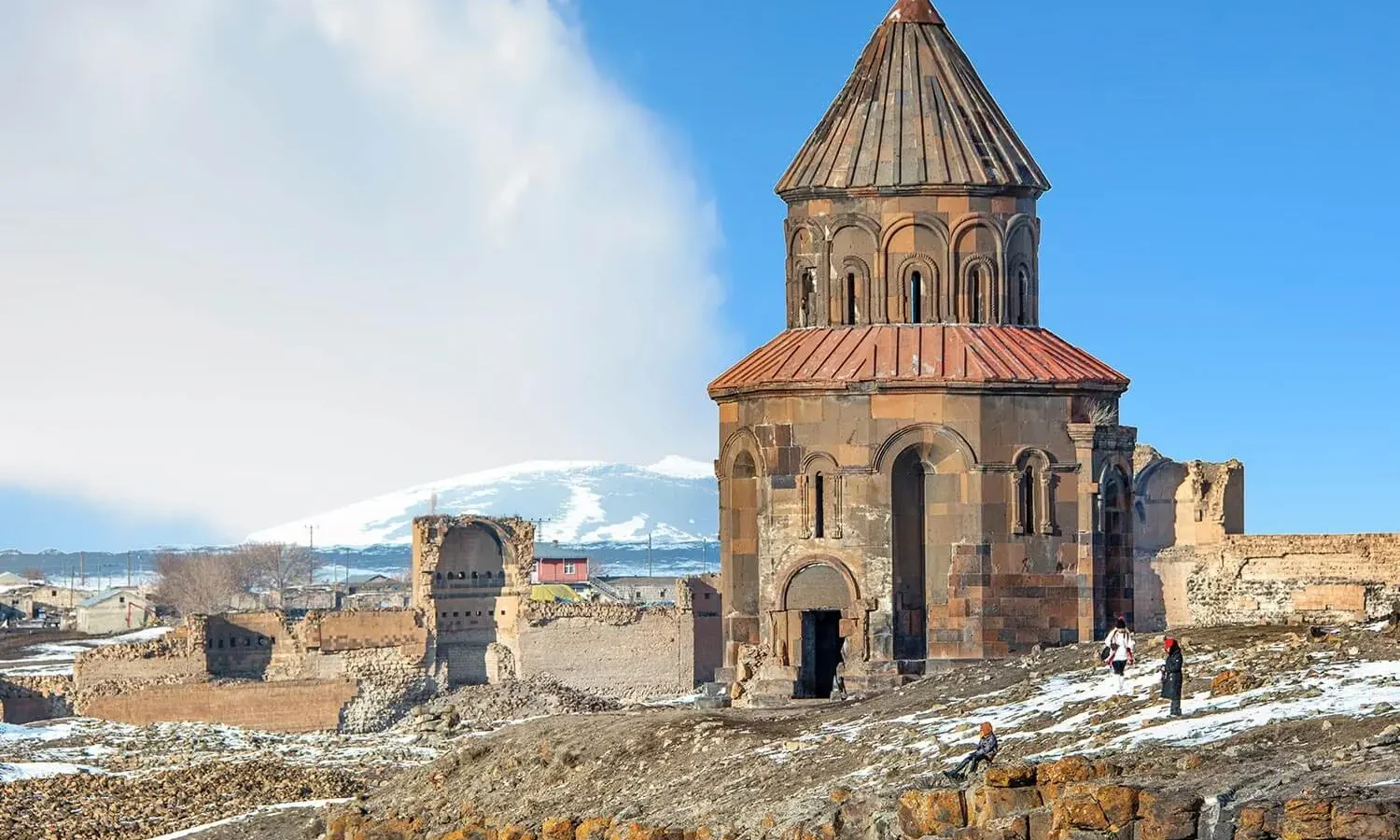
In the 10th and 11th centuries Ani was the capital of the Armenian Bagratid kingdom and one of the great trading cities on the routes between Byzantium, Persia and the Caucasus. Today the walls, a cathedral, several churches, a Seljuk mosque, a palace and the stumps of a bridge stand on an open grassland plateau. UNESCO describes it as a meeting place of Armenian, Georgian and Islamic cultural traditions, with architectural types spanning the 7th to the 13th centuries.
Turkish visitors also know it as the “City of 40 Gates” (40 Kapılı Şehir). The archaeological site is managed by the Ministry of Culture and Tourism, and excavations led from Türkiye continue every summer.
How do you get to Ani?
Ani lies about 42 km east of Kars city centre, roughly 45 minutes by road through the villages of the plateau. There is no regular public transport, so travellers come by hire car, taxi (agree the waiting time in advance) or a day tour from Kars. The nearest airport is Kars Harakani, about 6 km from the city.
Opening hours change through the year, so check them before you visit. Bring water and a hat: there is almost no shade, and the walk between the main monuments covers several kilometres.
Book an Ani tour
−5% Istambul readers save 5% on every tour below — applied at checkout.
Partner listings via GetYourGuide · free cancellation on most
When is the best time to visit Ani?
June to September brings the warmest weather and green grass across the plateau. Arrive at opening time or in the late afternoon, when the light on the red and black stone is best and the heat is lower. Spring and autumn are quieter and can be very fine, but the wind on the plateau is cold.
In winter Ani is often under snow. The site stays open with shorter hours, and the cathedral and walls against the white plateau make a striking sight, but dress for temperatures well below freezing.
What is the history of Ani?
The plateau has been inhabited since the Bronze Age. In 961 King Ashot III moved the Bagratid capital from Kars to Ani, and under his successors the city grew quickly. Smbat II built the great northern walls in the late 10th century, and the seat of the Armenian Catholicos moved to Ani in 992. Estimates of its population at its height run as high as 100,000, though historians treat that figure with caution.
The 2002 Kars inventory describes Ani as lying on the passage route of the old caravans: one of the largest trade centres of its time, with a citadel built for security. The brightest period of the city, it says, was the 10th century, when it was the capital of a local Christian principality and was furnished with many churches and civil buildings.
Like Kars, the inventory continues, Ani suffered invasion and destruction by many states because of its geopolitical position. In 1064 the Seljuk sultan Alp Arslan took Ani, and the Shaddadids, who held the city from 1072, enriched it with mosques, baths, palaces, houses and market places that form fine examples of Turkish Seljuk architecture. In this period the city was one of the most beautiful of the East and became a centre of trade and culture.
Georgian armies captured Ani several times in the 12th century, and from 1201 it was governed by the Zakarid princes. The Mongols sacked the city in 1236, and an earthquake in 1319 brought down the dome of the cathedral. With trade routes shifting, Ani dwindled to a small town and was almost entirely abandoned by the 18th century.
Scientific excavation began in 1892 under Nicholas Marr and continued until 1917. In its own words, the inventory notes that during the work carried out at Ani from 1890 onwards, some historic monuments that were on the verge of collapse were stabilised, and many new monuments were uncovered. Turkish teams have excavated the Seljuk bazaar, houses, cemetery and great bath in recent seasons, and the World Monuments Fund has worked with the Ministry on the cathedral and the Church of the Redeemer.
What is Ani famous for?
- Medieval Armenian architecture at its peak: the cathedral by the architect Trdat and the painted church of Tigran Honents.
- The Menuçehr Mosque, often described as the first Turkish mosque built in Anatolia.
- Its setting: a silent, walled plateau above a gorge with Armenia on the far bank.
- The Silk Road trade city of the 10th–13th centuries, with its bazaar, baths and bridge.
What can you see at Ani?
The walls and the Lion Gate. Visitors enter through the double walls on the north side, which according to the inventory were first built in 972 and were added to and strengthened later in the century. The three entrance gates in the north wall are worth seeing; the main entrance, the Lion Gate (Aslanlı Kapı), takes its name from the carved lion on its wall.
The Cathedral (Fethiye Mosque). The largest church of Ani, begun under Smbat II at the end of the 10th century and finished under Gagik I; sources give the completion as 1001 or 1010. The inventory describes it as a magnificent basilica-type building with three naves and a dome with a cylindrical body and conical roof. After Alp Arslan took Ani in 1064 it was used for a time as a mosque. The dome fell in the earthquake of 1319, but the building remains one of the best preserved at Ani. Conservation work with the World Monuments Fund has been under way since 2022, so parts may be fenced off.
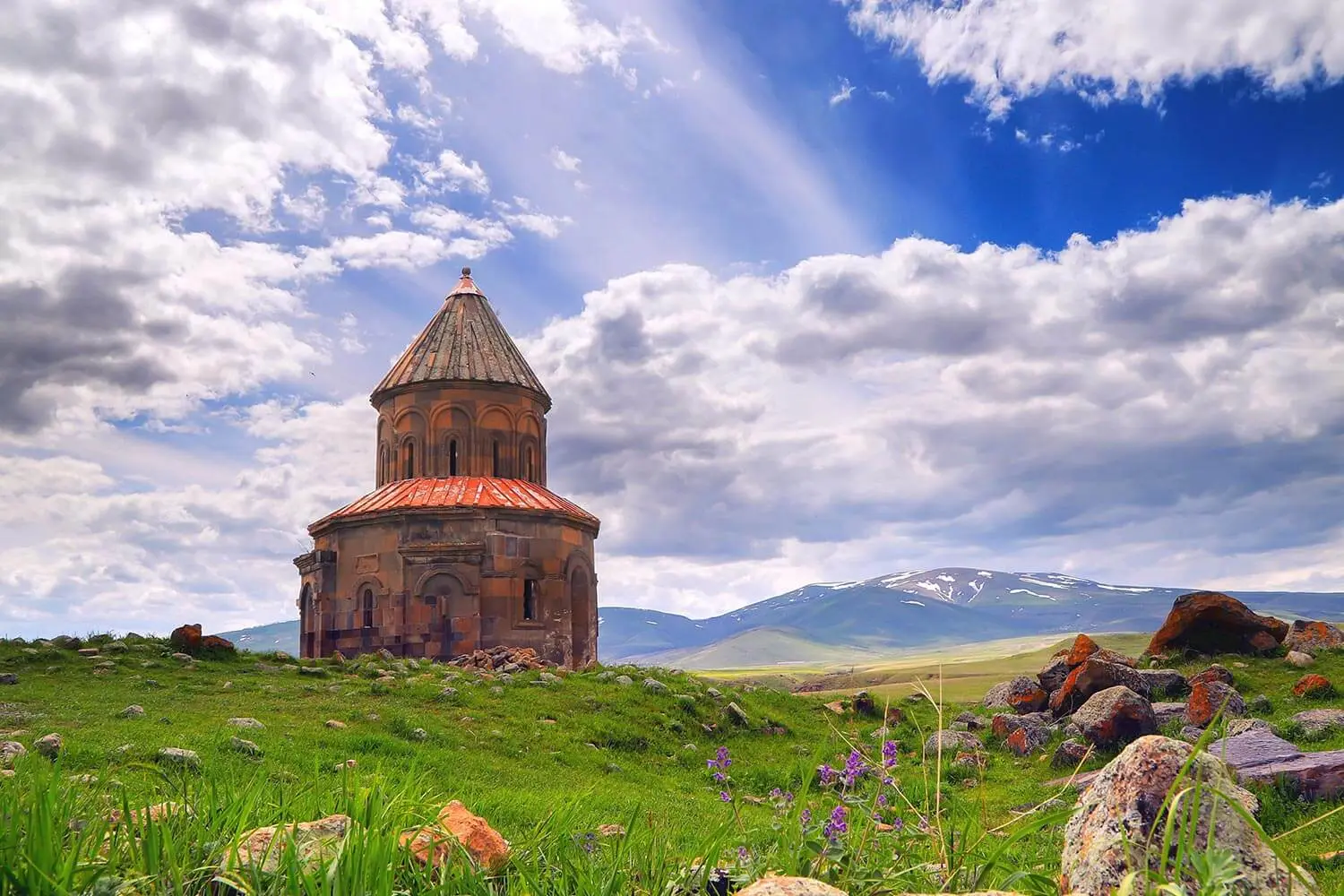
Church of St Gregory of Tigran Honents. Built in 1215 by Tigran Honents on a terrace looking over the Arpaçay valley. The inventory notes that the conical dome of the centrally planned building is decorated outside with arches of sixteen sides, the exterior with human, animal and plant motifs carved in stone, and the interior with frescoes of scenes from the Bible. It is the best-preserved monument on the site.
Church of the Redeemer. Built in 1034–1036. The inventory records that it was repaired in 1173, given a bell tower in 1291 and had its dome repaired in 1342. Its eastern half collapsed in a storm in 1955, leaving a dramatic cut-away section.
Church of the Holy Apostles. Built in 1031 as a patriarchal church on a four-leaf clover plan. After the Seljuks took Ani in 1064, a vaulted, domed hall decorated with coloured stones and a muqarnas dome was added to its south side and the building was turned into a caravanserai.
Church of St Gregory of Abughamrents. A small domed church of the late 10th century near the edge of the Bostanlar valley.
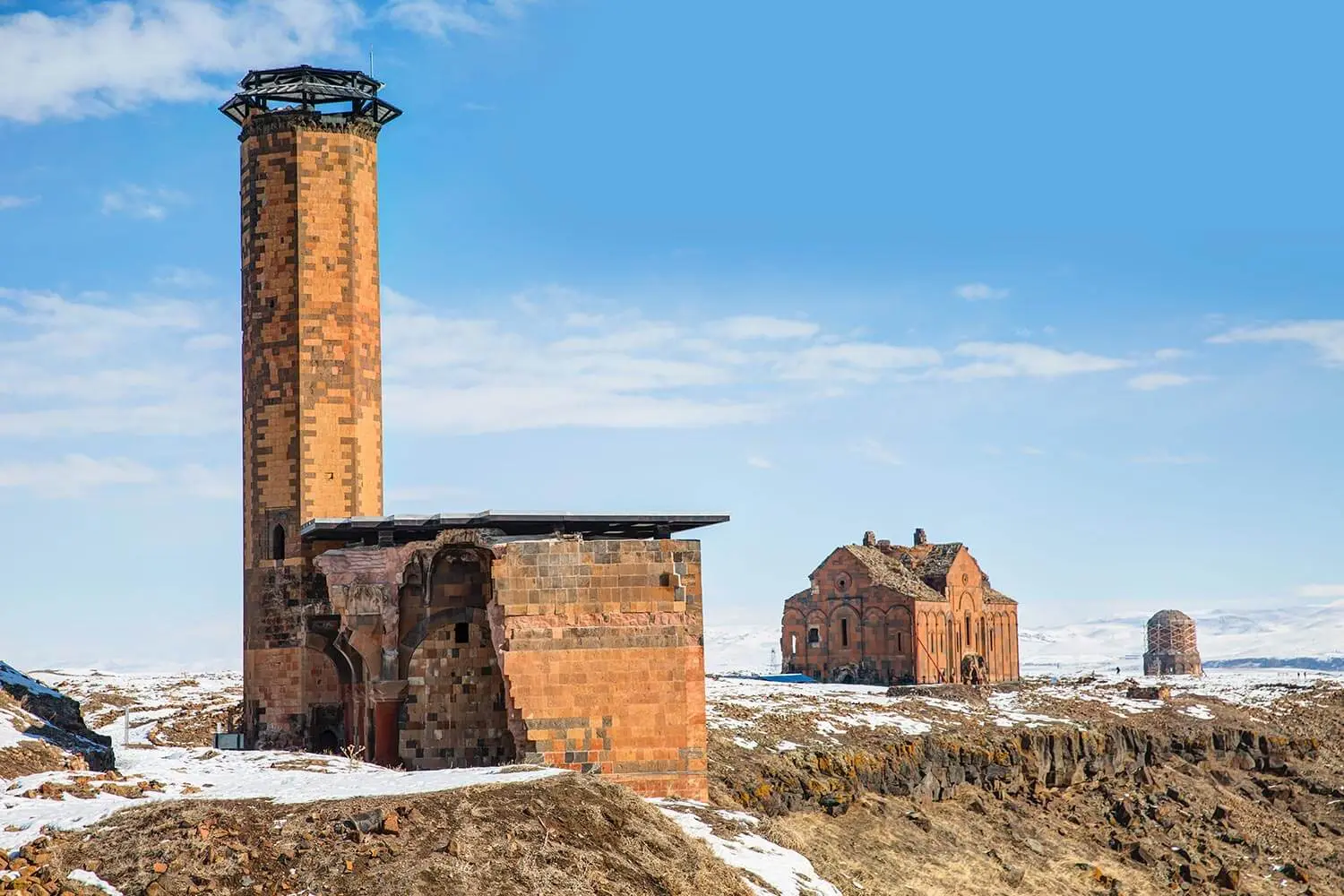
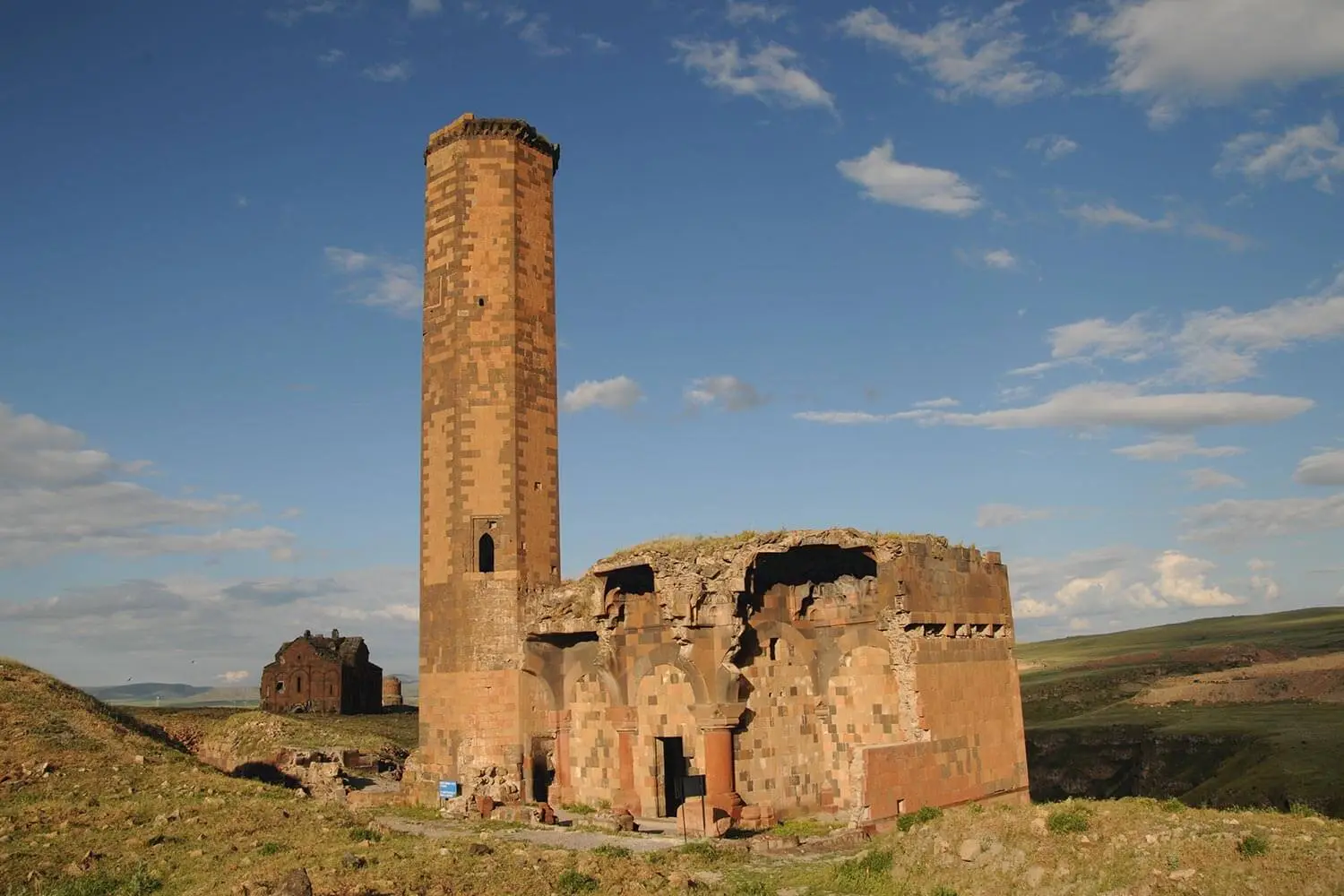
Menuçehr Mosque. Built for the Shaddadid emir Menuçehr; the inventory and the Ministry date it to 1072 and call it the first mosque the Seljuks built in Anatolia. It has three naves, and its ceilings are decorated with coloured stones in a mosaic effect and richly patterned geometric ornament. Its octagonal minaret still stands, with the word “Allah” inscribed below the balcony. Restoration began in 2020.
Seljuk Palace. At the northwestern tip of the site. The inventory describes it as a large complex with a portal decorated in geometric mosaic-like stonework, rooms, a gallery, storerooms and a fountain.
The Maiden’s Castle chapel (Kız Kalesi). Thought to date from the 12th or 13th century, built outside the great walls on a steep rock above the Arpaçay. Its stepped walls and the remains of service buildings around it give the impression of a monastery.
And more. The fire temple, the Ebul Muammeran Mosque, the remains of the Silk Road bridge over the Arpaçay and the bazaar street with its excavated shops.
Common misconceptions about Ani
Has Ani Cathedral been turned back into a mosque?
What people often assume: In July 2025 several outlets reported that the cathedral at Ani was being reopened as a mosque.
What the record says: The reports confused the building’s historical name, Fethiye Camii, with a change of use. The work under way is a conservation project by the Ministry of Culture and Tourism and the World Monuments Fund, after which the building is to reopen to visitors, and no change of function has been announced (CivilNet).



Frequently asked questions about Ani
How far is Ani from Kars?
About 42 km east of Kars city centre, roughly 45 minutes by car. There is no regular public bus, so use a taxi, hire car or tour.
What are Ani’s opening hours?
08:00–19:00 from April to October and 08:00–17:00 from October to April, with the ticket office closing an hour before.
How long do you need at Ani?
Allow three to four hours to walk between the main monuments. The site is large and open, with little shade.
When did Ani become a UNESCO World Heritage Site?
In July 2016, as the “Archaeological Site of Ani”.
Can you see Armenia from Ani?
Yes. The Arpaçay gorge below the city forms the border, and Armenian villages and fields are visible on the far bank.
What do the official records say about Ani?
The remains of the city of Ocaklı (Ani) are 48 km from Kars. Located near today’s Ocaklı village, beside the Arpaçay River close to the Turkey–Armenia border, the city lay on the passage route of the old caravans and was one of the largest trade centres of its time; its citadel was built for security. The brightest period of Ani was the 10th century, when the city was the capital of a local Christian principality and was furnished with many churches and civil buildings.
Ocaklı (Ani) is one of the important stops for tourists visiting our country. At Ani, the city walls, the medieval churches and the works of Seljuk architecture are well worth seeing. (Ministry of Culture and Tourism, Kars Provincial Tourism Inventory, 2002)
Ready to see Ani?
Hand-picked tours with good reviews and clear prices.
Partner listings via GetYourGuide · free cancellation on most
Before or after: Istanbul
Most trips start or end in Istanbul. Our own experiences there:

 Dinner, sunset and day cruises between Europe and Asia.See cruises bosporuscruise.com

 Historic Turkish baths in the old city — hand-picked hamams, booked direct.Book a hamam istanbulhamam.com

 Istanbul’s tallest viewpoint: both continents from 369 metres.Get tickets camlicatower.com

 Free audio guides in 15 languages, safe routes and local tips — plus 5% off GetYourGuide.Open the free guide localada.com
Nearby
All destinations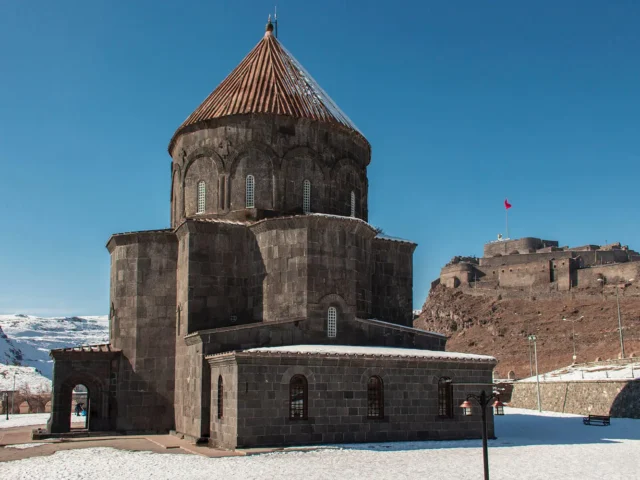
Kümbet Mosque
Kümbet Mosque in Kars: the 10th-century Church of the Holy…
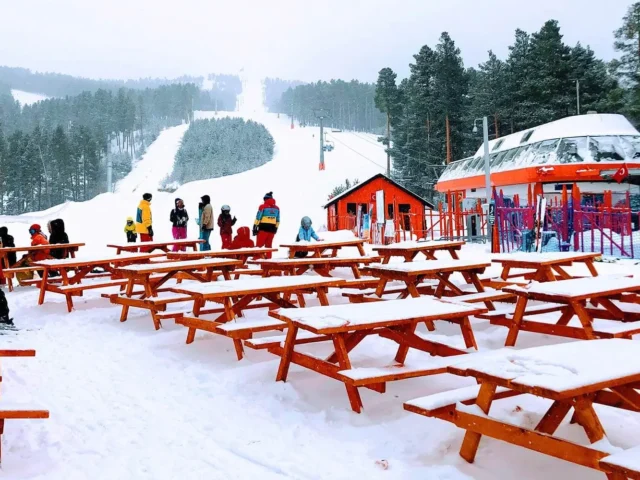
Sarıkamış
Sarıkamış in Kars: skiing on crystal snow at Cıbıltepe, Scots…
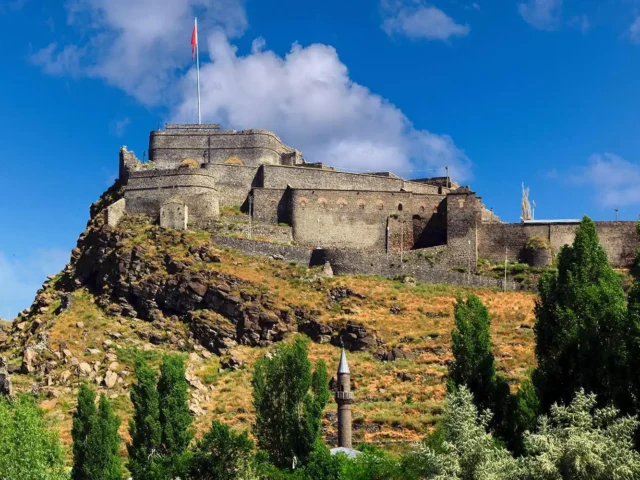
Kars Castle
Kars Castle: the basalt citadel above the Kars River, rebuilt…
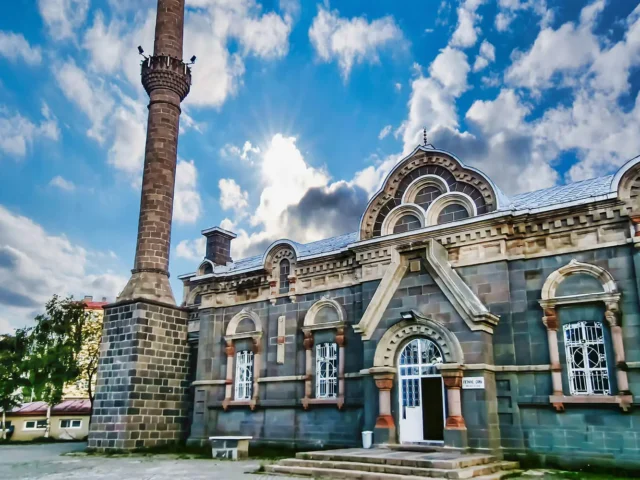
Fethiye Mosque
Fethiye Mosque in Kars: the Russian church of St Alexander…
