
Binbirkilise: The Thousand and One Churches of Karadağ
On this page
Key facts: Binbirkilise
- What it is: A group of Byzantine church, monastery, cistern and house ruins spread over the extinct volcano of Karadağ; the name means “Thousand and One Churches”.
- Where: Around Madenşehir, Üçkuyu and Değle villages, about 30–37 km north of Karaman, Karaman province.
- Period: Mostly late antique and Byzantine; the 2002 inventory dates the buildings between the 4th and 9th centuries, and the provincial directorate dates Basilica No. 1 at Madenşehir to around 500.
What is Binbirkilise?
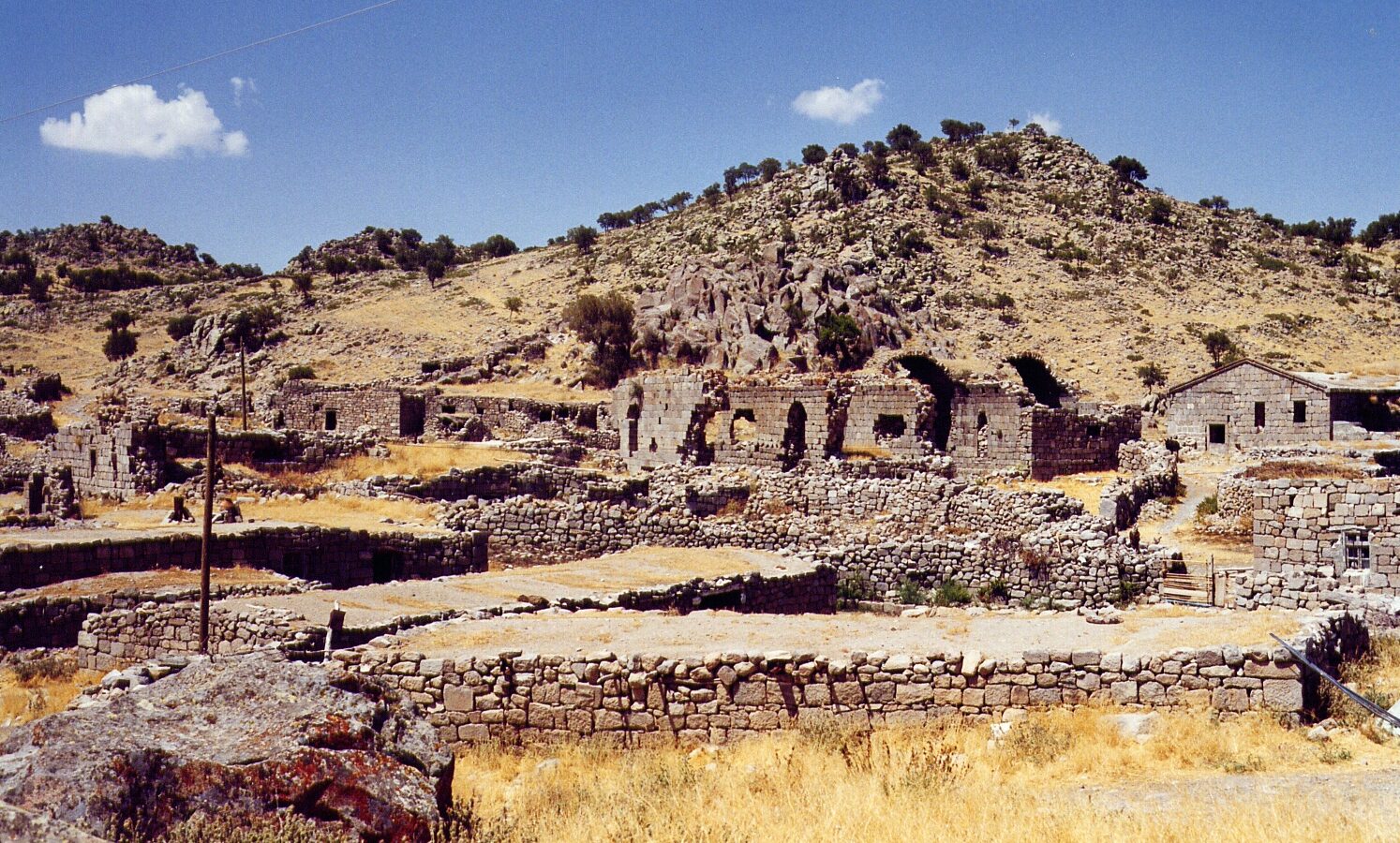
Binbirkilise (“Thousand and One Churches”) is the old name for the ruins scattered over Karadağ, a volcanic massif that rises abruptly from the plain north of Karaman. The 2002 inventory describes many churches, monasteries, basilicas, houses and cemeteries built on its peaks and lower slopes, with the highest point, Mahalaç Tepesi, at 2,288 m.
The ruins fall into two main groups. The lower one is in and around the village of Madenşehir (Madenşehri), where the village houses are built among and partly out of Byzantine basilicas. The upper one is at Değle, on the higher slopes of the mountain, where several churches stand in ruins with views across the Konya plain. Nobody counted a thousand and one churches; the name is the Turkish way of saying “a great many”.
It is not a ticketed, fenced site. You walk through working villages, between walls of dark volcanic stone, and the churches appear in fields, beside farmyards and on the hillsides above.
How do you get to Binbirkilise?
Madenşehir is about 37 km north of Karaman by road, reached by a minor road across the plain towards Karadağ; Üçkuyu and Değle are higher up the mountain beyond it. A car or a taxi from Karaman is the practical way to visit, since there is no regular service aimed at visitors. The nearest railway station is Karaman, with high-speed trains from Konya, Ankara and Istanbul, and the nearest airport is Konya (KYA).
Allow at least half a day. Wear walking shoes: the ground between the ruins is uneven, and the Değle group means a walk uphill over rough ground.
Tours in Anatolia
−5% Istambul readers save 5% on every tour below — applied at checkout.
Partner listings via GetYourGuide · free cancellation on most
When is the best time to visit Binbirkilise?
May, June, September and October. In spring the volcanic slopes turn green and the air is clear enough to see across the plain. Summer days are hot and there is almost no shade between the ruins, so go early. Karadağ is high enough for snow in winter, when the upper roads may be closed.
What is the history of Binbirkilise?
Karadağ was sacred long before Christianity. The inventory notes that Hittite hieroglyphic inscriptions and altars found on this massif, which rises suddenly from the plain, show that the Hittites also used it as a holy place.
In the Roman and Byzantine periods the area belonged to Lycaonia (see our Lycaonia guide), the region Paul and Barnabas crossed on their first missionary journey. The inventory states that Değle was one of the places where Saint Paul lived. The churches themselves were built over several centuries; the 2002 inventory gives the 4th to the 9th, and the provincial culture directorate dates Basilica No. 1 at Madenşehir, the largest building, to around the year 500. On Karadağ, the inventory says, early Christian architecture mixed with a local building style.
Travellers have been coming since at least the 17th century. Carl Holzmann published sketches of the ruins in 1904. Gertrude Bell explored the area in 1905 and returned with the archaeologist William Ramsay in 1907; together they surveyed and photographed the churches and published The Thousand and One Churches in 1909, still the basic record of the site. The Turkish art historian Semavi Eyice published further research in 1971.
Their photographs now show how much has been lost. Bell noticed on her second visit that many of the buildings she had recorded two years earlier had already been pulled down for their cut stone, and the robbing continued through the 20th century. Madenşehir has since been declared an urban conservation area (kentsel sit alanı).
What is Binbirkilise famous for?
- The density of churches. Few places in Anatolia have so many Byzantine church ruins in so small an area.
- Gertrude Bell. The site is one of the places where Bell, later famous in the Middle East, did her archaeological work, and her and Ramsay’s photographs are a well-known record of Byzantine Anatolia.
- Cisterns. Because the town was built on waterless ground, the inventory notes, every church, monastery, monks’ and students’ cell and house had its own cistern.
- The volcanic setting. Dark basalt walls on a green mountain above a flat, pale plain.
What can you see at Binbirkilise?
Madenşehir
Basilica No. 1 (Büyük Kilise or Mahallaç Kilisesi). At the entrance to the village, the largest of the Binbirkilise buildings. The inventory describes it as built of well-cut stone, with its entrance and its nine-arched left wing still standing, and a large cistern to the north.
Other churches. North of the town is the ruined Çanlı Kilise (“Church with the Bell”), and north-west of the first church a second church whose apse and entrance still stand. A cemetery lies in the middle of the old town. Around them are traces of basilicas, cisterns and houses mixed with the village buildings.
Değle
The upper churches. The inventory counts six Byzantine churches at Değle, all in ruins, with their inscriptions broken; the buildings are concentrated in Upper Değle. The provincial directorate adds that the houses here were simpler and less carefully built than the churches, with two or three rooms depending on need.
Tombs and the altar. There are Byzantine rock tombs and grave covers, and on the hill’s eastern slopes chamber tombs of cut stone with pyramidal roofs. An altar older than the Byzantine period was turned into a rock tomb in Byzantine times.
The sower relief. On the east face of a large rock block is a carved figure of a man holding a bowl in his left hand and scattering seed with his right.
Nearby
The Karaman Museum displays finds from the region, and the Kızıl Kilise (Red Church) near Yollarbaşı, now ruined, was in Byzantine times one of the main Christian centres together with Binbirkilise, according to the inventory.



Frequently asked questions about Binbirkilise
Where is Binbirkilise?
On Karadağ, an extinct volcano north of Karaman. The main ruins are in Madenşehir village, about 37 km from the city, and at Değle higher up the mountain.
Are there really 1,001 churches?
No. The name is a Turkish way of saying ‘very many’. The ruins include dozens of churches along with monasteries, cisterns, houses and tombs.
Is there an entrance fee for Binbirkilise?
The ruins are spread through and around working villages rather than inside a fenced site, so you can walk among them freely. Respect private yards and fields.
Who studied Binbirkilise?
Gertrude Bell and William Ramsay surveyed and photographed the churches in 1907 and published The Thousand and One Churches in 1909. Semavi Eyice published further research in 1971.
How long do you need at Binbirkilise?
Half a day for Madenşehir; a full day if you also walk up to the Değle churches.
What do the official records say about Binbirkilise?
On Karadağ, a volcanic mountain mass about 35 km north of Karaman (its highest point is Mahalaç Tepesi, 2,288 m), there are many churches, monasteries, basilicas, houses and cemeteries built between the 4th and 9th centuries, in the Byzantine period. From the 17th century onwards the area has been visited by many local and foreign travellers. Remains of Byzantine buildings are found on many of the large and small peaks of the Karadağ massif and on its slopes; they are most concentrated in the village of Madenşehir, 37 km from Karaman.
The Byzantine churches at the Değle ruins, on the upper peaks of Karadağ, number six and are in ruins, and the inscriptions here are broken too. Değle is one of the places where Saint Paul lived. In the buildings spread over the peaks and slopes of Karadağ, the architectural features of early Christianity have mixed with a local artistic style. (Ministry of Culture and Tourism, Karaman Provincial Tourism Inventory, 2002)
Ready to see Binbirkilise?
Hand-picked tours with good reviews and clear prices.
Partner listings via GetYourGuide · free cancellation on most
Before or after: Istanbul
Most trips start or end in Istanbul. Our own experiences there:

 Dinner, sunset and day cruises between Europe and Asia.See cruises bosporuscruise.com

 Historic Turkish baths in the old city — hand-picked hamams, booked direct.Book a hamam istanbulhamam.com

 Istanbul’s tallest viewpoint: both continents from 369 metres.Get tickets camlicatower.com

 Free audio guides in 15 languages, safe routes and local tips — plus 5% off GetYourGuide.Open the free guide localada.com
Nearby
All destinations
Karaman Castle
Karaman Castle: the three-walled citadel on a prehistoric mound in…
Yunus Emre Mosque and Tomb
The Yunus Emre Mosque and Tomb in Karaman: a Karamanid…
Hatuniye Madrasa
Hatuniye Madrasa in Karaman: built in 1382 by Nefise Sultan,…
Taşkale Granaries
Taşkale's granaries: over 250 grain stores cut into a cliff…
