
Double Minaret Madrasa: The Twin Towers of Erzurum
On this page
- What is the Double Minaret Madrasa?
- How do you get to the Double Minaret Madrasa?
- When is the best time to visit the Double Minaret Madrasa?
- What is the history of the Double Minaret Madrasa?
- What is the Double Minaret Madrasa famous for?
- What can you see at the Double Minaret Madrasa?
- Common misconceptions about the Double Minaret Madrasa
- Frequently asked questions about the Double Minaret Madrasa
- What do the official records say about the Double Minaret Madrasa?
Key facts: Double Minaret Madrasa
- What it is: A two-storey, four-iwan courtyard madrasa with twin brick minarets and a tomb, now the Erzurum Çifte Minareli Foundation Museum.
- Where: Tebriz Kapı area of central Erzurum, at the east end of Cumhuriyet Caddesi, north of the Three Tombs.
- Date: Second half of the 13th century; sources disagree on the exact date and patron. On UNESCO’s Tentative List within “Anatolian Seljuks Madrasahs” (2014) (UNESCO); not inscribed.
What is the Double Minaret Madrasa?
The Double Minaret Madrasa (Çifte Minareli Medrese) is the emblem of Erzurum: a monumental stone college with two fluted brick minarets rising from either side of a deeply carved portal. Behind the portal is a long arcaded courtyard surrounded by students’ rooms on two floors, with a domed tomb at the far end.
The 2002 inventory calls it a monumental example of the Anatolian Seljuk-period madrasa type with a courtyard, two storeys and four iwans. The whole complex covers an area of 38 by 48 m. It is also known as the Hatuniye Madrasa.
The building is open to visitors as the Erzurum Çifte Minareli Foundation Museum, which displays objects from the city’s pious foundations in the cells around the courtyard.
How do you get to the Double Minaret Madrasa?
It stands at the eastern end of the historic centre, a short walk from the Great Mosque, which is directly to its west. From the Yakutiye Madrasa on Cumhuriyet Caddesi, walk east for about ten minutes. The Three Tombs are just to the south, and the castle and Tepsi Minare are on the hill behind.
Book a Double Minaret Madrasa tour
−5% Istambul readers save 5% on every tour below — applied at checkout.
Partner listings via GetYourGuide · free cancellation on most
When is the best time to visit the Double Minaret Madrasa?
Any season works, since the courtyard and museum can be seen in an hour. Summer and early autumn are the most comfortable. In winter the minarets and portal are often framed by snow, which is when many of the best-known photographs are taken, but dress for temperatures well below freezing.
Visitor numbers have risen sharply, with more than half a million visitors reported in 2023, so arrive early on summer weekends.
What is the history of the Double Minaret Madrasa?
The date and founder are disputed. For many years, the inventory explains, it was claimed that the madrasa was built in the time of Huand (Hüdavend) Hatun, daughter of the Seljuk sultan Alaeddin Keykubad I, which is why it is also called the Hatuniye Madrasa. This view rested on an inscription mentioned in older sources, which was taken to Russia during the occupation of 1828–29. But the sources do not make clear whether the inscription was on the façade of the madrasa or on the door of the tomb, which was also carried off to Russia in the same years.
Because the inscription has been lost, the inventory adds, historians of Turkish art have argued that the madrasa must have been built under the Ilkhanids between 1285 and 1290. Turkish official and press sources often still give 1253. The safest statement is that it dates from the second half of the 13th century.
In modern times it was first restored in 1965. The General Directorate of Foundations began a further restoration in 2012, injecting the ground, strengthening the structure, completing the tile work on the minarets, replacing decayed stone and adding drainage for meltwater. The building has since reopened as a foundation museum.
What is the Double Minaret Madrasa famous for?
- The minarets. Two brick minarets with 16 flutes inlaid with turquoise tile, now partly damaged, stand on stone bases on either side of the portal.
- The portal. The inventory calls the crown portal that dominates the north façade a work of art in its own right. Its niche is very deep and covered with muqarnas, and the door is framed by five mouldings with palmette motifs.
- The reliefs. In the outermost moulding, a stylised tree of life grows from a small vase and surrounds the door. Four relief panels flank the portal, two on each side; on the right, the panel with the double-headed eagle has been completed.
- Scale. At 38 by 48 m, it is far larger than the Yakutiye Madrasa down the street.
What can you see at the Double Minaret Madrasa?
The courtyard. From the portal you pass into a long, narrow courtyard lined with columns. The geometric decoration is mostly on the column shafts, the iwan façades and the mouldings around the students’ doors; plant motifs appear on the portal, on the faces of the arches linking the courtyard columns, and inside the tomb.
The tomb. Attached to the south iwan, the tomb has a cubic base, a polygonal body and a conical roof. Walk round the outside of the building to see it from the Three Tombs garden.
The foundation museum. The cells hold a selection from the foundations’ inventory: manuscripts and Qur’ans, calligraphy panels, candlesticks, carpets and kilims, clocks, mosque banners, an incense burner and a large cauldron from a soup kitchen (imaret).
The view from outside. For the classic photograph of both minarets and the portal, stand back on the square to the north.
Common misconceptions about the Double Minaret Madrasa
Was it built in 1253 by the daughter of Alaeddin Keykubad?
What people often assume: That the madrasa was founded in 1253 by Hüdavend (Huand) Hatun, daughter of the Seljuk sultan Alaeddin Keykubad I.
What the record says: The inscription behind this attribution was taken to Russia in 1828–29 and it is not known whether it came from the madrasa or from the neighbouring tomb. Because it is lost, historians of Turkish art have proposed an Ilkhanid date of 1285–1290 instead. Ministry of Culture and Tourism, Erzurum Provincial Tourism Inventory, 2002 (see also UNESCO’s Tentative List entry).



Frequently asked questions about the Double Minaret Madrasa
Who built the Double Minaret Madrasa?
It is traditionally attributed to Hüdavend Hatun, daughter of Alaeddin Keykubad I, but the inscription was lost to Russia in 1828–29 and many art historians date it to the Ilkhanid period, around 1285–1290.
Can you go inside the Double Minaret Madrasa?
Yes. After restoration by the General Directorate of Foundations, it is open as the Erzurum Çifte Minareli Foundation Museum.
Why is it called the Hatuniye Madrasa?
Because tradition links it to a royal woman (hatun), Hüdavend Hatun, daughter of the Seljuk sultan Alaeddin Keykubad I.
How long do you need at the Double Minaret Madrasa?
About an hour for the courtyard, museum and tomb; combine it with the Three Tombs and the Great Mosque next door.
Is the Double Minaret Madrasa on the UNESCO list?
It is on the Tentative List as part of “Anatolian Seljuks Madrasahs” (2014), which has not been inscribed.
What do the official records say about the Double Minaret Madrasa?
It is a monumental example of the madrasa type of the Anatolian Seljuk period with a courtyard, two storeys and four iwans. As a whole it covers an area of 38 by 48 m. The crown portal that dominates its north façade is a work of art in its own right. From the portal you pass into the courtyard. The long, narrow courtyard is surrounded by columns, and the students’ rooms are arranged around it. There is a tomb attached to the iwan on the south side. The tomb consists of a polygonal body on a cubic base and a conical roof.
The bases of the brick minarets, with their 16 flutes inlaid with turquoise tile and now partly damaged, are striking. (Ministry of Culture and Tourism, Erzurum Provincial Tourism Inventory, 2002)
Ready to see Double Minaret Madrasa?
Hand-picked tours with good reviews and clear prices.
Partner listings via GetYourGuide · free cancellation on most
Before or after: Istanbul
Most trips start or end in Istanbul. Our own experiences there:

 Dinner, sunset and day cruises between Europe and Asia.See cruises bosporuscruise.com

 Historic Turkish baths in the old city — hand-picked hamams, booked direct.Book a hamam istanbulhamam.com

 Istanbul’s tallest viewpoint: both continents from 369 metres.Get tickets camlicatower.com

 Free audio guides in 15 languages, safe routes and local tips — plus 5% off GetYourGuide.Open the free guide localada.com
Nearby
All destinations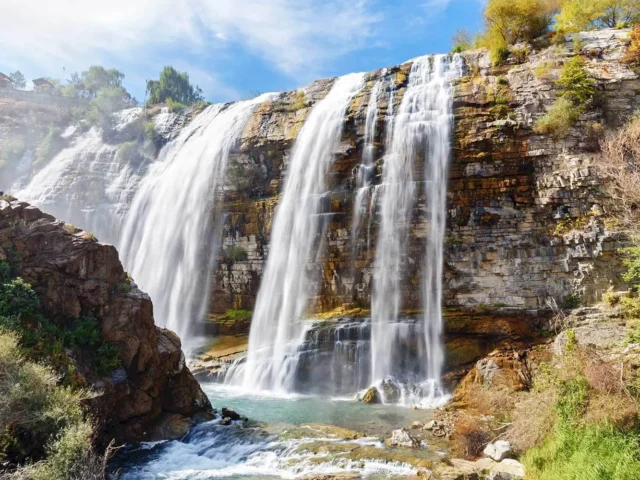
Tortum Waterfall
Tortum Waterfall in Erzurum’s Uzundere district: a 48 m drop…
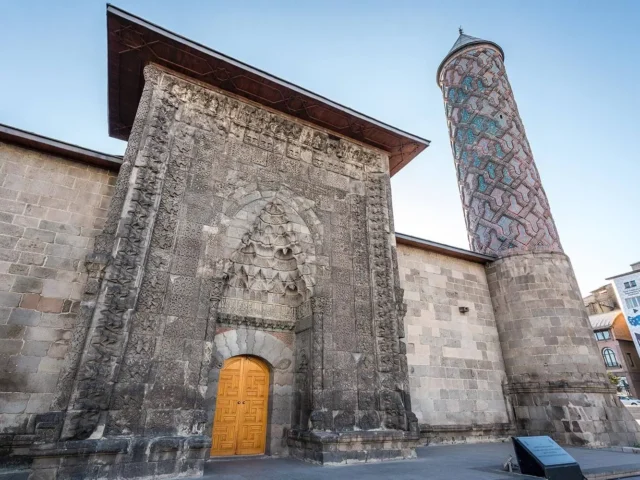
Yakutiye Madrasa
Yakutiye Madrasa in Erzurum: the 1310 Ilkhanid college with its…
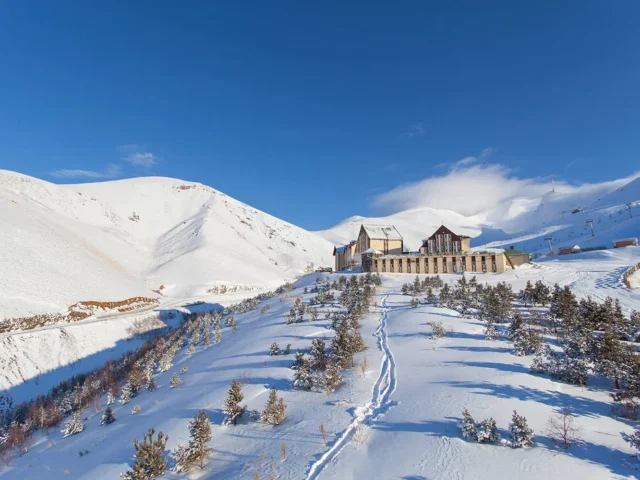
Palandöken
Palandöken ski area above Erzurum: powder snow from 2,200 m…
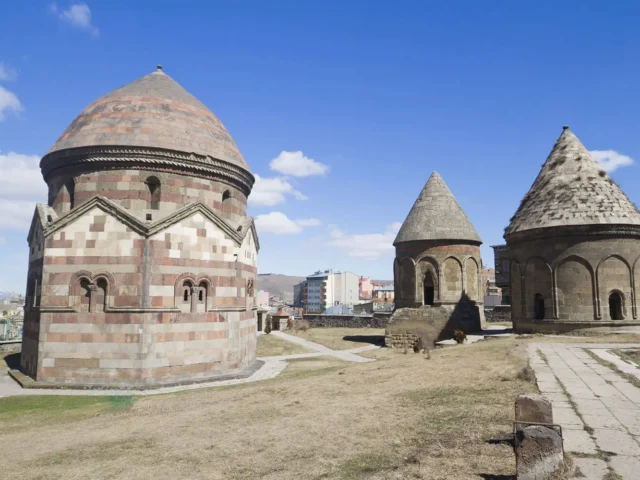
The Three Tombs
Üç Kümbetler in Erzurum: three medieval stone tomb towers, including…
