

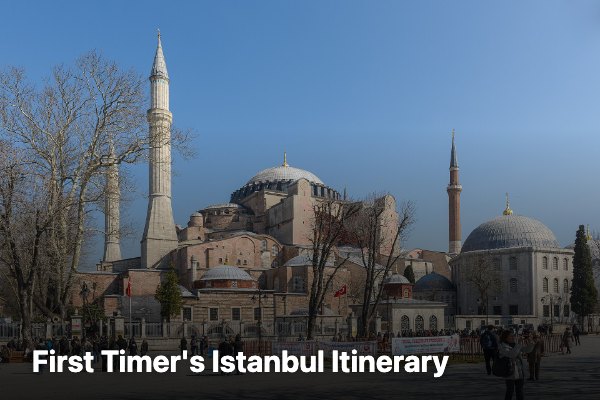
If this is your first visit, three days is the minimum that works and the split is straightforward. One day for the historic peninsula, one for the Bosphorus and the palaces, one for Beyoglu and the modern city. Everything else is an extension of that spine.
The mistakes first timers make in Istanbul are predictable and avoidable. Underestimating distances, ignoring the closing days, crossing between continents by road at rush hour, and turning up at a mosque during prayer. The plan below is built around all four.
First timer’s Istanbul itinerary at a glance
| Day | Area | What you see | How you move |
|---|---|---|---|
| 1 | Sultanahmet | Hagia Sophia, Blue Mosque, Hippodrome, a cistern, Topkapi Palace | On foot, T1 tram to arrive |
| 2 | The Bosphorus | Dolmabahce Palace, a Bosphorus cruise, Ortakoy | T1 tram to Kabatas, then boat |
| 3 | Beyoglu and the bazaars | Galata Tower, Istiklal Caddesi, Grand Bazaar, Spice Bazaar | Walking, funicular, historic tram |
Before you arrive, four things to sort out
Buy an Istanbulkart on arrival. This is the transit card and it is effectively compulsory, since cash is not accepted on most lines. Machines sit in every metro and tram station including the airport. One card can be shared between several people by tapping repeatedly, and it works on the tram, metro, funicular, buses, ferries and the Marmaray tunnel under the Bosphorus.
Book the big three ahead in high season. Hagia Sophia, Topkapi Palace and Dolmabahce Palace all operate timed entry and all sell out in July and August. Everything else on this itinerary can be decided on the day.
Know the closing days. Topkapi Palace closes Tuesdays. Dolmabahce Palace closes Mondays. The Grand Bazaar and Spice Bazaar close Sundays. Arrange the three days around these before you book anything.
Pack something that covers shoulders and knees. You will enter working mosques, and the dress rules are real. Head coverings for women are provided free at the main mosque entrances, so there is no need to buy a scarf from the stalls outside.
Day 1, Sultanahmet on foot
Everything today is within a fifteen minute walk of one square, which makes it the easiest day to get right and the best one to put first.
09:00, Hagia Sophia. Be there when it opens. The queue at nine is a fraction of what it becomes by eleven, and the morning light through the upper gallery windows is the reason photographers come early. Allow ninety minutes. This building spent nearly a thousand years as a cathedral and nearly five hundred as a mosque, and both readings are visible at once, which is the thing to look for.
11:00, the Blue Mosque. Straight across the square. Check the prayer times posted at the visitor entrance, because the mosque closes to visitors for roughly thirty minutes at each of the five daily prayers and for considerably longer around Friday noon. Shoes come off at the door and go in a bag you carry.
12:30, the Hippodrome. Twenty minutes to walk end to end along the western side of the square. The Obelisk of Theodosius was already 1,900 years old when the Romans moved it here from Egypt. The flat ground you are standing on was the chariot track.
14:00, underground. The Basilica Cistern is the famous one, with 336 columns and the two Medusa heads, and it queues accordingly. The Theodosius Cistern is nine minutes away near Cemberlitas, a tenth of the size, with a projection mapping show and almost no wait. If it is your first visit and you only do one, do the famous one and go early or late.
16:00, Topkapi Palace. Three hours if you include the Harem, which is a separate ticket and is the better half. If that is too much after a full day, move it to the morning of day three and shorten the bazaar time instead.
A slower version of this day, with the eating stops mapped in, is in the Sultanahmet day guide.
Day 2, the Bosphorus
Morning, Dolmabahce Palace. T1 tram to Kabatas. Entry is by timed guided tour and the last admission falls well before closing time, so arriving before 11:00 avoids being turned away at the gate. The palace is closed on Mondays. This is the nineteenth century Ottoman answer to Versailles and it is deliberately unsubtle.
Afternoon, a cruise on the strait. A boat trip on the Bosphorus is the most efficient sightseeing hour in Istanbul, because the shoreline delivers Ottoman palaces, wooden yali mansions, two intercontinental bridges and the Rumeli Fortress in sequence while you sit still. A standard sightseeing sailing runs about two hours from Kabatas up to the Fatih Sultan Mehmet Bridge and back.
There is a cheaper version of the same view. The scheduled public ferries between Eminonu, Kabatas, Uskudar and Kadikoy cross the strait for a normal transit fare and pass the same waterfront. You get no commentary and no upper deck seat, but you get the water.
Evening, Ortakoy. Under the Bosphorus Bridge, fifteen minutes by taxi from Kabatas or a walk along the shore from Besiktas. The waterfront mosque with the bridge behind it is the photograph everybody takes, and the surrounding streets handle dinner. In summer an evening dinner cruise replaces this and covers the meal at the same time.
Day 3, Beyoglu, Galata and the bazaars
Morning, across the Galata Bridge. Walk it from Eminonu, fifteen minutes past the fishermen on the upper deck and the fish sandwich boats moored below. Galata Tower is a short, steep climb from the northern end and the viewing gallery is narrow, so go early or expect to queue.
Midday, Istiklal Caddesi. The street runs 1.4 kilometres from Tunel up to Taksim Square. The historic red tram runs its length, though walking is usually faster given the crowds. What is worth your time is not the main street but the covered passages and side streets off the eastern side.
Afternoon, the bazaars. Back down to the Grand Bazaar, which has sixty one covered streets and around four thousand shops. Go in through the Nuruosmaniye gate to land on the main axis. The Spice Bazaar is ten minutes downhill toward Eminonu, smaller and better for things you will actually eat. Both close on Sundays.
Alternative for the afternoon. If shopping is not the point of your trip, use this slot for a Turkish bath instead. It runs ninety minutes to two hours, most of the historic hammams sit in this part of the city, and it is the single best thing to do to legs that have walked three days of hills. Book ahead, because the historic baths work on reservations and several split men’s and women’s hours rather than running separate sections.
What to skip on a first visit
Three things first timers routinely add and regret.
The Princes’ Islands. They need a full day including the ferry each way, and on a three day trip that day costs you the Bosphorus or Beyoglu. Save them for a longer visit.
A day trip out of the city. Bursa, Edirne and the Black Sea coast are all worth doing and none of them belong in a three day Istanbul plan.
Cramming both cisterns, both palaces and both bazaars. Istanbul rewards depth over coverage. Two hours inside Topkapi with a guide beats forty minutes each in four museums.
How much does a first trip to Istanbul cost?
Attraction pricing changed substantially in recent years and most state and municipal sites now charge foreign visitors a different rate from Turkish residents, with the gap widest at the headline monuments. Check the current price on each site’s own page rather than relying on figures quoted in older guides, which are consistently out of date.
The things that actually move the budget on a first trip.
Transport is close to free. Every trip in this itinerary runs on an Istanbulkart at a few lira per tap, ferries included. Five days of transport costs less than one museum entry.
The Museum Pass is conditional. It covers Ministry of Culture sites, which includes Topkapi Palace and the Archaeology Museums. It does not cover municipally operated attractions and it has never covered the private hammams. On a three day trip it usually does not pay for itself unless you are museum heavy.
Some sites refuse cash. Several municipal attractions take only credit or debit cards and Istanbulkart, and will not accept lira in cash or any foreign currency. Carry a card that works abroad.
Eating is where you save. A lunch in Sultanahmet and the same lunch two tram stops away are not the same price. Move away from the monuments before you sit down.
Free and worth doing. Every mosque including Suleymaniye and the Blue Mosque. The Galata Bridge. The public ferry crossings. Gulhane Park. The Suleymaniye terrace at sunset.
Getting around as a first timer
The T1 tram is the line that matters. It runs from Kabatas through Karakoy, Eminonu, Sultanahmet and Beyazit toward the city walls, and it connects almost every stop in this itinerary. Learn that one line and you can navigate the whole plan.
The F1 funicular links Kabatas to Taksim in under two minutes and saves a steep climb. The Tunel, running from Karakoy up to Istiklal, is the second oldest underground railway in the world and does the same job at the other end of the street.
Ferries are the right way to cross the Bosphorus. Both bridges seize up between 08:00 and 10:00 and again from 17:00 to 20:00, and a crossing that takes twenty minutes by boat can take an hour by taxi at those times.
Taxis are cheap and slow. Use them for the hill climbs and the late evening, not for crossing the city at rush hour.
Walk within districts, ride between them. Sultanahmet to Taksim looks like four kilometres on a map and is a serious walk with hills in practice.
What to know about mosques, markets and manners
Mosques. Free to enter, closed to visitors around each of the five daily prayers, and closed for longer at Friday noon. Women cover hair, shoulders and knees. Men avoid shorts. Shoes off at the door. Do not photograph people at prayer.
Bargaining. Expected in the Grand Bazaar for carpets, leather and jewellery. Not expected in shops with marked prices, in cafes, or at the Spice Bazaar’s food counters. If you are not going to buy, do not open a negotiation.
Tea. Offered constantly, including by shopkeepers with no expectation of a sale. Accepting is normal and does not commit you to anything.
Ramadan. If your trip falls during it, expect quieter days and much busier evenings, with the streets around the mosques filling before sunset. Eating in public during daylight is not an issue in tourist areas, but it is worth being aware of.
Where to stay on a first visit
| Area | Suits | Trade off |
|---|---|---|
| Sultanahmet | Walking to the monuments, first visits, short trips | Quiet at night, restaurants aimed at visitors |
| Beyoglu and Galata | Restaurants, bars, walkable to Karakoy | Twenty minutes from the main sights, hilly |
| Karakoy | Coffee, galleries, tram and ferry connections | Small area, fills quickly in season |
| Kadikoy, Asian side | Cheaper, better eating, local atmosphere | A daily crossing eats into a short trip |
For a first three day visit, Sultanahmet or Beyoglu. Both sit on the T1 tram, which is what this itinerary runs on.
If you have more time than three days, the three day itinerary and the longer plans extend this same spine rather than replacing it.
Frequently asked questions
How many days do you need in Istanbul for a first visit?
Three days covers the historic peninsula, the Bosphorus and Beyoglu without rushing. Four adds the Asian side. Two is enough only for Sultanahmet and a boat trip, and one day means choosing between the monuments and the water.
Is Istanbul easy to navigate for first timers?
Yes, if you use the tram and the ferries. The T1 tram line connects almost every major sight, signage is bilingual, and an Istanbulkart covers everything. What catches people out is distance and hills rather than complexity.
Is Istanbul safe for tourists?
Central Istanbul is a normal large city and the usual awareness applies, particularly around crowded transport and the bazaars where pickpocketing happens. The tourist districts are heavily policed. Nothing about this itinerary takes you anywhere that warrants special concern.
Do you need to book Hagia Sophia in advance?
In July and August, yes, and the same goes for Topkapi Palace and Dolmabahce Palace. Outside high season you can usually buy on the day, though arriving at opening still saves the longest queue.
What should you not do in Istanbul?
Do not cross between continents by taxi at rush hour when the ferry takes twenty minutes. Do not turn up at a mosque during prayer. Do not open a bargaining conversation you have no intention of finishing. And do not build a tight schedule around Topkapi on a Tuesday or the bazaars on a Sunday.
Is a Bosphorus cruise worth it for a first visit?
Yes. It is the one activity that gives you the shape of the city, which is difficult to grasp from the street. Whether you take a commentary sightseeing sailing or a public ferry for the price of a transit fare depends on your budget rather than on the view.
Can you see Istanbul without a guide?
Comfortably, for navigation and for most sites. A licensed guide adds the most inside Topkapi Palace and Hagia Sophia, where the history is dense and the on site information is thin. Everywhere else on this plan works self guided.
What is the best time of year for a first visit?
April to May or September to October. Daytime highs sit between 17 and 26 degrees, the crowds are manageable and the light is good. July and August are hot, humid and busy. November to March is wet, with December averaging around 99 mm of rain across fifteen or sixteen rainy days, though prices and queues both drop.

Comment (0)