
Gök Medrese: Sivas’s Twin-Minaret Seljuk Madrasa
On this page
Key facts: Gök Medrese (Sivas)
- What it is: A Seljuk madrasa with a carved marble portal, twin brick minarets and tile decoration; now the Gök Medrese Foundation Museum.
- Where: Central Sivas, a short walk from Hükümet Meydanı and the Şifaiye and Buruciye madrasas.
- Date: 1271, built by the vizier Sahip Ata Fahreddin Ali; architect Kaluyan of Konya.
What is Gök Medrese?
The Gök Medrese (“Blue Madrasa”) is one of the three madrasas built in Sivas in 1271, and the most richly decorated. Its tall portal, flanked by two fluted brick minarets with blue tiles, is one of the landmarks of the city. The provincial directorate calls it one of the most distinguished monuments of Seljuk art, and notes that Evliya Çelebi mentioned it in his Book of Travels.
The building now houses the Gök Medrese Foundation Museum (Gök Medrese Vakıf Müzesi).
How do you get to Gök Medrese?
It is in the centre of Sivas, a few minutes’ walk from Hükümet Meydanı and the park where the Şifaiye, Buruciye and Çifte Minareli madrasas stand. If you arrive by high-speed train or by air, a taxi or city bus will bring you to the centre, and from there everything is on foot.
Book a Gök Medrese tour
−5% Istambul readers save 5% on every tour below — applied at checkout.
Partner listings via GetYourGuide · free cancellation on most
When is the best time to visit Gök Medrese?
Morning light suits the west-facing portal less than afternoon light, when the sun falls on it and brings out the relief. Spring and early autumn are the best seasons in Sivas; winter is cold but the museum is indoors. Plan to see it with the other madrasas of the centre in the same half-day.
What is the history of Gök Medrese?
According to the inscription over the main portal on the west side, it was built in 1271 by Sahip Ata Fahreddin Ali, a vizier who became the effective ruler of the Seljuk Sultanate of Rum after the death of Muineddin Pervane in 1277. The inventory notes that, according to the signatures carved facing each other on the capitals of the portal’s side columns, its architect was Kaluyan of Konya. Sources differ on his background: some describe him as Armenian, others as a Cappadocian Greek.
The madrasa was restored in 1823 and remained in use as a school until 1926. Only the 13 rooms of the lower floor survive. Its main east iwan collapsed, and a wall was built in its place reusing stones and inscriptions. It is now a foundation museum run under the General Directorate of Foundations.
What is Gök Medrese famous for?
- The portal. On the marble surfaces running down from the bases of the minarets, large geometric, calligraphic and plant motifs are carved symmetrically and in high relief.
- The twin minarets. Two minarets of about 25 m rise on either side of the portal.
- The tiles. The sky-blue tiles that gave the building its name.
- The pool. The inventory calls its 22-sided courtyard pool the largest known Seljuk pool in Anatolia.
What can you see at Gök Medrese?
The mescid. To the right as you enter is the small mosque. Its wooden minbar is a later addition, but most of the mihrab has survived: it is covered in tiles and inscribed with the Throne Verse (Ayat al-Kursi). The transition to the dome is made with triangles, and the dome and its base are also tiled.
The Darülhadis. The square, domed room to the left of the entrance was the school of hadith; its inner walls are plastered.
The courtyard. The open, rectangular courtyard should have a pool at its centre, and the marble stones of the pool are still inside the building. To the north and south of the courtyard are porticoes built on six columns, with small doors behind them leading into the students’ cells.
The side iwans. The north and south iwans are decorated with tiles inside.
The museum. The foundation museum displays objects in the rooms around the courtyard.
Nearby
Buruciye Madrasa. Built in the same year, 1271, by Muzaffer Bey, son of Hibetullah Burucerdi. The inventory picks out its portal: a niche with a muqarnas hood, projecting rosettes, corner towers of clustered piers, an inscription band and windows. In its stone carving the emphasis is on the crown portal, where star, rumi and geometric motifs are worked shallowly but like lace.
The Şifaiye Madrasa (1217), the Buruciye Madrasa (1271) and the façade of the Çifte Minareli Madrasa (1271) are a few minutes’ walk away; seeing all four together shows the range of Seljuk architecture in a single city.



Frequently asked questions about Gök Medrese
Who built the Gök Medrese in Sivas?
The vizier Sahip Ata Fahreddin Ali in 1271. The architect, Kaluyan of Konya, signed the portal column capitals.
Why is it called the Gök Medrese?
Gök means sky blue, after the blue tiles on its minarets and inside the building.
Is the Gök Medrese a museum?
Yes. It houses the Gök Medrese Foundation Museum (Gök Medrese Vakıf Müzesi).
How tall are the minarets of the Gök Medrese?
The two minarets flanking the portal are about 25 m tall.
What else is nearby?
The Şifaiye, Buruciye and Çifte Minareli madrasas around the central park are a few minutes’ walk away.
What do the official records say about Gök Medrese?
As understood from its inscription over the main portal on the west side, where the entrance door is, it was built in 1271 by Sahip Ata Fahreddin Ali. According to the signature written facing each other on the capitals of the side columns of the crown portal, the architect of the Gök Medrese was Kaluyan of Konya. On the marble surface descending from the bases of the minarets, large geometric, written and plant motifs have been made symmetrically and in a plastic manner.
In the middle of the open, rectangular inner courtyard there should be a pool. The marble stones of this pool still stand inside the building today. It is the largest known Seljuk pool in Anatolia, with a 22-cornered polygonal plan. (Ministry of Culture and Tourism, Sivas Provincial Tourism Inventory, 2002)
Ready to see Gök Medrese?
Hand-picked tours with good reviews and clear prices.
Partner listings via GetYourGuide · free cancellation on most
Before or after: Istanbul
Most trips start or end in Istanbul. Our own experiences there:

 Dinner, sunset and day cruises between Europe and Asia.See cruises bosporuscruise.com

 Historic Turkish baths in the old city — hand-picked hamams, booked direct.Book a hamam istanbulhamam.com

 Istanbul’s tallest viewpoint: both continents from 369 metres.Get tickets camlicatower.com

 Free audio guides in 15 languages, safe routes and local tips — plus 5% off GetYourGuide.Open the free guide localada.com
Nearby
All destinationsŞifaiye Madrasa
Şifaiye Madrasa in Sivas: the 1217 Seljuk hospital and medical…
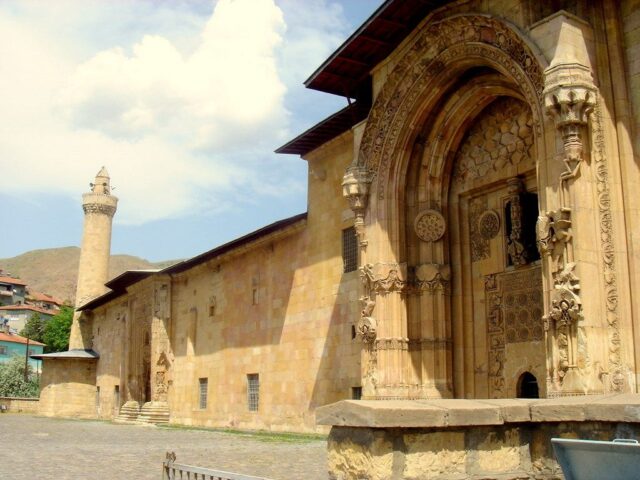
Great Mosque and Hospital of Divriği
Great Mosque and Hospital of Divriği: the 1228–29 UNESCO-listed complex…
Gökpınar Lake
Gökpınar Lake near Gürün, Sivas: a clear turquoise spring lake…
Kangal Balıklı Kaplıca
Kangal Balıklı Kaplıca in Sivas: the 36–37°C spring where small…
