
Aizanoi: The Temple of Zeus at Çavdarhisar
On this page
Key facts: Aizanoi
- What it is: A Roman city with one of the best-preserved temples in Anatolia, a combined theatre and stadium, and a market hall inscribed with Diocletian’s price edict.
- Where: Çavdarhisar village, Çavdarhisar district, southwest of Kütahya city.
- UNESCO Tentative List: “Aizanoi Antique City” since 2012 (UNESCO); not yet inscribed. Settled from the 3rd millennium BC, flourished in the 1st–3rd centuries AD.
What is Aizanoi?
Aizanoi is an ancient city at Çavdarhisar in Kütahya province, spread over both banks of the Koca Çay, the river the ancients called Penkalas. It was the main settlement of the Aizanitis, a region attached to Phrygia, and it flourished in the Roman imperial period.
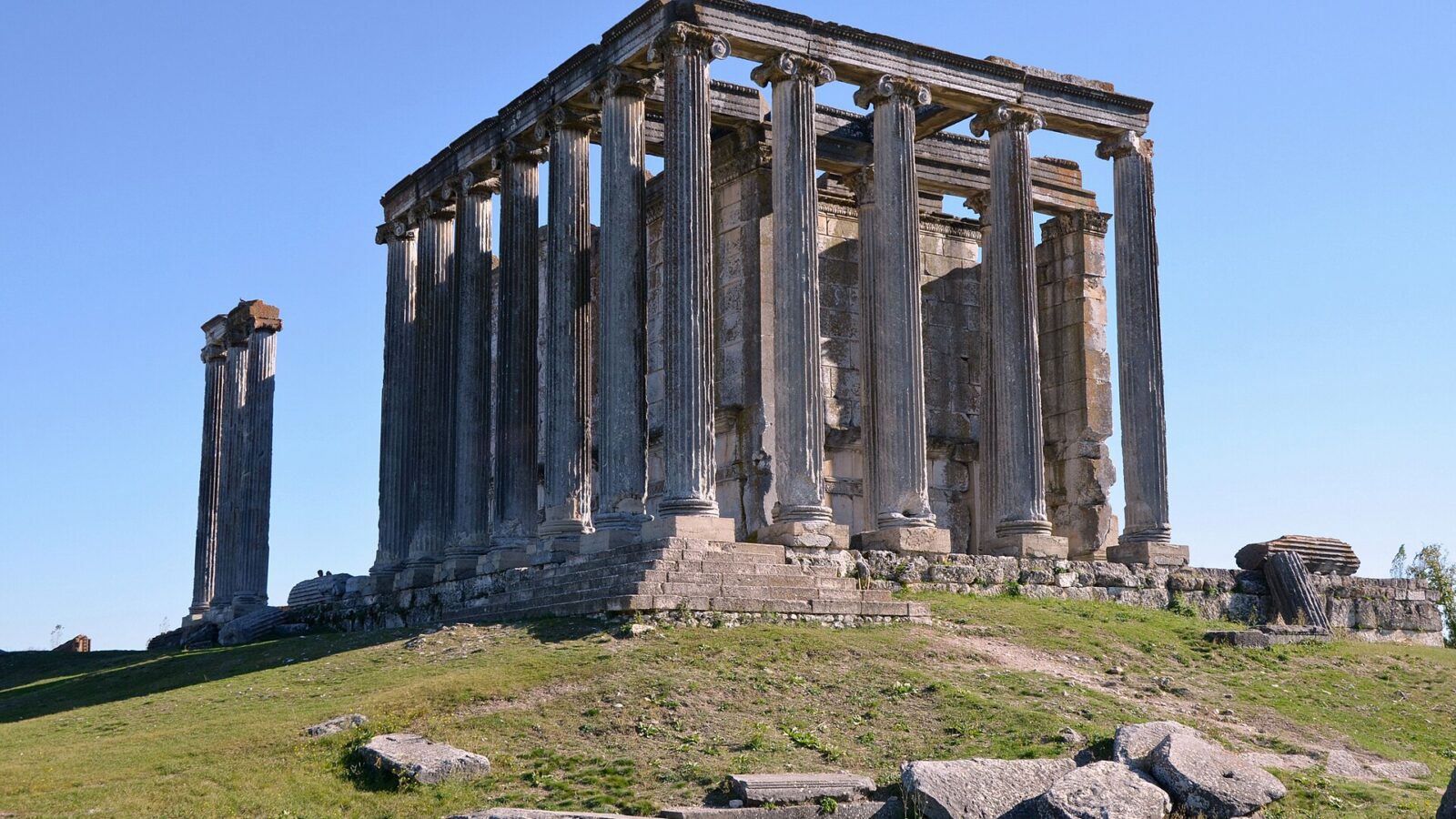
What survives is unusually complete. The Temple of Zeus still stands on its podium with many of its columns in place, and around it lie a combined theatre and stadium unique in the ancient world, two bath complexes, a colonnaded street, and a round market building whose walls carry a copy of the Emperor Diocletian’s edict on maximum prices. Two of the city’s Roman bridges still carry traffic across the river.
The provincial directorate estimates the city’s population in the Roman period at about 80,000. The 2002 provincial inventory calls Aizanoi the soundest and best-preserved ancient city of Anatolia. The German Archaeological Institute first excavated here in 1926, and systematic excavations have continued every year since 1970.
How do you get to Aizanoi?
Aizanoi lies in the centre of Çavdarhisar, a district town, southwest of Kütahya, roughly an hour by car. The ruins are spread around the village on both sides of the river, close enough to walk between them. The simplest way to get there is by car or taxi from Kütahya; ask locally about current bus services to Çavdarhisar. The nearest airport is Zafer Airport (KZR), between Kütahya and Afyonkarahisar.
Tours in Anatolia
−5% Istambul readers save 5% on every tour below — applied at checkout.
Partner listings via GetYourGuide · free cancellation on most
When is the best time to visit Aizanoi?
April to June and September to October. The site is open ground with very little shade, and summer afternoons on the plateau are hot, so in July and August go early. Winter is cold, but the temple under snow is striking. Allow at least two to three hours to see the temple, the theatre-stadium, the macellum, the baths and the bridges.
What is the history of Aizanoi?
According to the 2002 inventory, the city takes its name from Azan, a mythological hero born of the union of the water nymph Erato and the legendary king Arkas. The site has been settled since around 3000 BC; pottery found here dates from the first half of the 3rd millennium BC.
The inventory records that the city changed hands between the kingdoms of Pergamon and Bithynia and came under Roman rule in 133 BC. Its golden age came under the Roman Empire, when the temple, theatre, stadium, baths and bridges were built. In the early Byzantine period Aizanoi was the seat of a bishop, and it lost its importance in the 7th century. In the Middle Ages (13th century) it became a base of the Çavdar Tatars and later took the name Çavdarhisar; the Seljuks used the temple hill as a fortress.
The 1970 Gediz earthquake damaged the Temple of Zeus, which has since been restored. Recent finds include a jug containing 651 Roman silver coins, uncovered in 2021 near a stream, and in the same year a life-size statue of Hygieia holding a snake, found in the agora, and a marble statue of Heracles.
What is Aizanoi famous for?
- The Temple of Zeus, one of the best-preserved Roman temples in Anatolia, with a vaulted chamber beneath it.
- The theatre-stadium, a stadium and theatre built end to end and sharing a stage building, with no known parallel.
- The “first stock exchange”: the macellum, inscribed with a copy of Diocletian’s price edict of 301.
- Roman bridges still in use, one of them dated to September AD 157.
What can you see at Aizanoi?
The Temple of Zeus. Sources date it between the late 1st century and the reign of Hadrian (117–138); the provincial directorate gives the Hadrianic date. The temple has eight columns on the short sides and fifteen on the long sides, and stands on a podium of 53 × 35 m. The inventory notes that beneath it lies a hall covered with barrel vaults, a plan unusual in Anatolia and in Roman architecture, and the directorate identifies this underground cella as dedicated to the Phrygian goddess Meter Steunene. Busts of Zeus and Cybele decorated the acroteria of the pediments, and inscriptions on the porch walls honour Hadrian and the local benefactor Apuleius (Kütahya Culture and Tourism Directorate).
The stadium and theatre. The inventory states that the stadium and theatre combination at Aizanoi has no equal. Construction began in the 1st century AD and continued at intervals into the 3rd century. The directorate gives the stadium as 220 × 50 m, seating 13,500, and the two-tiered theatre as seating 15,000; the wall between them is carved with hunting scenes on both faces.
The macellum (Borsa). A round market building of the second half of the 2nd century AD, used as a grain market. On its partly restored walls is a copy, carved in the early 4th century, of the price edict issued by Diocletian in 301 to fight inflation, listing the prices of all goods sold in the imperial markets. This is why Aizanoi is often promoted as the home of the world’s first stock exchange.
The Mosaic Bath. In the second half of the 3rd century AD a second large bath was built inside an existing building of big limestone blocks. Its central hall has a fine mosaic floor showing a satyr and a maenad. After the 4th or 5th century the main hall was remodelled and used as the seat of the early Byzantine bishop.
The bridges and colonnaded street. In antiquity five bridges joined the two banks: one wooden footbridge and four arched stone bridges. Two survive, each with five arches, and both are still in use. An inscription shows that one opened in September AD 157, built by Apuleius Eurykles. A colonnaded street runs from the macellum over a bridge towards the Temple of Zeus. Elsewhere on the site are two agoras, a gymnasium, an ancient dam, necropolises and, on the east bank, a round structure of 16 columns and monumental tombs.
Common misconceptions about Aizanoi
Was the macellum really the world’s first stock exchange?
What people often assume: That the building was a stock exchange in the modern sense, as the “Borsa” name suggests.
What the record says: It was a macellum, a market building used for grain; its fame comes from the copy of Diocletian’s price edict of 301 carved on its walls, which fixed maximum prices for goods across the empire (Kütahya Culture and Tourism Directorate).



Frequently asked questions about Aizanoi
Where is Aizanoi?
In the centre of Çavdarhisar, southwest of Kütahya, roughly an hour by car.
Is Aizanoi a UNESCO World Heritage Site?
Not yet. Aizanoi Antique City has been on UNESCO’s Tentative List since 2012.
What is special about the Temple of Zeus at Aizanoi?
It is one of the best-preserved Roman temples in Anatolia, with many columns standing and a barrel-vaulted hall beneath its podium.
Why is Aizanoi called the home of the first stock exchange?
Its round macellum, a grain market, carries a copy of Diocletian’s price edict of AD 301, which fixed prices across the empire.
How long do you need at Aizanoi?
Two to three hours for the temple, theatre-stadium, macellum, baths and bridges.
What do the official records say about Aizanoi?
The ancient city of Aizanoi was founded on both banks of the Penkalas river. The city’s name comes from a mythological hero named Azan, born of the union of the water nymph Erato and the legendary king Arkas. The ancient city of Aizanoi was the main settlement of the Aizanitis, who lived attached to Phrygia.
The world’s first stock exchange is in the ancient city of Aizanoi. The building, used as a grain market in the second half of the 2nd century AD, is called the Macellum. On the partly repaired walls of the exchange building there is a copy, from the early 4th century AD, of the wage and price fixing made by the Emperor Diocletian in 301 to fight inflation. This inscription lists the prices of all goods sold in the imperial markets. (Ministry of Culture and Tourism, Kütahya Provincial Tourism Inventory, 2002)
Main photo: Carole Raddato from FRANKFURT, Germany, CC BY-SA 2.0, via Wikimedia Commons.
Ready to see Aizanoi?
Hand-picked tours with good reviews and clear prices.
Partner listings via GetYourGuide · free cancellation on most
Before or after: Istanbul
Most trips start or end in Istanbul. Our own experiences there:

 Dinner, sunset and day cruises between Europe and Asia.See cruises bosporuscruise.com

 Historic Turkish baths in the old city — hand-picked hamams, booked direct.Book a hamam istanbulhamam.com

 Istanbul’s tallest viewpoint: both continents from 369 metres.Get tickets camlicatower.com

 Free audio guides in 15 languages, safe routes and local tips — plus 5% off GetYourGuide.Open the free guide localada.com
Nearby
All destinationsKütahya Castle
Kütahya Castle on Hisar Tepesi: a 70-tower fortress with Roman,…
Germiyan Street
Germiyan Street in Kütahya: 18th-century timber houses with projecting upper…
Kütahya Tile Museum
Kütahya Tile Museum: tiles and ceramics in the 1411–1412 imaret…
Kütahya
Kütahya travel guide: the Roman city of Aizanoi, hand-painted tiles,…
