

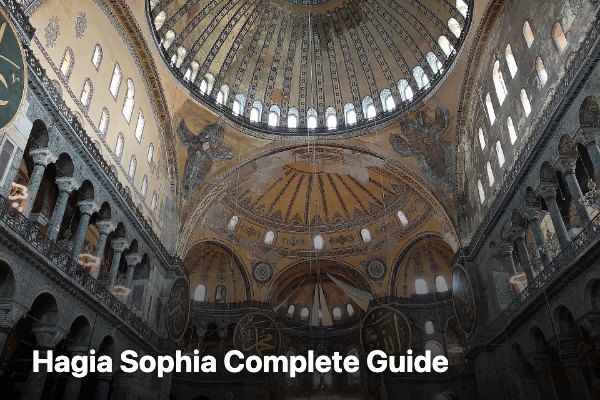
Hagia Sophia is a working mosque, officially Ayasofya-i Kebir Cami-i Serifi, and has been since July 2020. Since January 2024 foreign visitors have followed a separate ticketed route through the upper gallery, priced at 25 euro, entered from a booth opposite the Fountain of Ahmed III rather than through the worshippers’ door. Prayer in the main hall remains free for everyone.
That single change is what most guidance published before 2024 gets wrong, so it is worth knowing before you plan the visit.
Hagia Sophia tickets and prices
| What | Detail |
|---|---|
| Visitor route price | 25 euro per person, charged in euro at a rate set at the booth |
| Free entry | Children under 8 with an adult, on production of passport or ID |
| Prayer hall | Free, for worship |
| What the ticket includes | The upper gallery route and an augmented reality commentary in 23 languages, delivered by QR code to your own phone |
| Headphones | Sold at the booth, bring your own to save money |
| Head covering | Sold at the booth, headscarf 1 euro, body cover 3 euro |
| Museum Pass | Not valid |
| Press and ICOMOS cards | Not accepted |
Prices checked August 2026. Two points that catch people out.
The Museum Pass does not work here. Hagia Sophia does not appear on the Ministry of Culture’s museum fee list at all, because it is a mosque rather than a museum. Neither the Museum Pass Istanbul nor Muzekart is valid.
Head coverings are sold, not given. Many Istanbul mosques hand out scarves free at the door. Hagia Sophia sells them at the ticket booth. Bring your own and you save the euro and the queue.
There is also a separate museum devoted to the history of Hagia Sophia, in a different building on Sultanahmet Square, with its own ticket. Thirteen halls across around 3,200 square metres, open daily 09:00 to 20:00. It is not part of the mosque and its ticket does not admit you to the building, which is a distinction worth checking before you buy anything online.
Opening hours and prayer times
The ticketed visitor route runs 09:00 to 19:30 daily. No separate summer and winter hours are published.
The mosque itself keeps much longer hours for worship. Doors open thirty minutes before the dawn prayer, the hall is cleared thirty minutes after sunrise for cleaning, and admission for prayer continues from 09:00 through to midnight.
Friday is the day to plan around. The visiting area closes from 12:00 to 14:00 for Friday prayers. If your weekend includes a Friday, put Hagia Sophia in the morning or after two.
You will find guides stating that the visitor route closes for thirty minutes around each of the five daily prayers. That rule applies at other Istanbul mosques and appears to be a holdover from the arrangement before 2024, when visitors shared the ground floor. Since the gallery route is physically separated from the prayer hall, the only routine closure documented is the Friday midday one. The ticket operator’s own terms say only that visiting hours may be restricted according to the mosque’s worship programme and that entry may be stopped at certain times.
What you see on the visitor route
The ticketed route takes you up a ramp to the gallery floor, along the south gallery, through the Marble Door, and out by a ramp on the northeast side. You look down into the main hall from above rather than walking it.
The Deesis mosaic. Christ between the Virgin and John the Baptist, on the west wall of the south gallery. Usually dated to the thirteenth century, though some scholarship places the group in the twelfth. This is the one people come for, and the modelling of Christ’s face is the reason.
The Empress Zoe mosaic. Constantine IX Monomachos and Zoe flanking Christ Pantocrator, eleventh century. The heads have been altered, since Zoe outlived three husbands and the panel was updated each time.
The Comnenus mosaic. John II Komnenos, the Hungarian Empress Irene and their son Alexios flanking the Virgin and Child, twelfth century.
The Viking runic graffiti. Carved into the marble parapet in the middle of the south gallery, ninth century, reading roughly “Halvdan was here”. A Varangian guardsman scratched his name into the stone of the greatest church in Christendom and it is still there.
The grave marker of Enrico Dandolo, the Doge of Venice who led the Fourth Crusade, set into the floor opposite the Deesis.
The Marble Door, separating the south and west galleries, one face traditionally read as heaven and the other as hell. The Synod of 1166 met here.
The Emperor Alexander portrait, tucked into a recessed arch of the north gallery and easy to walk past.
The ground floor mosaics, including the southwest vestibule panel and the Imperial Door tympanum, are in the prayer area rather than on the ticketed route.
The dome restoration, and what it means for a 2026 visit
This matters more than anything else on this page for anyone visiting right now.
The first comprehensive restoration of the main dome in the building’s history began in April 2025. The aim is earthquake resilience. Work is being carried out from the exterior to avoid damaging the interior mosaics, with lead cladding removed, repaired and replaced.
To protect the dome mosaics, a temporary covering system has been installed and a steel platform is being built on the four main piers at a height of 43.5 metres. The building stays open to worshippers and visitors throughout.
The practical consequence is that the dome interior is currently obscured and scaffolding is visible inside and out. The work is expected to run two to three years from 2025. If the dome is the reason you are going, check the current position before you buy a ticket.
Dress code and rules
Women should cover their hair to enter. Scarves are sold at the ticket booth for one euro. Shoulders and knees covered applies to everyone as standard mosque practice.
Phones on silent. Phone use on the gallery route is permitted for the augmented reality commentary.
Photography is allowed for personal use, including short video. Flash is strongly discouraged. Commercial and news photography needs written permission. Do not photograph people at prayer.
No food or drink, including bringing it in.
Pushchairs must be folded and carried on the visiting route, to protect the historic floors.
Accessibility is limited. The ramps and stairs on the visiting route are not suitable for visitors with walking difficulties, who are directed to use the Turkish Citizen Entrance with their tickets instead.
The history in order
Three churches have stood on this site, and the current building is the third.
| Date | Event |
|---|---|
| 360 | First church opened by Constantius II, wooden roofed basilica known as the Megale Ekklesia |
| 404 | Burned in the riot following the exile of Patriarch John Chrysostom |
| 415 | Second church opened by Theodosius II, five naved and wooden roofed |
| 13 January 532 | Destroyed during the Nika Revolt |
| 23 February 532 | Construction of the present building begins under Justinian I |
| 27 December 537 | Consecrated, five years later |
| 7 May 558 | East side of the dome collapses after an earthquake |
| 24 December 562 | Reopened with a higher dome by Isidorus the Younger |
| 1204 | Sacked in the Fourth Crusade, becomes a Catholic cathedral for 57 years |
| 1261 | Returned to Orthodox use |
| 1453 | Converted to a mosque by Mehmed II after the conquest |
| 1847 to 1849 | Fossati restoration under Abdulmecid, mosaics uncovered and recorded |
| 1 February 1935 | Opened as a museum |
| 24 July 2020 | First Friday prayers after reconversion to a mosque |
| April 2025 | First comprehensive dome restoration begins |
Two details worth carrying into the building with you. Justinian’s architects were Anthemius of Tralles, a mathematician, and Isidorus of Miletus, a geometer and engineer, rather than builders by trade. And the whole thing went up in five years, which is faster than most cathedrals of a tenth the size managed in the following millennium.
The architecture, in numbers
The dome. 55.60 metres from the floor. Diameter 31.87 metres north to south and 30.86 east to west, so it is slightly elliptical rather than circular.
The building. 100 metres from apse to outer narthex, 69.50 metres wide.
The structural idea. The dome sits on pendentives, the curved triangular surfaces that let a round dome rest on a square base. Thrust runs east and west into descending half domes, and sideways into piers, arches and gallery vaults. Fusing a basilica plan with a central dome is the innovation, and nothing at this scale had been attempted before.
The columns. 104 in total, 40 on the lower level and 64 in the gallery. Columns from the Temple of Artemis at Ephesus stand in the naves, and eight porphyry columns from Egypt sit under the half domes. The marble is from Marmara Island, Euboea, Afyon and North Africa.
The minarets. Four, around 60 metres. Mehmed II added a wooden one that no longer survives. A brick minaret dates from the Mehmed II or Bayezid II period. The remaining minarets were built or rebuilt by Mimar Sinan under Selim II and Murad III, and they do structural work as well as religious, acting as buttresses.
The calligraphic roundels. Eight of them, 7.5 metres across, on linden wood, by Kazasker Mustafa Izzet Efendi during the Fossati restoration. He also wrote the verse from Surah An-Nur in the dome.
Practical notes
Getting there. Sultanahmet stop on the T1 tram, which runs from Kabatas through Karakoy and Eminonu. The mosque sits on Sultanahmet Square with the Blue Mosque directly opposite.
Finding the visitor entrance. The ticket booth and gate are opposite the Fountain of Ahmed III. The easiest way to locate it is to walk toward Topkapi Palace’s imperial gate. Worshippers use the main gate on Ayasofya Meydani, and there is a separate Turkish Citizen Entrance, so the queues are physically distinct.
The entrance has moved before and will move again. Because of restoration work at the Bayezid II minaret on the northeast side, the current visitor gate is a temporary installation. When the work finishes the gate under that minaret becomes the main visiting entrance.
Volume. The mosque’s own figure is around 35,000 people a day across worship and visits combined. Early is the answer.
Combining it. The Blue Mosque is across the square, the Hippodrome runs down one side of it and Topkapi Palace is five minutes north.
All four fit comfortably into a single day, and the Sultanahmet day guide sets out the order that wastes the least time.
Frequently asked questions
Is Hagia Sophia a mosque or a museum?
A mosque. It was a museum from 1935 until 2020, when the Council of State annulled the 1934 decision and a presidential decree reopened it for worship. Its official name is Ayasofya-i Kebir Cami-i Serifi and no part of the building is designated a museum.
How much does it cost to visit Hagia Sophia?
The visitor route through the upper gallery costs 25 euro for foreign visitors, charged in euro. Children under eight enter free with an adult. Entry to the prayer hall for worship is free. The Museum Pass is not valid.
Is Hagia Sophia free?
Free for worship, ticketed for sightseeing. Since January 2024 the two have been separated, with worshippers using the main gate and visitors following a paid route through the upper gallery from a different entrance.
When was Hagia Sophia built?
The present building was begun on 23 February 532 under Justinian I and consecrated on 27 December 537, so five years. Two earlier churches stood on the site, opened in 360 and 415, both destroyed by fire and riot.
Who built Hagia Sophia?
Commissioned by the Byzantine Emperor Justinian I and designed by Anthemius of Tralles, a mathematician, and Isidorus of Miletus, a geometer and engineer. After the dome collapsed in 558 it was rebuilt higher by Isidorus the Younger, nephew of the original architect.
What should you wear to Hagia Sophia?
Shoulders and knees covered for everyone, and a head covering for women. Scarves are sold at the ticket booth for one euro rather than given out free, so bringing your own saves time and money.
How long does a visit take?
No official figure is published. The gallery circuit is one way, up a ramp and out a ramp, so the pace is largely set by how long you stop at the mosaics. Allow an hour to be comfortable, and add queueing time in high season.
Can you go inside the main hall as a tourist?
The ground floor is the prayer area and remains free for worship. Foreign visitors are routed to the ticketed gallery entrance, and the current arrangement for non-worshipping visitors on the ground floor is not clearly published. If this matters to your visit, ask at the booth rather than relying on older guidance.
Is Hagia Sophia worth visiting during the restoration?
The building is open and the gallery mosaics, which are the highlight of the ticketed route, are unaffected. What you lose is the view up into the dome, which is covered by protective work and scaffolding. If the dome is the reason for your visit, check the current state of the work first.

Comment (0)