

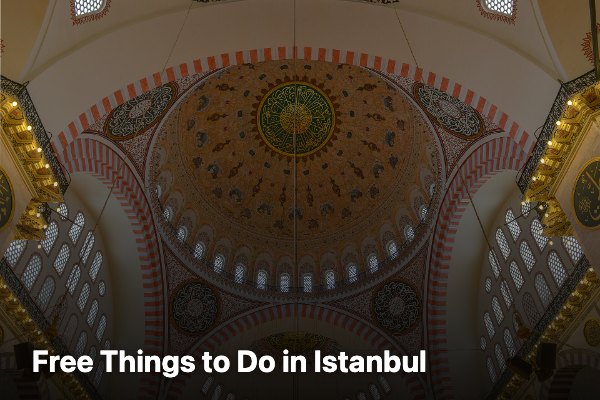
Museum entry in Istanbul has become expensive, particularly for foreign visitors, who pay separate and considerably higher rates at most state and municipal sites. What has not changed is that a great deal of the best of the city costs nothing at all. Every mosque is free. So are both bazaars, the parks, the bridges and the two best viewpoints in the city.
Here are fifteen things that cost nothing, followed by the ones that cost the price of a single tram tap.
The fifteen, at a glance
| # | What | Where | Best time |
|---|---|---|---|
| 1 | Suleymaniye Mosque and its terrace | Historic peninsula | Sunset |
| 2 | The Blue Mosque | Sultanahmet | Early morning |
| 3 | The Grand Bazaar | Beyazit | Weekday morning |
| 4 | The Spice Bazaar | Eminonu | Any time except Sunday |
| 5 | The Hippodrome | Sultanahmet | Midday |
| 6 | The Galata Bridge | Eminonu to Karakoy | Evening |
| 7 | Gulhane Park | Below Topkapi | April for the tulips |
| 8 | Kadikoy produce market | Asian side | Morning |
| 9 | The Moda shoreline | Asian side | Late afternoon |
| 10 | Ortakoy square | European shore | Evening |
| 11 | Balat and Fener | Golden Horn | Morning light |
| 12 | Eyupsultan and the cemetery walk | Head of the Golden Horn | Weekday |
| 13 | Camlica Hill | Asian side | Before sunset |
| 14 | The archaeological park at Binbirdirek | Historic peninsula | Any time |
| 15 | Istiklal Caddesi and its passages | Beyoglu | Evening |
1. Suleymaniye Mosque and the terrace behind it
Mimar Sinan’s masterpiece, free to enter like every working mosque in the country, and the terrace on its northern side looks straight down the Golden Horn at Galata. This is the best free view in Istanbul and one of the best views full stop. The mosque complex also holds Sinan’s own tomb, which is smaller than you would expect and easy to walk past.
2. The Blue Mosque
Free, like all mosques. The Sultan Ahmed Mosque closes to visitors for about half an hour around each of the five daily prayers and for considerably longer at Friday noon, so check the posted times. Head coverings are handed out free at the entrance, so there is no need to buy a scarf outside.
3. The Grand Bazaar
Sixty one covered streets and around four thousand shops, and walking through costs nothing at all. Enter the Grand Bazaar through the Nuruosmaniye gate to land on the main axis rather than in the carpet section aimed at tour groups. Closed Sundays.
4. The Spice Bazaar
Ten minutes downhill from the Grand Bazaar toward Eminonu, smaller and louder, and free to walk. The streets immediately around it are more interesting than the covered hall itself, particularly the ones selling cheese, pickles and coffee to people who actually live here. Also closed Sundays.
5. The Hippodrome
An open public square with three ancient monuments standing in it and no ticket of any kind. The Hippodrome holds the Obelisk of Theodosius, which was already 1,900 years old when the Romans moved it here from Egypt, the Serpent Column from Delphi and the Walled Obelisk. The flat ground is the old Byzantine chariot track.
6. The Galata Bridge
Fifteen minutes on foot between two continents’ worth of atmosphere, past anglers on the upper deck and the restaurant strip below. Free, and the best orientation exercise in the city. Do it once by day and once after dark, when the peninsula behind you is lit.
7. Gulhane Park
The old outer garden of Topkapi Palace, now a public park below the palace walls and free to enter. It is the closest proper green space to Sultanahmet, it slopes down toward the water with views over the mouth of the Bosphorus, and in April it fills with tulips.
8. Kadikoy produce market
A working neighbourhood market rather than a tourist one, five minutes inland from the Kadikoy ferry terminal. Fish laid out on ice, twenty kinds of cheese from different regions of Anatolia, pickle shops selling turnip juice by the glass. Walking through costs nothing and it is the most alive place on this list.
9. The Moda shoreline
Twenty five minutes south of Kadikoy along the water, a residential neighbourhood with a coastal park where the city sits on the grass in the late afternoon. The old city sits across the water in front of you and the Princes’ Islands offshore. This is where the sunset is, and it is free.
10. Ortakoy square
A small nineteenth century mosque at the water’s edge with a suspension bridge arching directly over it. Free to stand there, free to go inside the mosque, and the most photographed composition in the city. The baked potato stalls are not free but they are cheap.
11. Balat and Fener
The colour washed houses along Vodina Caddesi and Kiremit Caddesi are the photograph everyone comes for, and the streets cost nothing to walk. The Greek Orthodox Patriarchate at Fener is also free to enter, with no ticket and a donation box inside. The red brick building on the hill above it is a school, not the Patriarchate, which is the most common mix up in the district.
12. Eyupsultan and the walk up through the cemetery
The mosque at the head of the Golden Horn is free, as is the tomb complex around it. Behind it, a path climbs about 1.7 kilometres through the historic cemetery to Pierre Loti Hill, roughly twenty minutes on foot, opening onto views down the whole waterway. The cable car costs a transit fare. The walk costs nothing and is better.
13. Camlica Hill
The highest point overlooking the city, free to enter, taking in both bridges, the Golden Horn, the peninsula and the islands from one spot. Camlica Hill has tea gardens under the pines where Istanbul families spend Sunday afternoons, and a glass of tea there costs a fraction of the same glass in Sultanahmet.
14. The archaeological park at Binbirdirek
Two public squares separated by a reflecting pool, sitting directly on top of a fifth century Byzantine cistern just off Divan Yolu. The paving of the upper square reproduces the geometry of the reservoir underneath it, so the buried building is drawn out in stone at your feet. Free, level, shaded on two sides and almost always empty.
15. Istiklal Caddesi and the passages off it
The street itself is a thoroughfare, busiest between nine and midnight. What is worth the walk is the covered passages off the eastern side, which cost nothing to wander and hold the parts of Beyoglu that have not been smoothed out yet.
Nearly free, which is close enough
Four things that cost the price of a single transit tap and deliver more than most paid attractions.
The ferry across the Bosphorus. Eminonu or Kabatas to Kadikoy or Uskudar, about twenty minutes, at a normal transit fare. It passes the same waterfront as a sightseeing cruise. You get no commentary and no upper deck seat, but you get the water and the skyline for the price of a bus ride.
The Golden Horn ferry. A longer crossing up the waterway past Fener, Balat and Eyupsultan, again at a standard fare. Fifty five minutes end to end.
The Pierre Loti cable car. Four hundred and twenty metres up the hill in three and a quarter minutes, at a standard İstanbulkart fare.
The Tunel. The second oldest underground railway in the world, running from Karakoy up to Istiklal since 1875, at a normal transit fare for a ninety second ride.
What is not free, and how to think about it
Worth being straight about the money, because the gap between free and paid in Istanbul is wide.
Most state and municipal attractions now charge foreign visitors a separate and much higher rate than residents. Hagia Sophia’s visitor route is priced in euro. Several municipal sites take cards or İstanbulkart only and refuse cash in any currency, including lira. And the Museum Pass covers Ministry of Culture sites only, so it does not apply to municipally run attractions and never applied to the private hammams.
The practical approach is to pick two or three ticketed sites you genuinely want and build the rest of the trip from the list above. A day made of mosques, bazaars, a ferry crossing and a hill costs the price of four tram taps and is not a lesser day.
A free day that actually works
Morning at Suleymaniye, then downhill through the Spice Bazaar to Eminonu. Ferry across to Kadikoy for the market and lunch. Walk south to Moda for the shoreline. Ferry back at dusk, then walk the Galata Bridge into Karakoy as the peninsula lights up behind you.
Total cost, two transit fares and whatever you eat. That is a genuinely good day in Istanbul, and it is close to what a resident’s Sunday looks like.
If you have longer and want to mix free days with ticketed ones, the three day itinerary shows where the paid sights fit around them.
For the shortlist of what actually earns its ticket price, see the Istanbul bucket list.
Frequently asked questions
Are mosques free to visit in Istanbul?
Yes, all of them, including the Blue Mosque, Suleymaniye and Ortakoy. They are working places of worship rather than ticketed monuments. They close to visitors for about half an hour around each of the five daily prayers and for longer at Friday noon.
Is the Grand Bazaar free to enter?
Yes. Both the Grand Bazaar and the Spice Bazaar are free to walk through, and neither has a ticket. Both close on Sundays, which is the one thing to plan around.
What is the best free view in Istanbul?
The terrace behind Suleymaniye Mosque, looking down the Golden Horn toward Galata, at sunset. Camlica Hill on the Asian side is the other contender, giving both bridges and the whole city from one point. Neither charges anything.
Is Hagia Sophia free?
Free for worship, ticketed for sightseeing. Since January 2024 foreign visitors have followed a separate paid route through the upper gallery, entered from a different door than the one worshippers use.
Can you see the Bosphorus without paying for a cruise?
Yes. The scheduled public ferries between Eminonu, Kabatas, Uskudar and Kadikoy cross the strait for a normal transit fare and pass the same waterfront as a sightseeing boat. You lose the commentary and the open upper deck, and you keep the view.
Is there a free way up Pierre Loti Hill?
Yes, on foot. A path climbs about 1.7 kilometres through the Eyupsultan cemetery, roughly twenty minutes, and opens onto views over the Golden Horn as it goes. The cable car costs a standard transit fare if you would rather ride.
How much does a day in Istanbul cost if you avoid tickets?
Very little beyond food. Mosques, bazaars, parks, bridges, viewpoints and neighbourhoods are all free, and the ferries and trams that connect them run on a single İstanbulkart at a few lira per tap. The variable is where you sit down to eat, which changes the total more than anything else.
Is the Museum Pass worth buying?
Only if you enter enough Ministry of Culture sites to clear the price. It does not cover municipally run attractions, it does not cover Hagia Sophia, and it never covered the hammams. Count the specific places on your list rather than assuming it pays for itself.

Comment (0)